How does hypnosis help with self-doubt?
Can Hypnotherapy Silence the Inner Critic?
TL;DR: Chronic self-doubt is not an honest assessment of your capabilities. It is a subconscious programme built from early experiences, critical feedback, and repeated conclusions about your worth that the conscious mind never signed off on. At Mind Spirit Body Hypnosis in Oshawa, Ontario, Fanis Makrigiannis uses hypnotherapy and NLP to work directly with the subconscious architecture of self-doubt, helping clients of all ages across the province build confidence that holds under pressure rather than collapsing the moment it is tested.
Quick Answer
Hypnotherapy for self-doubt is a subconscious-focused approach that identifies and rewrites the limiting beliefs, early experiences, and inner critic patterns that generate chronic self-doubt, by accessing the deeper layers of the mind where those patterns were formed and updating them with more accurate and supportive beliefs. Research published in the International Journal of Clinical and Experimental Hypnosis found that hypnotherapy produced significant improvements in self-esteem and self-efficacy, with effects sustained at follow-up. Fanis Makrigiannis, a Certified Hypnotherapist and NLP Master Practitioner at Mind Spirit Body Hypnosis in Oshawa, Ontario, offers virtual sessions across the province for clients of all ages ready to stop letting self-doubt make their decisions for them.
Questions This Article Answers
What causes chronic self-doubt?
Can hypnotherapy help with self-doubt and low confidence?
Why does positive thinking not fix self-doubt?
How is chronic self-doubt different from healthy self-reflection?
What is the best treatment for chronic self-doubt?
In This Article:
You did not submit the job application because you were not quite qualified enough. The idea you did not raise because someone else would probably say it better. The project took you three times as long to finish because you kept questioning whether it was good enough. The compliment you deflected because you assumed they did not really mean it.
Chronic self-doubt is not modesty. It is a subconscious programme that runs automatically, filtering every opportunity, every piece of feedback, and every decision through the lens of not enough.
In my practice, clients who come for self-doubt work often arrive having achieved a great deal by external measures. Good jobs, strong relationships, real accomplishments. And yet the internal experience is one of perpetual uncertainty about whether they deserve any of it, whether they are capable of sustaining it, and whether the next situation will finally expose what they have always suspected about themselves.
The outer performance and the inner experience can be completely disconnected. That disconnect is the subconscious programme running.
What Is Chronic Self-Doubt and Where Does It Come From?
Healthy self-reflection is a valuable cognitive skill. It allows us to assess our performance honestly, identify areas for growth, and calibrate our confidence to our actual capabilities. It is proportionate, temporary, and actionable.
Chronic self-doubt is something entirely different. It is persistent, disproportionate, and not driven by honest assessment. It arrives before any evidence is available. It survives clear evidence to the contrary. And it tends to intensify precisely when the stakes are highest, making it most destructive in the situations that matter most.
Research published in the Journal of Personality and Social Psychology found that people with high levels of trait self-doubt showed significantly reduced motivation, task persistence, and self-regulatory capacity compared to those with calibrated confidence, regardless of their actual ability level (Oleson et al., 2000). The doubt itself becomes the limiting factor, not the capability.
Chronic self-doubt almost always has identifiable subconscious origins. Common sources include:
Critical or conditional parenting. When approval from caregivers was tied to performance, perfection, or specific behaviours, the subconscious learned that the baseline self is not enough. Worth must be earned. And the earning never quite feels complete.
Early public failure or humiliation. A presentation that went badly, a teacher's dismissal, a moment of being laughed at, or a public failure at something that mattered. The subconscious files these moments as evidence and retrieves them reliably whenever a similar situation approaches.
Chronic comparison. Growing up in environments where comparison was constant, whether academic, athletic, appearance-based, or social, builds a subconscious habit of locating oneself on a hierarchy and consistently finding oneself lacking.
Bullying or chronic criticism. When an external critical voice is sustained over time, the subconscious eventually internalizes it. The bully or critic leaves, but the voice stays, now running from inside.
Trauma and emotional neglect. When early emotional needs were not met, or when the environment was unpredictable, the subconscious often drew the conclusion that the self is the problem. This is the origin of the deepest and most pervasive forms of self-doubt.
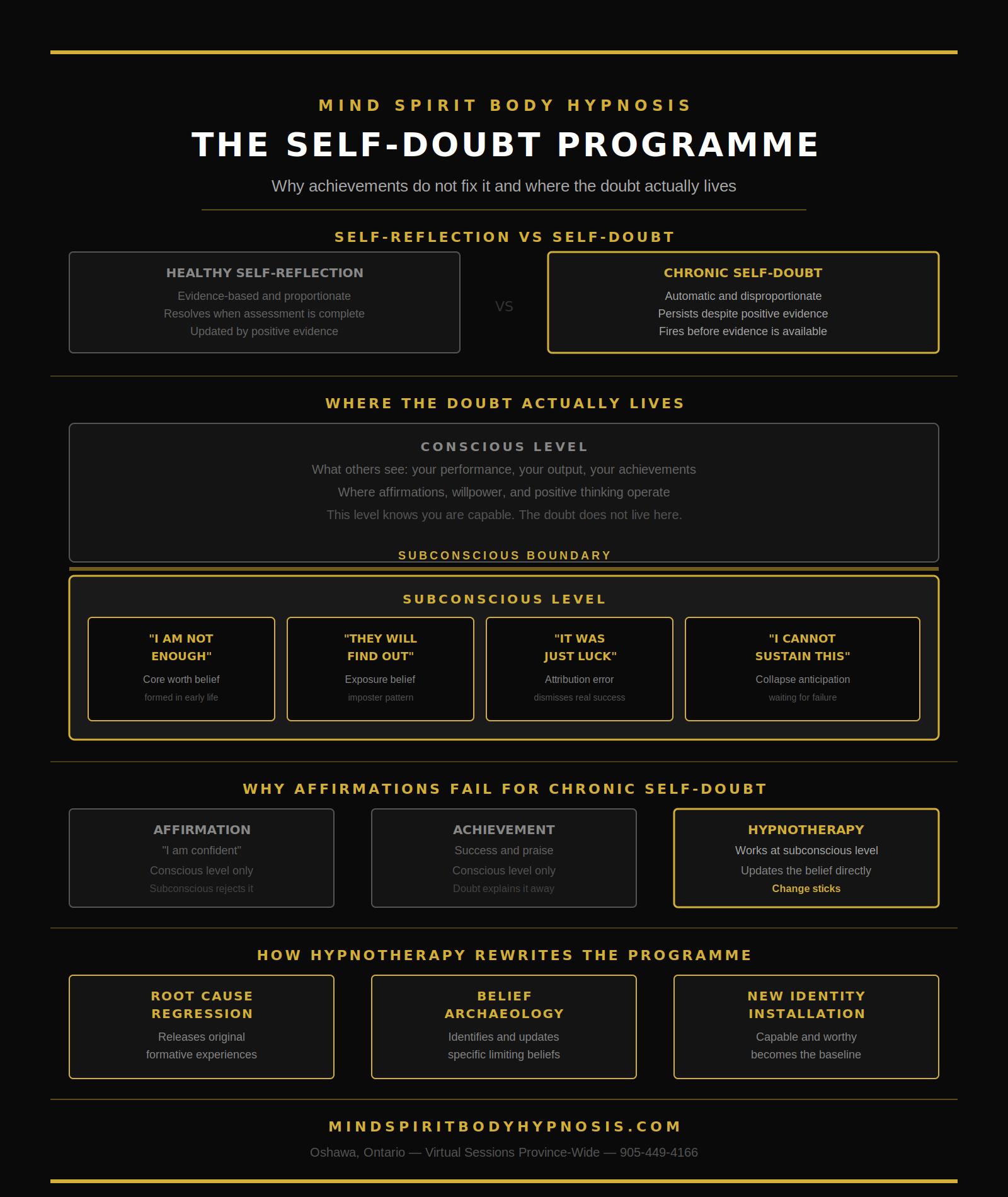
How Is Chronic Self-Doubt Different From Healthy Self-Reflection?
This distinction matters because many clients with chronic self-doubt have been told that some self-doubt is healthy, that it keeps you humble, and that arrogance is worse. This framing often keeps the pattern in place longer than it should.
Healthy self-reflection is honest, proportionate, and calibrated to evidence. It asks: how did I actually perform? What could I do differently? It produces useful information and then resolves.
Chronic self-doubt is none of these things. It is automatic rather than considered. It fires before any evidence is available. It is not updated by positive evidence. And it produces not useful information but paralysis, over-preparation, avoidance, and a persistent low-grade sense of inadequacy that has no resolution.
Here is how the two experiences compare in practice:
Healthy self-reflection: Evidence-based, temporary, resolves when assessment is complete, proportionate to actual stakes, produces learning.
Chronic self-doubt: Automatic, persistent, not resolved by positive evidence, disproportionate to stakes, produces avoidance and paralysis.
For more on how self-doubt and self-sabotage interact and reinforce each other, the hypnotherapy for self-sabotage pillar page at Mind Spirit Body Hypnosis covers the broader pattern in detail.
Why Positive Thinking Does Not Fix Self-Doubt
This is the most important thing to understand about chronic self-doubt and the reason that affirmations, vision boards, and motivational content produce temporary lifts but no lasting change.
Positive thinking operates at the conscious level. Self-doubt is a subconscious programme. The two do not operate in the same place.
When a person with deeply held subconscious self-doubt tells themselves they are capable and confident, the conscious mind hears it. The subconscious does not believe it. And because the subconscious is more powerful than the conscious mind in governing automatic responses, the doubt returns the moment the affirmation wears off, which is typically within hours.
Research on self-affirmation and self-esteem confirms this pattern: affirmations are effective for people with already moderate to high self-esteem, and counterproductive for people with low self-esteem, because the subconscious rejects statements it cannot yet verify as true (Wood et al., 2009). Telling a person with chronic self-doubt that they are great not only fails to help but can actively increase the gap between how they want to feel and how they actually feel.
Hypnotherapy bypasses the conscious skeptic entirely. It works directly with the subconscious, where the doubt lives, accessing the original experiences that generated the limiting beliefs and updating them at the level where they were formed.
For more on how the subconscious maintains confidence-related patterns and how NLP addresses them, the hypnotherapy for self-esteem page covers the foundational mechanisms in detail.
How Hypnotherapy Rewrites the Self-Doubt Programme
As a certified hypnotherapist trained through the American Board of Hypnotherapy, I approach chronic self-doubt as a subconscious programme with identifiable origins, not as an accurate reflection of the person's actual capabilities. The work is precise and compassionate, and it builds tools the client can use independently between sessions.
Root cause regression. The trance state allows access to the original experiences that established the self-doubt pattern. These formative moments, whether a parent's critical comment, a teacher's dismissal, a moment of failure, or years of comparison, are revisited with an adult perspective and resources. The emotional charge attached to them is released, and the subconscious receives an updated interpretation: those experiences say nothing reliable about current worth or capability.
Belief archaeology. Many clients carry specific subconscious beliefs they have never articulated consciously: "I am not the kind of person who succeeds at things like this." "If people knew what I was really like, they would not be impressed." "My achievements are luck, not ability." In trance, these beliefs are identified, examined, and systematically updated with more accurate and functional ones.
Inner critic neutralization. The internal critical voice that drives chronic self-doubt has a specific structure: a location, a tone, a character, an authority. NLP and hypnotherapy work directly with that structure, reducing the voice's volume, changing its tone, and relocating its authority so it no longer has automatic veto power over confidence and action.
New identity installation. Confidence is not primarily a set of behaviours. It is an identity. Who a person believes themselves to be at the subconscious level determines what actions feel available and what actions feel impossible. Hypnotherapy installs a new identity structure, one in which being capable, worthy, and deserving is the baseline rather than the exception.
Future pacing. The subconscious is walked through vivid, sensory-rich scenes of the client in situations where self-doubt previously limited them, now responding with genuine confidence, clarity, and ease. These scenes become reference points that the subconscious draws on when the real situation arrives.
A meta-analysis published in the American Journal of Clinical Hypnosis found that hypnotherapy produced significant and lasting improvements in self-esteem, with participants reporting meaningful changes in self-concept and reduced negative self-evaluation compared to control conditions (Stanton, 1989).

NLP Techniques That Silence the Inner Critic
NLP offers precise, rapid tools for dismantling the internal architecture of chronic self-doubt. Clients I work with in Ontario find these particularly useful as portable tools between sessions.
Submodality works on the inner critic voice. The critical voice has a specific internal structure: a location in mental space, a volume, a tone, a pace, an authority. Changing those qualities directly reduces the impact of the voice. When the inner critic is moved to a more distant location, made quieter and slower, and given a less authoritative tone, its ability to generate doubt is proportionally reduced.
The swish pattern for self-doubt. A rapid NLP technique that interrupts the automatic move from situation to self-doubt and replaces it with an automatic move toward a confident, capable state. Particularly effective for the habitual self-doubt that fires in specific contexts: before speaking in meetings, before submitting creative work, before any situation involving assessment or comparison.
Logical levels of belief change. Chronic self-doubt is almost always operating at the identity level: "I am not capable of this." NLP logical levels work addresses this at the structural level, shifting the identity statement from fixed limitation to open possibility.
Resource anchoring. A state of genuine confidence, clarity, and capability experienced during trance is anchored to a physical cue. The client can activate this anchor before any situation where self-doubt typically fires, shifting the internal state before the pattern can gain momentum.
More about how NLP and hypnotherapy are combined at Mind Spirit Body Hypnosis is available on the about page.
What to Expect in a Session
The first session is a conversation. Where does the self-doubt show up most? In what situations is it strongest? Is there a specific internal voice, or more of a feeling? When did it begin, or has it always been present? What would you do differently if the doubt were not there?
This mapping shapes the subconscious work. The induction is gentle, and most clients reach a deeply relaxed trance state within minutes. The core work then targets the specific beliefs and experiences identified in the conversation.
Most self-doubt programmes at Mind Spirit Body Hypnosis run between four and six sessions. Many clients notice a meaningful shift in their internal experience after the first two. The self-doubt does not simply disappear overnight, but it loses its automatic authority. The first signs are often subtle: noticing the thought but not being governed by it, submitting the work before it is perfect, saying the thing in the meeting without the preceding rehearsal of everything that could go wrong.
All sessions are delivered virtually and are available to clients aged 10 and older across Ontario from the comfort of their own homes.
What My Clients Say
"Working with Fanis has changed my life. After years of therapy for anxiety and confidence issues, I wanted to try something different. This experience has transformed me from the inside out and continues to have an effect even after our sessions. I am now able to be myself, face my fears, surround myself with those who care about me and live a fulfilling and happy life. So grateful."
Kristen W. | Anxiety and Confidence | Five Stars
FAQ
Can hypnotherapy help with self-doubt and low confidence? Yes. Hypnotherapy works directly with the subconscious beliefs and early experiences that generate chronic self-doubt, updating them at the level where they were formed. Research supports significant and lasting improvements in self-esteem and self-concept through hypnotherapy.
What causes chronic self-doubt? Chronic self-doubt is almost always rooted in early experiences: critical or conditional parenting, early public failure or humiliation, chronic comparison, bullying, or emotional neglect. The subconscious concluded from these experiences about worth and capability, and it has been applying those conclusions automatically ever since.
Why does positive thinking not fix self-doubt? Positive thinking operates at the conscious level. Self-doubt is a subconscious programme. Research shows that affirmations are counterproductive for people with low self-esteem because the subconscious rejects statements it cannot yet verify as true. Hypnotherapy bypasses the conscious mind and works directly with the subconscious, where the doubt lives.
How is chronic self-doubt different from healthy self-reflection? Healthy self-reflection is evidence-based, proportionate, and resolves when assessment is complete. Chronic self-doubt is automatic, persistent, not updated by positive evidence, and disproportionate to the actual stakes. It fires before evidence is available and survives evidence to the contrary.
What is the best treatment for chronic self-doubt? Approaches that work at the subconscious level, including hypnotherapy and NLP, are most effective because they address the limiting beliefs and early experiences that generate the doubt rather than trying to override them with conscious willpower or affirmations. At Mind Spirit Body Hypnosis, hypnotherapy and NLP are combined for a comprehensive result.
How many sessions will I need? Most clients at Mind Spirit Body Hypnosis working on chronic self-doubt complete four to six sessions. Many notice a meaningful shift after the first two. The timeline depends on the depth of the original pattern and whether there are compounding anxiety, trauma, or perfectionism components.
Is this suitable for younger clients? Yes. Mind Spirit Body Hypnosis works with clients aged 10 and older. Self-doubt is common in adolescents and young people and responds well to hypnotherapy and NLP, which are gentle, non-invasive, and medication-free.
Can I do sessions virtually from anywhere in Ontario? Yes. All sessions are delivered virtually, province-wide, with no referral required.
What if I have had self-doubt my whole life? Lifelong patterns can absolutely shift. The subconscious does not have an expiry date for change. Many clients who have doubted themselves for decades find that addressing the subconscious root produces changes that years of affirmation, therapy, and self-help could not achieve.
How do I get started? Book a free 30-minute virtual strategy session at calendly.com/mindspiritbodyhypnosis. No referral needed.
Ready to Take the Next Step?
If self-doubt has been the quiet constant in every achievement, every opportunity, and every relationship, that is not your honest assessment of your worth. It is a programme. And it can be rewritten.
I offer a free 30-minute virtual strategy session for new clients across Ontario. There is no pressure, just a conversation about what has been getting in the way and how hypnotherapy or NLP may help.
Book your free session: calendly.com/mindspiritbodyhypnosis
Call or text: 905-449-4166
Email: mindspiritbodyhypnosis@gmail.com
Visit: mindspiritbodyhypnosis.com
Serving clients virtually across Ontario, including Durham Region, Toronto, Ontario, and beyond.
Disclaimer: This article is for informational purposes only and does not constitute medical or psychological advice. Hypnotherapy and NLP are complementary approaches and are not a substitute for diagnosis or treatment by a qualified healthcare provider. Please consult a licensed professional if you have concerns about your mental health.
Written by Fanis Makrigiannis | Certified Hypnotherapist & NLP Master Practitioner | Mind Spirit Body Hypnosis.