Can hypnotherapy cure the fear of flying?
Can Hypnotherapy Cure a Fear of Flying?
TL;DR: Fear of flying is not about airplanes. It is about what the subconscious has filed as dangerous, and that filing can be updated. At Mind Spirit Body Hypnosis in Oshawa, Ontario, Fanis Makrigiannis uses hypnotherapy and NLP to work directly with the subconscious threat response driving aviophobia, helping clients of all ages across the province reclaim the freedom to travel without dread.
Quick Answer
Hypnotherapy for fear of flying is a subconscious-focused approach that addresses aviophobia by accessing the original experiences and threat associations that established the fear response, releasing their emotional charge, and retraining the nervous system to associate flying with manageable discomfort rather than catastrophic danger. Research consistently supports hypnotherapy as an effective approach for specific phobias, including flight anxiety, with participants reporting significant reductions in fear and avoidance. Fanis Makrigiannis, a Certified Hypnotherapist and NLP Master Practitioner at Mind Spirit Body Hypnosis in Oshawa, Ontario, offers virtual sessions across the province for clients of all ages ready to stop letting flight anxiety make their travel decisions for them.
Questions This Article Answers
Can hypnotherapy really cure a fear of flying?
What causes fear of flying?
Why is turbulence so frightening even when it is safe?
How is fear of flying different from a general dislike of air travel?
What is the best treatment for aviophobia?
In This Article:
You know flying is safe. You have read the statistics. You understand rationally that the odds of something going wrong are vanishingly small. And then the boarding announcement comes, and your body does something completely different from what your rational mind knows to be true.
Your heart rate climbs. Your palms go cold. A tight, held quality settles into your chest that does not respond to facts, reassurance, or deep breaths. And if the plane hits turbulence, everything your rational mind has built dissolves in seconds.
That is not ignorance. That is the subconscious doing its job. The problem is that its job description was written in a different context, and it has not received the update.
In my practice, clients who come for flight anxiety often describe having avoided travel for years or decades. Holidays declined. Family gatherings missed. Career opportunities turned down because they required flights. The cost of the fear accumulates quietly and becomes enormous.
What Is Aviophobia and How Common Is It?
Aviophobia, also known as aerophobia or flight phobia, is an intense, persistent fear of flying that causes significant distress and leads to avoidance of air travel. It is classified as a specific phobia under the DSM-5, in the situational subtype alongside fears of enclosed spaces and heights.
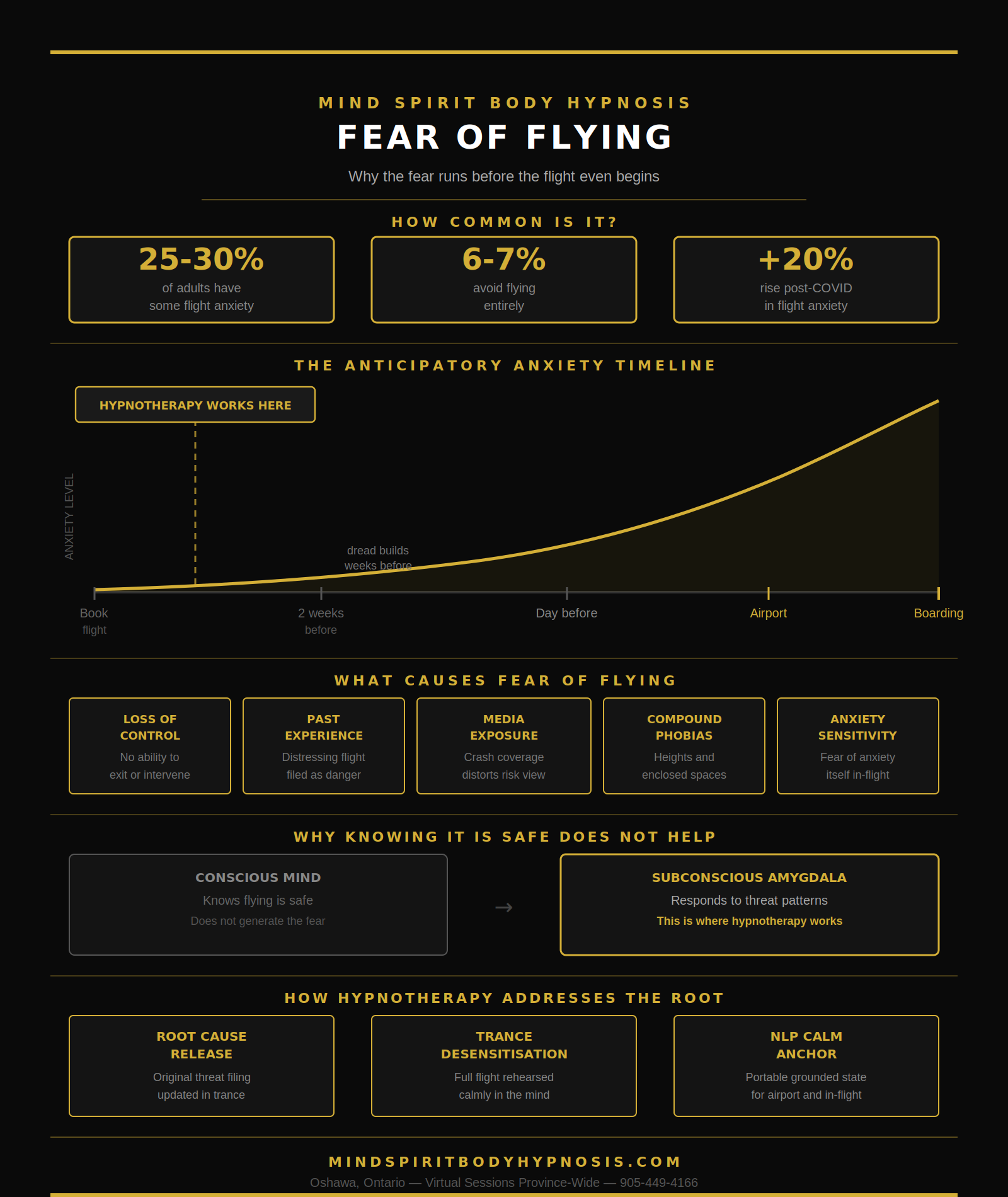
It is far more common than most people realize. Approximately 25 to 30 percent of adults experience some degree of flight anxiety, while 6 to 7 percent of the global population has clinical aviophobia severe enough to avoid flying entirely. Post-COVID data suggest flight anxiety increased by 15 to 20 percent following the pandemic, with many new cases linked to health anxiety and a generalized sense of vulnerability rather than traditional flight-specific fear.
In Ontario, where international travel is common for business, family connection, and tourism, fear of flying carries real practical consequences. Clients I work with across Durham Region and the GTA frequently describe the fear affecting not just holidays but relationships, career progression, and their sense of personal freedom.
What Causes Fear of Flying?
The causes of flight anxiety are more varied than most people expect, and the specific triggers differ significantly from person to person. Understanding the root of an individual's fear is essential to addressing it effectively.
Fear of loss of control. This is the most commonly reported driver. On a plane, the passenger cannot intervene, exit, or change the situation. For people whose nervous system has a high need for control as a coping mechanism, this helplessness activates a powerful threat response regardless of how intellectually safe they know the situation to be.
Traumatic or distressing flight experience. Severe turbulence, an emergency landing, a flight during a period of high personal stress, or even witnessing another passenger's panic can create a subconscious imprint that associates flying with danger. The original experience gets filed as evidence, and the subconscious applies that evidence to every subsequent flight.
Indirect learning and media exposure. Aviation disasters receive disproportionate media coverage relative to their actual frequency. The subconscious processes repeated exposure to crash footage and emergency news without the statistical context that would balance the threat assessment. Over time, the brain's impression of flying risk becomes systematically distorted.
Compound phobias. Many people with flight anxiety are not primarily afraid of the flight itself. They are afraid of enclosed spaces, of heights, of losing control of their anxiety in a public setting, or of being unable to escape. The aeroplane becomes the arena in which multiple fears converge simultaneously.
Generalized anxiety. For people with chronic anxiety or a dysregulated nervous system, the aeroplane environment, loud, enclosed, unpredictable, and inescapable, provides an intense concentration of anxiety triggers. Flight anxiety is often a manifestation of the broader anxiety pattern rather than a specific aviophobia.
Research published in the Journal of Anxiety Disorders found that flight anxiety is significantly predicted by anxiety sensitivity, the fear of anxiety symptoms themselves, alongside specific fears of crashes and loss of control (Oakes & Bor, 2010). For more on how anxiety sensitivity and phobias interact and how they are addressed through hypnotherapy, the hypnotherapy for anxiety and stress pillar page covers the foundational nervous system mechanisms.
Why Knowing Flying Is Safe Does Not Stop the Fear
This is one of the most important things to understand about aviophobia and the source of enormous frustration for people who have it.
The rational mind knows flying is safe. It has looked up the statistics. It has read the reassurance. It believes, at a conscious level, that nothing terrible is going to happen. And none of that information reaches the part of the brain that generates the fear.
The fear response is generated by the amygdala, a subcortical brain region that operates below the level of conscious rational thought. The amygdala does not process statistics. It processes patterns that resemble previously filed threats and responds with an alarm when it detects them. The smell of recycled air, the sound of engines, the sensation of the seatbelt clicking, all of these can become conditioned stimuli that activate the threat response automatically, faster than any conscious reassurance can intervene.
This is why telling yourself that flying is safe does not work, and why the statistics that every anxious flyer has memorized do not help in the moment. The information is in the conscious mind. The fear is in the subconscious. Hypnotherapy works at the level where the fear actually lives.
For more on how phobia responses are held in the nervous system and how hypnotherapy and NLP address them, the hypnotherapy for fears and phobias pillar page covers the clinical framework in detail.
How Hypnotherapy Addresses Fear of Flying at the Root
As a certified hypnotherapist trained through the American Board of Hypnotherapy, I approach flight anxiety as a subconscious threat response with identifiable origins and a specific internal structure that can be changed. The work is precise, compassionate, and adapted to the specific fear presentation identified for each client.
Root cause identification and release. Many cases of flight anxiety trace to a specific originating experience: a frightening flight, a period of high stress during which flying became associated with vulnerability, or years of accumulated media exposure that distorted the subconscious threat assessment. In trance, those origins are identified, the emotional charge attached to them is released, and the subconscious receives an updated interpretation: flying in safe commercial aircraft is not the same as the threat that was originally filed.
Systematic desensitization in trance. Using guided imagery within the deeply relaxed hypnotic state, the client moves through a detailed mental rehearsal of the flying experience from beginning to end. Checking in. The departure lounge. The boarding gate. The cabin. Takeoff. Cruising altitude. Turbulence. Landing. At each stage, the nervous system is trained to respond with calm rather than alarm, in a completely safe internal environment without requiring actual exposure before the client is ready.
Anticipatory anxiety interruption. For many people with flight anxiety, the worst part is not the flight itself but the weeks of dread before it. Hypnotherapy works directly with anticipatory anxiety, installing new associations so that thinking about an upcoming flight produces a calm, prepared feeling rather than escalating dread.
Control reframing. For clients whose fear is primarily driven by loss of control, trance work addresses the subconscious belief that control is essential to safety. A new framework is installed: being a passenger is a choice made from a position of agency, not a helpless state. The relationship between safety and personal control is updated at the subconscious level.
A meta-analysis of non-pharmacological treatments for flight anxiety found that hypnotherapy and cognitive behavioural therapy both produced significant reductions in flight-related fear and avoidance, with hypnotherapy particularly effective for clients with deeper subconscious roots to the fear (Oakes & Bor, 2010).

NLP Techniques That Calm the Flying Response
NLP offers precise, practical tools for dismantling the internal architecture of flight anxiety. Clients I work with in Ontario find these particularly useful as independent tools to apply during flights.
Submodality works on the fear image. The internal representation of flying anxiety has a specific structure: a mental image with particular qualities of size, proximity, vividness, and emotional charge. Changing those qualities directly reduces the fear response. When the feared scenario is made smaller, more distant, and less vivid in the mind's representation, the alarm it generates reduces proportionally.
The fast phobia cure. One of the most well-established NLP techniques for specific phobias. Using a structured dissociation process, the client is guided to reprocess the fear-triggering memory or scenario from a safe, detached perspective. Many clients experience significant reductions in fear intensity after a single application.
Anchoring a calm flight state. A deeply calm, grounded, and secure state experienced during trance is anchored to a physical cue. Activating this anchor at the airport, on boarding, or during turbulence provides an immediate shift in nervous system state, replacing the automatic alarm response with a practised calm.
Mental rehearsal. The subconscious does not fully distinguish between a vividly imagined experience and a real one. NLP mental rehearsal installs a detailed, sensory-rich representation of a calm, comfortable flight. The subconscious files this as a reference experience, making the actual flight feel more familiar and less threatening.
More about how NLP and hypnotherapy are combined in practice at Mind Spirit Body Hypnosis is available on the about page.
What to Expect in a Session
The first session is a conversation. When did the fear of flying start? Is there a specific incident, or did it develop gradually? What is the worst part: the anticipation, takeoff, turbulence, landing, or the enclosed space? Has there been a flight in the past that felt manageable, and if so, what was different?
This mapping shapes the subconscious work. The induction is gentle, and most clients reach a deeply relaxed state within minutes. The trance work then proceeds according to the specific fear structure identified in the conversation.
Flight anxiety typically responds well and relatively quickly to hypnotherapy. Many clients notice a meaningful reduction in anticipatory anxiety after the first session and report a significantly different experience on their next flight. Most programmes at Mind Spirit Body Hypnosis run between two and four sessions.
All sessions are delivered virtually and are available to clients aged 10 and older across Ontario from the comfort of their own homes. The virtual format works particularly well for flight anxiety because the sessions can be completed privately, without requiring travel to a clinic.
What My Clients Say
"I came to Fanis with pretty severe anxiety surrounding a fear of heights and flying. I felt my anxiety was holding me back from fully living my life and experiencing the world. After 3 sessions with Fanis my anxiety is next to nothing and I have been able to experience things I never thought possible. I would highly recommend Fanis to anyone suffering from anxiety or phobias!"
Chris H. | Anxiety and Phobias | Five Stars
FAQ
Can hypnotherapy really cure a fear of flying? Hypnotherapy produces significant and often rapid reductions in flight anxiety by addressing the subconscious threat response at its root. Research supports hypnotherapy as effective for specific phobias, including flight anxiety, with participants reporting meaningful reductions in fear and avoidance. Many clients fly comfortably after two to four sessions.
What causes fear of flying? The most common causes are fear of loss of control, a distressing past flight experience, accumulated media exposure to aviation disasters, compound phobias involving enclosed spaces or heights, and generalized anxiety that intensifies in the airplane environment. The specific root varies significantly from person to person.
Why does knowing flying is safe not stop the fear? Fear of flying is generated by the amygdala, a brain region that operates below conscious rational thought and does not process statistics. It responds to conditioned patterns it has associated with threat. No amount of conscious reassurance reaches that level. Hypnotherapy works directly with the subconscious, where the fear is held.
How is fear of flying different from a general dislike of air travel? A general dislike of air travel produces mild discomfort that is manageable and does not significantly alter behaviour. Clinical aviophobia produces intense, disproportionate fear that leads to significant avoidance, anticipatory dread lasting days or weeks, and a meaningful impact on career, relationships, and personal freedom.
What is the best treatment for aviophobia? Research supports both cognitive behavioural therapy and hypnotherapy as effective approaches for flight anxiety. Hypnotherapy is particularly effective for clients with deeper subconscious roots to the fear, as it addresses the threat-based learning that drives the response rather than managing the conscious thoughts and behaviours it produces.
How many sessions will I need? Most clients at Mind Spirit Body Hypnosis working on flight anxiety complete two to four sessions. Many notice a significant shift in anticipatory anxiety after the first session and report a meaningfully different experience on their next flight.
Is this suitable for younger clients? Yes. Mind Spirit Body Hypnosis works with clients aged 10 and older. Flight anxiety in children and adolescents responds well to hypnotherapy and NLP, which are gentle, non-invasive, and medication-free.
Can I do sessions virtually from anywhere in Ontario? Yes. All sessions are delivered virtually, province-wide, with no referral required.
What if I have had this fear for many years? Long-standing flight anxiety can absolutely shift. The subconscious does not have an expiry date for change. Many clients who have avoided flying for a decade or more find that addressing the subconscious root produces changes they did not believe were possible.
How do I get started? Book a free 30-minute virtual strategy session at calendly.com/mindspiritbodyhypnosis. No referral needed.
Ready to Take the Next Step?
If fear of flying has been deciding where you go and what you experience, that is a high cost. And it does not have to continue.
I offer a free 30-minute virtual strategy session for new clients across Ontario. There is no pressure, just a conversation about what is happening and how hypnotherapy or NLP may help you fly with confidence.
Book your free session: calendly.com/mindspiritbodyhypnosis
Call or text: 905-449-4166
Email: mindspiritbodyhypnosis@gmail.com
Visit: mindspiritbodyhypnosis.com
Serving clients virtually across Ontario, including Durham Region, Toronto, Ottawa, and beyond.
Disclaimer: This article is for informational purposes only and does not constitute medical or psychological advice. Hypnotherapy and NLP are complementary approaches and are not a substitute for diagnosis or treatment by a qualified healthcare provider. Please consult a licensed professional if you have concerns about your mental health. Results vary by individual.
Written by Fanis Makrigiannis | Certified Hypnotherapist & NLP Master Practitioner | Mind Spirit Body Hypnosis.