Can hypnotherapy overcome social anxiety?
Can Hypnotherapy Overcome Social Anxiety?
TL;DR: Social anxiety is not shyness, and it is not introversion. It is a subconscious threat response that fires in social situations, generating a fear of judgement, humiliation, or rejection that is disproportionate to any actual risk, and it can become so limiting that entire dimensions of life, career, relationships, and daily activity are reorganized around avoiding it. At Mind Spirit Body Hypnosis in Oshawa, Ontario, Fanis Makrigiannis uses hypnotherapy and NLP to address social anxiety at the subconscious level, helping clients of all ages across the province engage with the social world with genuine ease rather than performed tolerance.
Quick Answer
Hypnotherapy for social anxiety is a subconscious-focused approach that addresses the conditioned threat response, negative self-beliefs, and avoidance patterns that maintain social anxiety disorder, by retraining the nervous system's automatic responses to social situations and updating the subconscious conclusions about judgment, worth, and belonging that drive the fear. Research published in the International Journal of Clinical and Experimental Hypnosis found hypnotherapy effective in reducing social anxiety symptoms, with significant improvements maintained at follow-up. Fanis Makrigiannis, a Certified Hypnotherapist and NLP Master Practitioner at Mind Spirit Body Hypnosis in Oshawa, Ontario, offers virtual sessions across the province for clients of all ages ready to stop letting social anxiety make their choices for them.
Questions This Article Answers
Can hypnotherapy help with social anxiety disorder?
What causes social anxiety?
How is social anxiety different from shyness?
Why does social anxiety get worse over time if untreated?
What is the best treatment for social anxiety in Ontario?
In This Article:
You prepare for the conversation in advance. You replay it afterwards. You decline invitations when the anxiety feels too high, then feel the combination of relief and shame that comes with having avoided something again. You perform adequately in situations where others seem to simply be present, and the performance is exhausting.
Or perhaps it is more specific: you can manage most social situations, but presentations, job interviews, meeting new people, or situations where you might be singled out or observed produce a response that feels completely out of proportion to what is happening.
Either way, the internal experience is similar: a nervous system convinced that social situations represent a genuine threat, running a full or partial fight-or-flight response in contexts where the only actual danger is the possibility that someone might judge you unfavourably.
In my practice, clients with social anxiety often arrive having managed it for years through avoidance, preparation, and performance. Many have become skilled at concealing it from others. What they have not been able to do is make it stop from the inside.
What Is Social Anxiety and How Is It Different From Shyness?
Social anxiety disorder is a formally recognized condition listed in the DSM-5, characterized by a marked and persistent fear of social situations in which the person may be exposed to scrutiny by others. It is distinguished from normal social discomfort by its intensity, its persistence, its disproportionality to any actual threat, and its significant impact on daily functioning.
According to the Anxiety and Depression Association of America, social anxiety disorder affects approximately 15 million adults in the United States and is one of the most common anxiety disorders globally. In Canada, rates are comparable, with the Canadian Mental Health Association identifying social anxiety as the third most common mental health concern, behind only depression and generalized anxiety disorder.
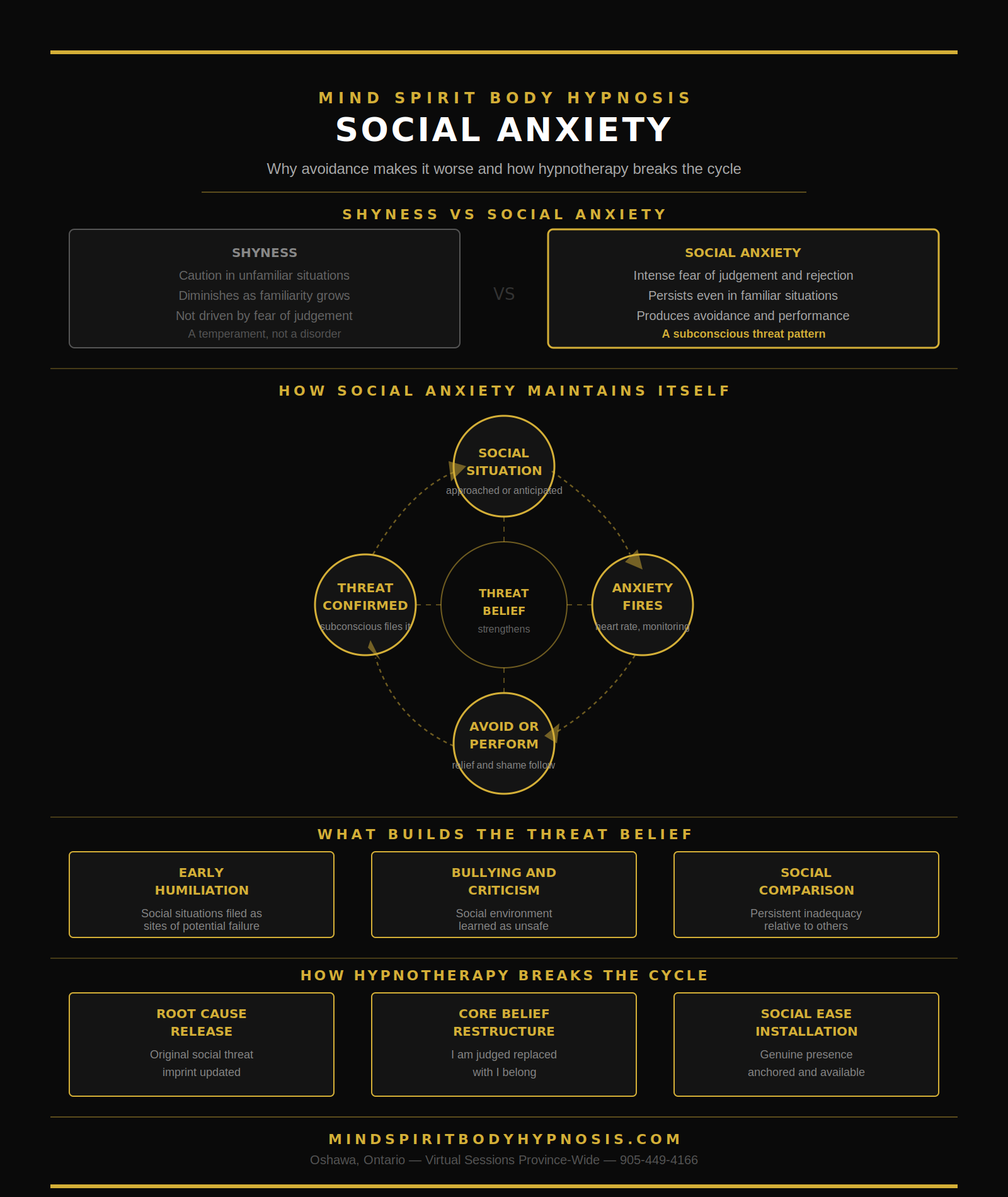
It is important to distinguish social anxiety from shyness and introversion, because this distinction matters for treatment. Shyness is a temperament: a tendency toward caution and reserve in unfamiliar social situations that diminishes as comfort develops. Introversion is an energy orientation: a preference for less stimulating social environments that is not driven by fear.
Social anxiety is different from both. It is not about preference or temperament but about fear. The person with social anxiety may desperately want to engage, to speak, to connect, and be prevented from doing so fully by a subconscious threat response that fires automatically and disproportionately.
⭐ Pro Tip: A reliable way to distinguish social anxiety from introversion is to notice the quality of the reluctance. Introverts decline social situations because they genuinely prefer quieter environments and recover energy through solitude. People with social anxiety decline because the anticipation of judgment produces genuine dread, and they often feel significant regret, shame, or longing after declining. If avoiding social situations produces relief followed by self-criticism, social anxiety rather than introversion is likely at the root.
What Causes Social Anxiety?
Social anxiety almost always has identifiable subconscious origins, even when those origins are not immediately obvious to the person experiencing it.
Early social failure or humiliation. A specific experience of being publicly embarrassed, laughed at, criticized in front of others, or excluded can create a powerful subconscious imprint. The brain files social situations as potential sites of humiliation and activates a protective response to prevent the original painful experience from recurring.
Bullying. Sustained bullying, whether in school, in the workplace, or online, teaches the subconscious that the social environment is unsafe. The vigilance and self-monitoring that bullying survivors develop as protective adaptations can persist long after the bullying has ended, maintaining a chronic social threat response.
Critical or unpredictable family environments. Growing up in an environment where critical commentary on behaviour, appearance, or performance was frequent, or where parental approval was conditional and unpredictable, builds a subconscious orientation toward managing the perceptions of others as a survival strategy.
Social comparison and social media. Chronic comparison in social media environments creates a continuously updated internal hierarchy in which the person's social standing is monitored against an idealized standard that produces persistent inadequacy. This heightened self-consciousness is a direct driver of social anxiety.
Generalized anxiety sensitization. For people with underlying anxiety, social situations become increasingly activating over time as the nervous system learns to anticipate anxiety in evaluative contexts. The fear of experiencing anxiety in public, sometimes called anxiety about anxiety, compounds the original social fear into something significantly larger.
Research published in the British Journal of Psychiatry found that social anxiety disorder responds significantly better to approaches that directly address the subconscious beliefs and safety behaviours maintaining it than to exposure-only approaches that leave the underlying belief system intact (Clark et al., 2006).
For more on how anxiety is maintained by the nervous system and how hypnotherapy addresses the root, the hypnotherapy for anxiety and stress pillar page covers the foundational mechanisms in detail.
Why Social Anxiety Gets Worse Without Treatment
This is one of the most important things to understand about social anxiety and one of the reasons that managing it through avoidance alone is so counterproductive.
Social anxiety maintains and strengthens itself through the avoidance it generates. Each time a social situation is avoided, the subconscious receives a confirmation: that situation was dangerous enough to avoid, which means the threat assessment was correct. The anxiety is reinforced rather than resolved, and the situations that trigger it tend to expand over time.
The safety behaviours that social anxiety produces, rehearsing conversations in advance, sitting near exits, minimizing eye contact, and over-preparing for every social interaction, have the same effect. They prevent the subconscious from receiving the disconfirming evidence that the social situation was actually safe. The threat belief is maintained precisely because the behaviour that would disprove it is never allowed to occur naturally.
Additionally, the shame that often accompanies social anxiety creates a secondary barrier to treatment. Many people with social anxiety are significantly more embarrassed about the anxiety than about any social performance issues it has caused, making it difficult to seek help until the limitation has become severe.
⭐ Pro Tip: If you notice that the situations triggering your social anxiety have expanded over time, this is an important signal that the pattern is strengthening rather than resolving on its own. Social anxiety does not typically self-resolve in adulthood without direct intervention. The good news is that it responds very well to hypnotherapy because the subconscious patterns maintaining it, the threat beliefs, the safety behaviours, and the avoidance loops, are exactly what hypnotherapy is designed to address.
How Hypnotherapy Addresses Social Anxiety at the Root
As a certified hypnotherapist trained through the American Board of Hypnotherapy, I approach social anxiety as a subconscious threat pattern with identifiable origins and a specific maintenance structure. The work addresses both the root and the day-to-day patterns that keep it running.
Root cause identification and release. In many cases, social anxiety traces to a specific formative experience: a moment of humiliation, a period of bullying, a critical relationship that established the belief that the social self is inadequate. In trance, these origins are accessed with adult resources and perspective. The emotional charge attached to them is released, and the subconscious receives an updated interpretation: the danger that those experiences represented no longer applies to current social situations.
Core belief restructuring. Social anxiety is sustained by a set of subconscious beliefs about the self in relation to others: I am being judged, I am inadequate, I will be found out, I do not belong. These beliefs are not consciously held as opinions but as subconscious operating assumptions that filter every social perception. In trance, these assumptions are identified and systematically updated with more accurate and functional alternatives.
Safety behaviour dissolution. The protective patterns that social anxiety produces, over-preparation, self-monitoring, avoidance, and conversational rehearsal, are addressed in trance as subconscious habits rather than as conscious choices. As the underlying threat belief is updated, the need for the protective behaviours reduces naturally, without the person having to force themselves to stop behaviours that had previously felt essential.
Social confidence installation. Using guided imagery and direct suggestion in trance, vivid and fully sensory experiences of genuine social ease are installed: the client is present and comfortable in a variety of social contexts, engaging without excessive monitoring, belonging without performance. These scenes are filed as reference experiences, making genuine social ease feel familiar and available rather than impossibly distant.
A meta-analysis of psychological treatments for social anxiety disorder found that hypnotherapy produced significant effect sizes for social anxiety symptom reduction, with effects comparable to cognitive behavioural therapy for certain aspects of the presentation and superior for the subconscious belief and avoidance components specifically (Schoenberger, 2000).
NLP Techniques That Build Genuine Social Confidence
NLP offers precise, practical tools for dismantling the internal architecture of social anxiety. Clients I work with across Ontario find these particularly useful as portable tools between sessions.
Submodality works on the feared social scenario. The internal representation of a feared social situation has specific qualities: size, vividness, proximity, and emotional intensity. Changing those qualities directly reduces the anxiety response. When the feared situation is made smaller, more distant, and less vivid in the internal representation, the physiological anxiety it generates reduces proportionally.
The circle of excellence for social contexts. A resource state of genuine social ease, characterized by calm presence, natural engagement, and a complete absence of self-monitoring, is built in trance and anchored to a physical cue. Before any challenging social situation, activating the anchor provides immediate access to this state rather than the monitoring, rehearsing state that social anxiety produces.
Perceptual positions for social perspective. Social anxiety involves being trapped inside a first-person, self-critical, inwardly monitoring experience of social situations. Moving to a second position, genuinely considering the social interaction from the perspective of another person present, almost universally reduces the intensity of the self-critical experience and introduces a perspective in which the person is typically not as visible, scrutinized, or inadequate as the anxiety suggests.
Future pacing successful social engagement. The subconscious is walked through vivid scenes of the client in their most feared social contexts, present and engaged, conversing naturally, contributing and belonging, without the background monitoring that social anxiety produces. These scenes become reference experiences that the subconscious draws on when the actual social situation arrives.
More about how these techniques are applied at Mind Spirit Body Hypnosis is available on the about page.
What to Expect in a Session
The first session is a conversation. Which social situations are most activating? Are there specific types, such as large groups, one-on-one conversations, or situations involving performance or evaluation? When did the social anxiety begin, or has it always been present? What has it cost in terms of career, relationships, and daily life? And what would genuine social ease look and feel like?
This mapping shapes the subconscious work. The induction is gentle, and most clients reach a deeply relaxed trance state within minutes. The core work then targets the specific beliefs, experiences, and safety behaviour patterns identified in the conversation.
Social anxiety typically responds well to hypnotherapy. Many clients notice a meaningful shift after the first two to three sessions: a reduction in anticipatory dread, a greater ability to be present in social situations without excessive monitoring, and a growing sense that belonging is available to them rather than something that must be earned through perfect performance.
Most social anxiety programmes at Mind Spirit Body Hypnosis run between four and six sessions. For more on how self-esteem and social confidence are addressed at Mind Spirit Body Hypnosis, the hypnotherapy for self-esteem page covers the overlapping patterns in detail. All sessions are delivered virtually and are available to clients aged 10 and older across Ontario from the comfort of their own homes.
What My Clients Say
"Working with Fanis has changed my life. After years of therapy for anxiety and confidence issues, I wanted to try something different. This experience has transformed me from the inside out and continues to have an effect even after our sessions. I am now able to be myself, face my fears, surround myself with those who care about me and live a fulfilling and happy life. So grateful."
Kristen W. | Anxiety and Confidence | Five Stars
FAQ
Can hypnotherapy help with social anxiety disorder? Yes. Hypnotherapy directly addresses the subconscious threat beliefs, avoidance patterns, and nervous system dysregulation that maintain social anxiety. Research supports significant effect sizes for social anxiety symptom reduction through hypnotherapy, with effects maintained at follow-up.
What causes social anxiety? Social anxiety is most commonly caused by early social humiliation or bullying that created a subconscious threat association with social situations, critical or conditional family environments, social comparison and media-driven self-consciousness, and in some cases, generalized anxiety that has sensitized the nervous system to evaluative social contexts. It is a subconscious pattern, not a personality trait.
How is social anxiety different from shyness? Shyness is a temperament characterized by caution in new social situations that diminishes as familiarity develops. Social anxiety is a conditioned threat response that produces genuine fear of judgement, humiliation, or rejection and does not resolve with familiarity alone. People with social anxiety often desperately want to engage and are prevented from doing so fully by the automatic fear response.
Why does social anxiety get worse over time without treatment? Social anxiety self-reinforces through avoidance. Each situation avoided confirms the subconscious threat assessment rather than disproving it. The situations that trigger the anxiety tend to expand, the safety behaviours become more elaborate, and the shame associated with the anxiety creates a secondary barrier to seeking help. Direct intervention at the subconscious level is typically required to interrupt this maintenance cycle.
What is the best treatment for social anxiety in Ontario? Research supports cognitive behavioural therapy and hypnotherapy as effective treatments for social anxiety disorder. Hypnotherapy is particularly effective because it directly addresses the subconscious beliefs and safety behaviour patterns that CBT's behavioural components alone often cannot fully reach. At Mind Spirit Body Hypnosis, hypnotherapy and NLP are combined for a comprehensive result.
How many sessions will I need? Most clients at Mind Spirit Body Hypnosis working on social anxiety complete four to six sessions. Many notice a meaningful shift after the first two to three sessions. The timeline depends on the severity and duration of the pattern and whether there are compounding factors such as trauma, perfectionism, or broader anxiety.
Is this suitable for younger clients? Yes. Mind Spirit Body Hypnosis works with clients aged 10 and older. Social anxiety is particularly common in adolescents and young adults and responds well to hypnotherapy and NLP, which are gentle, non-invasive, and medication-free.
Can I do sessions virtually from anywhere in Ontario? Yes. All sessions are delivered virtually, province-wide, with no referral required. The virtual format is particularly well suited to social anxiety clients, as it allows full engagement from the safety of a familiar environment without the additional anxiety of attending a clinic in person.
What if I have had social anxiety my whole life? Lifelong social anxiety can absolutely shift. The subconscious patterns maintaining it were learned and can be unlearned. Many clients who have managed social anxiety for their entire adult lives find that addressing the subconscious root produces changes in their social experience that years of conscious effort could not achieve.
How do I get started? Book a free 30-minute virtual strategy session at calendly.com/mindspiritbodyhypnosis. No referral needed.
Ready to Take the Next Step?
If social anxiety has been quietly shaping your choices, your relationships, and your sense of what is possible for you, that is not your personality. It is a subconscious pattern. And it can change.
I offer a free 30-minute virtual strategy session for new clients across Ontario. There is no pressure, just a conversation about what has been getting in the way and how hypnotherapy or NLP may help you engage with the social world with genuine ease.
Book your free session: calendly.com/mindspiritbodyhypnosis
Call or text: 905-449-4166
Email: info@mindspiritbodyhypnosis.com
Visit: mindspiritbodyhypnosis.com
Serving clients virtually across Ontario, including Durham Region, Toronto, Ottawa, and beyond.
Disclaimer: This article is for informational purposes only and does not constitute medical or psychological advice. Hypnotherapy and NLP are complementary approaches and are not a substitute for diagnosis or treatment by a qualified healthcare provider. If social anxiety is significantly affecting your daily life, please consult a qualified professional. Results vary by individual.
Written by Fanis Makrigiannis | Certified Hypnotherapist & NLP Master Practitioner | Mind Spirit Body Hypnosis.