Can hypnotherapy help with anger management?
Can Hypnotherapy Help With Anger Management?
TL;DR: Anger is not a character flaw. It is a subconscious threat response that fires faster than any conscious decision can intervene, and when it is disproportionate, persistent, or damaging to relationships and careers, the root is almost always something that happened long before the situation that triggered it. At Mind Spirit Body Hypnosis in Oshawa, Ontario, Fanis Makrigiannis uses hypnotherapy and NLP to work directly with the subconscious drivers of chronic anger, helping clients of all ages across the province respond rather than react.
Quick Answer
Hypnotherapy for anger management is a subconscious-focused approach that identifies and addresses the underlying threat responses, unresolved emotional material, and limiting beliefs that generate disproportionate anger, by retraining the nervous system and updating the subconscious patterns that trigger the anger response before conscious regulation is possible. Research published in the American Journal of Clinical Hypnosis found hypnotherapy effective in reducing anger and hostility scores, with effects maintained at follow-up. Fanis Makrigiannis, a Certified Hypnotherapist and NLP Master Practitioner at Mind Spirit Body Hypnosis in Oshawa, Ontario, offers virtual sessions across the province for clients of all ages ready to stop being controlled by their anger.
Questions This Article Answers
Can hypnotherapy help with anger management?
What causes chronic anger?
Why is anger so hard to control in the moment?
How is chronic anger different from healthy anger?
What is the best treatment for anger issues?
In This Article:
You know it is happening. You can feel it building. And yet, despite knowing, despite the awareness, despite having decided a hundred times that you are going to handle the next one differently, the response comes anyway. Faster than intention. Louder than you wanted. And then the aftermath: the regret, the damage, the quiet cost to the relationships and professional standing that matter most to you.
Chronic anger is one of the most isolating patterns a person can carry, partly because of the shame it generates and partly because the conventional advice, count to ten, take a breath, walk away, describes what to do with the anger without ever addressing where it comes from.
In my practice, clients who come for anger management work are rarely the people the stereotype suggests. They are thoughtful, self-aware, often highly successful individuals who are bewildered and exhausted by the gap between who they know themselves to be and how they respond when the anger fires. That gap is the subconscious at work. And closing it requires working at the level where the pattern lives.
What Is Chronic Anger and How Is It Different From Healthy Anger?
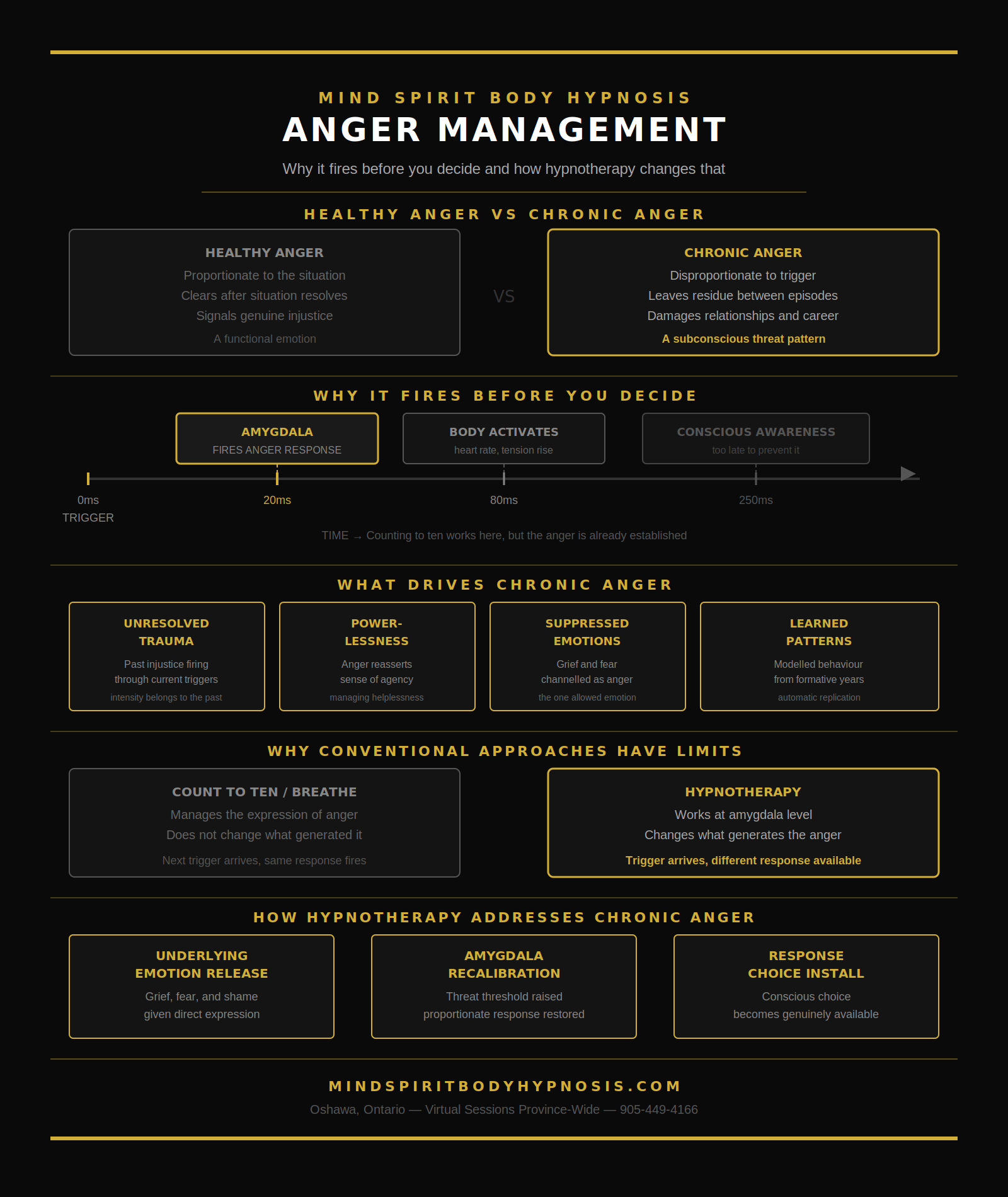
Healthy anger is a normal and functional emotional response. It signals that a boundary has been crossed, that something important is being threatened or disrespected, and it mobilizes the energy needed to address that threat effectively. Healthy anger is proportionate, time-limited, and actionable. It fires in response to genuine injustice or violation and subsides when the situation has been addressed.
Chronic anger is different in character. It is disproportionate to its triggers, meaning the intensity of the response exceeds what the situation actually warrants. It is persistent, meaning it does not fully subside between episodes and leaves a residue of irritability, resentment, or tension that colours daily experience. And it is damaging to relationships, to professional life, to physical health, and to the person's own sense of self.
According to the Canadian Mental Health Association, anger management difficulties affect a significant proportion of the adult population, with chronic anger associated with elevated risk of cardiovascular disease, relationship breakdown, workplace disciplinary action, and mental health comorbidities including depression and anxiety. In Ontario, stress-related anger in workplace and family contexts is among the most commonly reported concerns in clinical and coaching settings.
⭐ Pro Tip: A reliable way to identify whether anger has moved from healthy to chronic is to notice the ratio of triggers to intensity and whether the anger is leaving residue. Healthy anger fires proportionately and clears. Chronic anger fires disproportionately and leaves a background irritability, resentment, or hair-trigger sensitivity that persists between episodes. If you find yourself easily re-activated by minor triggers, or if you notice that the anger from one situation is still present when the next one arrives, the pattern has become systemic rather than situational.
What Causes Chronic Anger?
Chronic anger almost always has subconscious roots that predate the situations currently triggering it. Understanding those roots is essential to changing the pattern.
Unresolved trauma and injustice. Trauma, particularly trauma involving violation of safety, trust, or fairness, leaves the nervous system in a state of chronic threat-readiness. When current situations activate even a partial resemblance to the original threat, the response fires at the intensity appropriate to the original event rather than the current one. The person is genuinely angry about the current situation, but they are also, simultaneously, angry about everything that was never resolved.
Powerlessness and control. Anger is often the emotional response to a sense of powerlessness. When the subconscious has concluded that the environment is unreliable, unfair, or threatening, and that the person cannot control or influence what happens to them, anger becomes the primary tool for reasserting a sense of agency. Chronic anger is the subconscious managing a deep experience of helplessness.
Unmet needs and suppressed emotion. For many clients, chronic anger is the emotion that is allowed when others are not. Sadness, fear, grief, and vulnerability may have been shamed, invalidated, or modelled as unacceptable in the formative environment. Anger is the acceptable substitute, and it becomes the channel through which a wide range of other emotional material is expressed, often without the person recognizing that the anger is a surface expression of something more complex beneath.
Learned response patterns. Anger can be a learned relational pattern. If the modelled behaviour in the family of origin was to respond to difficulty with anger, the subconscious has filed this as the normal and appropriate way to handle frustration, threat, or disappointment. The pattern is not a choice but an automatic replication of learned behaviour.
Research published in the Journal of Consulting and Clinical Psychology found that anger is significantly predicted by early adversity, including childhood trauma and invalidating environments, and that anger interventions are most effective when they address the subconscious emotional material underlying the surface response rather than focusing exclusively on the behaviour itself (DiGiuseppe & Tafrate, 2003).
For more on how trauma and unresolved emotional material are addressed at Mind Spirit Body Hypnosis, the EMDR trauma therapy page covers the neurological foundations of trauma-based anger in detail.
Why Anger Is So Hard to Control in the Moment
This is one of the most important things to understand about chronic anger, and the reason that conscious strategies alone so rarely produce lasting change.
The anger response is generated by the amygdala, the brain's threat detection system, which operates below the level of conscious rational thought. When the amygdala identifies a threat pattern, it activates the stress response within milliseconds, far faster than the prefrontal cortex, which governs conscious regulation, can intervene. This is sometimes called amygdala hijack: the emotional brain takes over before the reasoning brain has a chance to engage.
In chronic anger, the amygdala's threat threshold is lowered. Situations that would not register as threatening in a calm, regulated nervous system are detected as significant threats and trigger the full anger response. By the time conscious awareness arrives, the physiological anger state is already established, and what follows is not a choice to be angry but an attempt to manage anger that has already arrived.
This is why counting to ten, taking a breath, and walking away, while genuinely useful as immediate de-escalation tools, do not change the pattern. They manage the expression of the anger without addressing what generated it. The next trigger arrives, and the same response fires again.
Hypnotherapy works at the amygdala level, directly with the subconscious threat detection system and the emotional material that has lowered its threshold. Rather than asking the conscious mind to repeatedly override an automatic response, it changes the automatic response itself.
For more on how the nervous system drives anxiety and anger responses and how hypnotherapy addresses both, the hypnotherapy for anxiety and stress pillar page covers the foundational nervous system mechanisms.
How Hypnotherapy Addresses Anger at the Root
As a certified hypnotherapist trained through the American Board of Hypnotherapy, I approach chronic anger as a subconscious pattern with identifiable emotional roots and a specific neurological architecture. The work addresses both the underlying material and the automatic trigger-response pattern that maintains the anger in daily life.
Underlying emotion identification and release. In trance, the emotions beneath the anger are accessed and given direct expression for the first time. The grief that anger has been substituting for. The fear that anger has been protecting against. The powerlessness that anger has been managing. When these underlying emotions receive direct attention and release, the pressure the anger has been carrying is significantly reduced, and the trigger threshold rises naturally.
Root cause regression. The subconscious origins of the anger pattern are identified and revisited in trance with adult resources and perspective. The original experiences of injustice, violation, powerlessness, or emotional invalidation that established the hair-trigger response are processed, and the emotional charge attached to them is released. The amygdala's threat database is updated: current situations are no longer evaluated through the lens of what happened then.
Amygdala recalibration. Using direct suggestion and guided imagery in trance, the nervous system's threat threshold is recalibrated. Situations that previously triggered the full anger response are approached with a more proportionate assessment. The response available in genuinely threatening situations remains intact. The disproportionate activation in non-threatening situations is reduced.
Response choice installation. A specific, chosen alternative response to the typical anger triggers is installed in trance. Rather than the automatic escalation that currently follows the trigger, the client experiences a genuine moment of conscious choice: aware of the trigger, feeling the activation, and choosing a response that serves their values and relationships rather than replicating the pattern. This installation of response choice is one of the most significant outcomes of the work.
A study published in the American Journal of Clinical Hypnosis found that hypnotherapy produced significant reductions in anger, hostility, and aggression scores in a clinical sample, with improvements in self-reported emotional regulation and interpersonal functioning maintained at three-month follow-up (Dowd, 2004).
NLP Techniques That Break the Anger Pattern
NLP offers precise, portable tools for dismantling the specific pattern architecture of chronic anger. Clients I work with across Ontario find these particularly useful as independent tools between sessions.
Submodality work on the anger state. The internal experience of anger has a specific structure: a location in the body, a colour, a temperature, a sound, a direction of movement. Changing those qualities directly reduces the intensity of the experience. When the anger is made smaller, cooler, more distant, and less directional in the internal representation, the physiological intensity reduces proportionally. This can be done in under two minutes and provides an immediate alternative to the escalating state.
The pattern interrupt. A specific NLP technique for breaking the automatic anger escalation sequence mid-cycle. Rather than trying to suppress the anger once it has fully activated, the pattern interrupt inserts a moment of awareness between the trigger and the habitual response, creating a gap in which a different choice can be made. Over time, the gap widens, and the automatic quality of the escalation dissolves.
Parts integration for anger. Many clients with chronic anger have an internal conflict: the part that wants to express and protect, and the part that recognizes the cost of the anger and wants to stop. NLP parts integration resolves this conflict, creating internal alignment so the person is no longer fighting themselves in the moment of activation.
Anchoring a grounded response state. A state of genuine groundedness, calm authority, and confident boundary-setting experienced in trance is anchored to a physical cue. When anger begins to activate, applying the anchor provides an immediate alternative physiological state that does not require suppression of the underlying emotion but channels it into a more functional expression.
More about how NLP and hypnotherapy are combined in practice at Mind Spirit Body Hypnosis is available on the about page.

What to Expect in a Session
The first session is a conversation without judgment. What situations most reliably trigger the anger? What does it feel like in the body when it starts? How long has this been a pattern? Is there a sense of what is underneath the anger? What has the anger cost, and what would change if it no longer ran the response?
This mapping shapes the subconscious work. The induction is gentle, and most clients reach a deeply relaxed trance state within minutes. The first session often focuses on the underlying emotion work, because accessing and releasing what the anger has been substituting for frequently produces an immediate reduction in activation intensity that surprises clients who had expected to work much harder for any change at all.
Most anger management programmes at Mind Spirit Body Hypnosis run between four and six sessions. Many clients notice a meaningful shift in their trigger threshold and response quality after the first two sessions. All sessions are delivered virtually and are available to clients aged 10 and older across Ontario from the comfort of their own homes.
What My Clients Say
"I cannot say enough about how amazing Fanis is! He has truly changed my life. I was always an anxious person and always overthinking everything. After seeing Fanis I feel like a completely different person. The anxiety is gone and my mind is actually quiet for the first time in my life. I am forever grateful."
Amanda B. | Anxiety and Overthinking | Five Stars
FAQ
Can hypnotherapy help with anger management? Yes. Hypnotherapy directly addresses the subconscious threat responses, unresolved emotional material, and amygdala threshold dysregulation that drive chronic anger. Research confirms significant reductions in anger, hostility, and aggression scores through hypnotherapy, with effects maintained at follow-up.
What causes chronic anger? Chronic anger is most commonly caused by unresolved trauma and injustice held in the nervous system, subconscious experiences of powerlessness and lack of control, suppressed emotions that have no other acceptable channel, and learned anger response patterns modelled in the formative environment. The current trigger is rarely the actual source of the anger's intensity.
Why is anger so hard to control in the moment? Anger is generated by the amygdala, which activates within milliseconds, far faster than the prefrontal cortex can intervene. By the time conscious awareness arrives, the anger is already established physiologically. Counting to ten manages the expression; it does not change the response. Hypnotherapy changes the response at the amygdala level rather than relying on conscious regulation to repeatedly override it.
How is chronic anger different from healthy anger? Healthy anger is proportionate, time-limited, and actionable. It responds to genuine injustice or boundary violation and subsides when the situation is addressed. Chronic anger is disproportionate to its triggers, persists between episodes, and leaves a background irritability or resentment that affects daily experience regardless of the current situation.
What is the best treatment for anger issues? Approaches that address the subconscious emotional roots and recalibrate the nervous system's threat threshold produce the most lasting results for chronic anger. Hypnotherapy is particularly effective because it works at the amygdala level rather than relying on conscious willpower to repeatedly override an automatic response.
How many sessions will I need? Most clients at Mind Spirit Body Hypnosis working on anger management complete four to six sessions. Many notice a meaningful shift in trigger threshold and response quality after the first two sessions. The timeline depends on the depth of the emotional roots and whether there is significant trauma material involved.
Is this suitable for younger clients? Yes. Mind Spirit Body Hypnosis works with clients aged 10 and older. Anger difficulties in children and adolescents respond well to hypnotherapy and NLP, which are gentle, non-invasive, and medication-free.
Can I do sessions virtually from anywhere in Ontario? Yes. All sessions are delivered virtually, province-wide, with no referral required.
What if I have been told to try anger management classes? Anger management classes and cognitive approaches are valuable complements to hypnotherapy. They provide conscious frameworks and skills for managing anger expression. Hypnotherapy addresses what is generating the anger below the level that those approaches can reach. The two work well together.
How do I get started? Book a free 30-minute virtual strategy session at calendly.com/mindspiritbodyhypnosis. No referral needed.
Ready to Take the Next Step?
If anger has been damaging what matters most to you, and every resolution to handle the next one differently has eventually failed, the root has not yet been addressed.
I offer a free 30-minute virtual strategy session for new clients across Ontario. There is no pressure and no judgment, just a conversation about what is happening and how hypnotherapy or NLP may help you respond rather than react.
Book your free session:calendly.com/mindspiritbodyhypnosis
Call or text:905-449-4166
Email:info@mindspiritbodyhypnosis.com
Visit:mindspiritbodyhypnosis.com
Serving clients virtually across Ontario, including Durham Region, Toronto, Ottawa, and beyond.
Disclaimer: This article is for informational purposes only and does not constitute medical or psychological advice. Hypnotherapy and NLP are complementary approaches and are not a substitute for diagnosis or treatment by a qualified healthcare provider. If anger is affecting your safety or the safety of others, please seek immediate professional support. Results vary by individual.
Written by Fanis Makrigiannis | Certified Hypnotherapist & NLP Master Practitioner | Mind Spirit Body Hypnosis.