Can hypnotherapy break a phone or screen addiction?
Can Hypnotherapy Break a Phone or Screen Addiction?
TL;DR: Phone and screen addiction is not a moral failure or a lack of discipline. It is a dopamine-driven habit loop that technology platforms have been deliberately engineered to create and sustain, and it runs in the subconscious long before any conscious decision to scroll is made. At Mind Spirit Body Hypnosis in Oshawa, Ontario, Fanis Makrigiannis uses hypnotherapy and NLP to rewire the compulsive reach for screens at the subconscious level, helping clients of all ages across the province reclaim their attention, their time, and their presence.
Quick Answer
Hypnotherapy for phone and screen addiction is a subconscious-focused approach that addresses the dopamine reward loops, emotional triggers, and compulsive checking patterns that drive excessive screen use by retraining the nervous system's automatic responses to digital stimuli and addressing the underlying emotional needs that screens have been meeting. Research published in Frontiers in Psychiatry found a significant positive correlation between hypnotisability and smartphone addiction in a Canadian sample, with addiction scores notably higher in Canada than in other countries, suggesting strong susceptibility to hypnotherapy-based intervention. Fanis Makrigiannis, a Certified Hypnotherapist and NLP Master Practitioner at Mind Spirit Body Hypnosis in Oshawa, Ontario, offers virtual sessions across the province for clients of all ages ready to put the phone down.
Questions This Article Answers
Can hypnotherapy help with phone or screen addiction?
What causes phone addiction?
Why is it so hard to put the phone down?
How is phone addiction different from normal phone use?
What is the best way to break a screen addiction?
In This Article:
You pick up the phone to check one thing, and thirty minutes have passed. You wake up, and the first thing you reach for is on the nightstand. You are in a conversation with someone you care about, and part of your attention is somewhere else, checking, monitoring, waiting for the notification that tells the subconscious it can relax.
You know it is too much. You have known for a while. And you keep picking it up anyway.
That is not a character failure. That is a dopamine loop that some of the world's most sophisticated engineers have spent billions of dollars and decades of psychological research designing. The compulsive reach for the phone is not a personal weakness. It is a predictable response to a system specifically built to produce it.
In my practice, clients who come for screen addiction work range from young professionals whose evening hours have been consumed by endless scrolling, to parents who notice the phone is affecting their presence with their children to students whose academic work is constantly derailed by compulsive checking. What they share is not a lack of awareness but an inability to act consistently on what they know. That gap between knowing and doing is the subconscious at work.
What Is Phone Addiction and How Common Is It?
Phone addiction, more formally described as problematic smartphone use or smartphone addiction, is a pattern of compulsive, excessive screen engagement that interferes with daily functioning, relationships, sleep, work, and well-being. It shares neurological features with behavioural addictions, activating the same dopamine-driven reward circuitry involved in gambling and substance use.
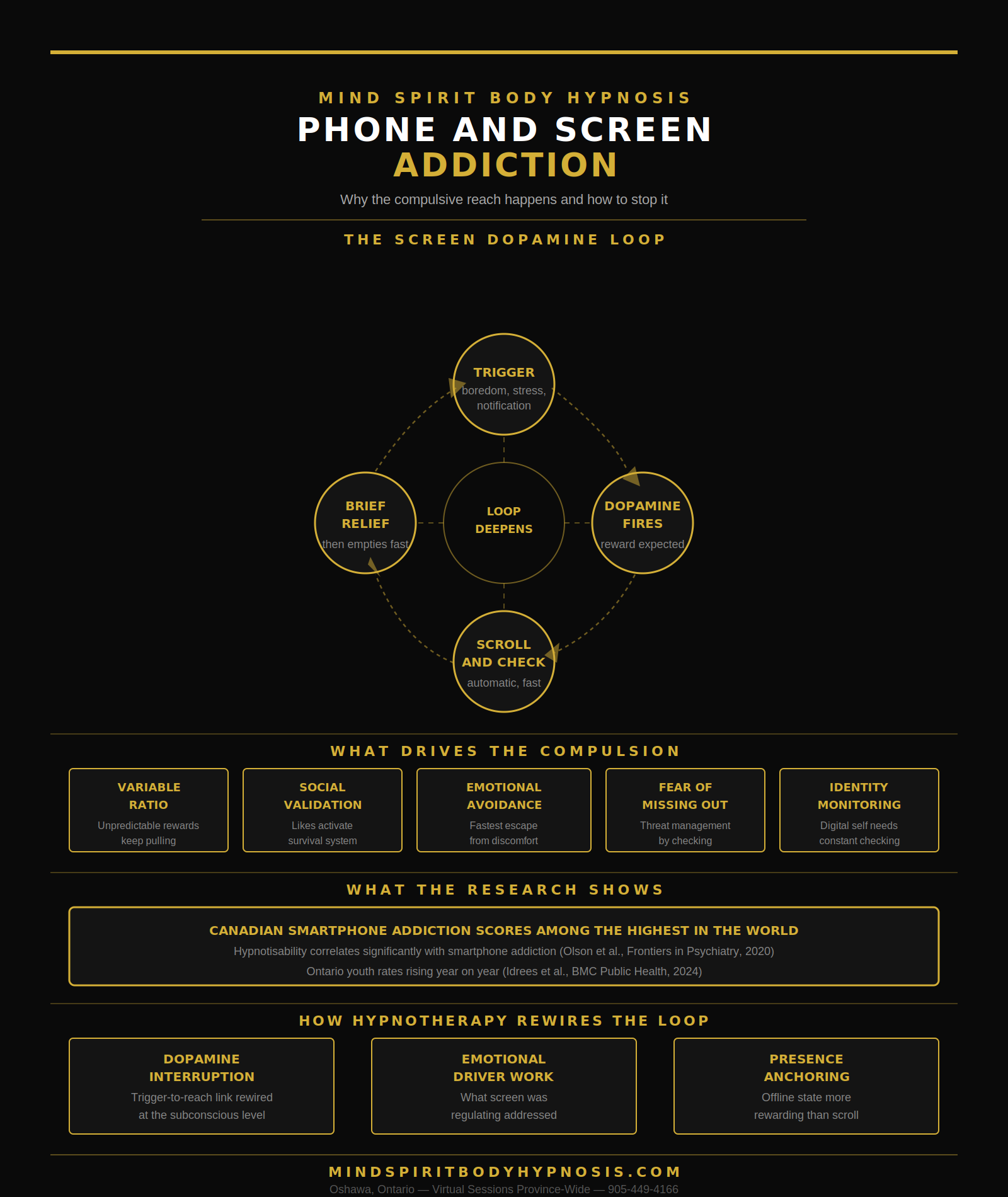
It is significantly more common than most people realize, particularly in Canada. Research published in Frontiers in Psychiatry, using data from a Canadian sample of 641 participants, found that smartphone addiction scores in Canada were unexpectedly high compared to international norms, and that there was a significant positive correlation between hypnotisability and smartphone addiction scores, suggesting that the same absorbed, automatic quality of attention that makes people highly responsive to hypnosis also makes them highly susceptible to the compulsive pull of screens (Olson et al., 2020).
A 2024 study published in BMC Public Health found significant associations between problematic technology use, life stress, and reduced self-esteem among high school students in Ontario, with rates of problematic use increasing year on year since 2020 (Idrees et al., 2024).
The population most affected in Ontario spans adolescents and young adults, but increasingly includes working adults aged 25 to 45 whose professional use of devices has blurred into compulsive personal use, making it difficult to distinguish necessary engagement from habitual avoidance.
⭐ Pro Tip: One of the most reliable ways to distinguish problematic phone use from normal phone use is to notice what happens when the phone is not available. Normal phone use produces mild inconvenience when the phone is absent. Problematic use produces restlessness, irritability, a persistent low-grade sense of missing something, and an inability to fully settle into any activity that does not involve a screen. This withdrawal-like response is the clearest sign that the subconscious has filed the phone as a primary source of regulation, and it is exactly what hypnotherapy addresses.
What Causes Screen Addiction?
Phone addiction does not develop because people lack discipline. It develops because smartphones and the platforms on them have been engineered with extraordinary sophistication to exploit the neurological mechanisms that govern attention, reward, and social behaviour.
Variable ratio reinforcement. The same mechanism that drives gambling addiction is built into every social media feed, notification system, and recommendation algorithm. Variable ratio reinforcement, in which rewards arrive unpredictably and intermittently, produces the highest and most persistent engagement because the subconscious cannot predict when the reward will come and therefore cannot stop looking. Each scroll, each check, each pull-to-refresh is a subconscious attempt to find the reward that might be there this time.
Social validation and belonging needs. Likes, comments, shares, and follower counts activate the brain's social reward system directly. Humans are profoundly social animals, and the subconscious treats social acceptance as a survival signal. The phone provides a continuous stream of social feedback, and the subconscious learns to seek it as reliably as it seeks food or safety.
Emotional avoidance and regulation. For many people, the phone has become the primary tool for managing uncomfortable emotional states: boredom, loneliness, anxiety, stress, restlessness. The screen provides an immediate and reliable escape from whatever is present in the room that the person would rather not be in. The subconscious learns that the phone solves the discomfort, and it reaches for it automatically whenever discomfort arises.
Fear of missing out. The subconscious has learned that the digital environment is constantly producing events, news, conversations, and opportunities that might be relevant and that missing them carries social or informational cost. The compulsive checking is the subconscious managing this threat, ensuring that nothing important goes undetected.
Identity and self-concept. For adolescents especially, but increasingly for adults, social media has become a primary arena for identity construction and self-presentation. The phone is not merely a device but a stage, and the compulsion to check it is partly a compulsion to monitor how the performed self is being received.
Why Is It So Hard to Put the Phone Down?
Understanding why willpower alone fails to solve phone addiction is essential to understanding why hypnotherapy works where personal resolve typically does not.
The decision to put the phone down is conscious. The reach to pick it up is subconscious. The two do not operate at the same level, which means conscious resolution is competing with a subconscious automatic response that is faster, more powerful, and has been reinforced thousands of times.
Research published in Computers in Human Behaviour found that habitual phone use, distinguished from intentional phone use by its automatic, non-deliberate quality, is the primary predictor of problematic smartphone use, and that habit strength is a significantly better predictor of continued use than conscious intention to reduce it. The person genuinely intends to use the phone less. The subconscious has a different plan.
Added to this is the role of emotional avoidance. When the phone has become a primary emotional regulation tool, removing it without addressing what it has been regulating leaves the person facing unmanageable discomfort with no alternative tool. The subconscious resists this outcome and reinstates the phone use, often without the person registering that a conscious choice was made.
Hypnotherapy works at the subconscious level where the habit and the emotional regulation pattern actually live. Rather than asking the conscious mind to override an automatic response, it changes the automatic response itself.
For more on how habit loops are maintained by the subconscious and how they respond to hypnotherapy, the hypnotherapy for habits and addictions pillar page at Mind Spirit Body Hypnosis covers the foundational mechanisms in detail.
How Hypnotherapy Addresses Screen Addiction at the Root
As a certified hypnotherapist trained through the American Board of Hypnotherapy, I approach phone and screen addiction as a subconscious habit pattern with identifiable emotional drivers and a specific reward architecture that can be dismantled and replaced. The work is practical, non-judgmental, and builds the internal tools for genuine change rather than temporary willpower-based restraint.
Dopamine pattern interruption. The automatic reach for the phone in response to boredom, discomfort, or a notification trigger is addressed directly in trance. The specific triggers that most reliably activate the checking behaviour are identified and, using guided suggestion, the automatic connection between trigger and phone reach is interrupted and replaced with a new response. The trigger fires. The reach does not follow.
Emotional driver work. The session identifies what the phone is actually doing for the person. If it is regulating anxiety, the underlying anxiety is addressed directly. If it is providing social belonging, better internal sources of that belonging are installed. If it is avoiding uncomfortable emotions or an unsatisfying life situation, those underlying issues are approached with compassion and addressed at the root. When the subconscious has a more effective way to meet the emotional need, the phone loses its function as the primary tool.
Presence anchoring. A state of genuine, embodied present-moment awareness, experienced in trance as something qualitatively different from the distracted, fragmented state that screen addiction produces, is anchored to a physical cue. When the compulsive reach occurs in daily life, activating the anchor provides an immediate alternative internal experience: the quality of being genuinely here, rather than the fractured attention of habitual scrolling.
Identity-level shift. For clients whose phone use has become central to their identity or self-monitoring, trance work at the identity level installs a new sense of self that does not require continuous digital feedback for its stability. The person becomes, at the subconscious level, someone who uses the phone with intention rather than someone who is used by it.
For more on how anxiety and emotional avoidance drive habitual behaviour and how hypnotherapy addresses both, the hypnotherapy for anxiety and stress page covers the relevant nervous system and subconscious mechanisms.
NLP Techniques That Restore Intentional Phone Use
NLP offers precise, practical tools for dismantling the specific habit architecture of screen addiction. Clients I work with across Ontario find these particularly useful as independent tools between sessions.
The pattern interrupt. A specific NLP technique applied to the automatic reach for the phone. Rather than attempting to suppress the urge, the pattern interrupt inserts a brief moment of conscious awareness between the trigger and the habitual response. This gap, initially only a second or two, is widened progressively until the automatic quality of the phone’s reach dissolves and genuine choice re-enters the behaviour.
Submodality work on the phone pull. The internal experience of being drawn to the phone has a specific structure: a direction of pull, a quality of compulsion, a felt urgency. Changing those qualities directly reduces the strength of the pull. When the compulsion is made less urgent, more diffuse, and less directional in the internal representation, the automatic reach loses its momentum.
Future pacing a new relationship with technology. The subconscious is walked through vivid scenes of the client moving through their daily life with a genuinely intentional relationship with their phone: picking it up for a specific purpose, completing the task, putting it down. Being present at dinner. Sleeping through the night without reaching for the nightstand. These scenes are filed as expected memory, making intentional phone use feel natural rather than effortful.
Anchoring a rich offline experience. States of genuine absorption, creativity, connection, and aliveness accessed during trance and anchored to a physical cue provide the subconscious with an alternative source of the neurochemical reward it has been seeking through screens. When the offline experience is genuinely more rewarding than the online one, the screen loses its compelling quality not through discipline but through natural preference.
More about the hypnotherapy and NLP approach at Mind Spirit Body Hypnosis is available on the about page.

What to Expect in a Session
The first session is a conversation without judgment. How much time do you estimate you spend on screens per day? What are the situations in which the use becomes most compulsive? What have you noticed it is doing for you emotionally? What has already been tried? And what would you do with your time and attention if the compulsion were no longer running it?
This mapping shapes the subconscious work. The induction is gentle, and most clients reach a deeply relaxed trance state within minutes. The core work targets the specific triggers, emotional drivers, and reward patterns identified in the conversation.
Most screen addiction programmes at Mind Spirit Body Hypnosis run between three and five sessions. Many clients notice a meaningful shift in the automatic quality of their phone use after the first two sessions: a moment of awareness before reaching for it that was not there before, a greater ability to leave it on the other side of the room, a reduction in the background restlessness that previously drove the checking. All sessions are delivered virtually and are available to clients aged 10 and older across Ontario from the comfort of their own homes.
What My Clients Say
"Fanis has done so much for me in such a short period of time — helped me quit smoking, and also helped me to believe and love myself. So professional and patient like no one I have ever met. He has given me hope and strength I have been needing for a long time. I could never thank him enough. Today I believe in myself!"
Natasha C. | Quit Smoking | Five Stars
FAQ
Can hypnotherapy help with phone or screen addiction? Yes. Hypnotherapy works directly with the dopamine reward loops, emotional regulation patterns, and compulsive trigger responses that drive excessive screen use. Research confirms that Canadians score higher on smartphone addiction measures than international norms, and that hypnotisability correlates positively with smartphone addiction, suggesting strong responsiveness to hypnotherapy-based intervention.
What causes phone addiction? Phone addiction is caused by deliberately engineered variable ratio reinforcement in social media and notification systems, social validation needs activated by digital feedback, emotional avoidance and regulation patterns, fear of missing out, and in some cases identity and self-concept patterns that make continuous digital monitoring feel essential. It is a subconscious pattern produced by a system designed to create it.
Why is it so hard to put the phone down? The decision to put the phone down is conscious. The reach to pick it up is subconscious. Willpower operates at the conscious level. The habit operates at the subconscious level. Research confirms that habit strength is a significantly better predictor of phone use than conscious intention to reduce it. Hypnotherapy addresses the habit at the level where it lives.
How is phone addiction different from normal phone use? Normal phone use is predominantly intentional and does not produce significant withdrawal-like symptoms when the phone is unavailable. Problematic phone use is predominantly automatic and produces restlessness, irritability, and an inability to settle when the phone is absent. The key distinction is whether use is directed by conscious intention or by subconscious compulsion.
What is the best way to break a screen addiction? Approaches that address the subconscious dopamine pattern and emotional drivers produce the most lasting results. Hypnotherapy is particularly effective because it changes the automatic behaviour at the level where it lives rather than relying on conscious willpower to repeatedly override it.
How many sessions will I need? Most clients at Mind Spirit Body Hypnosis working on screen addiction complete three to five sessions. Many notice a meaningful shift in the automatic quality of their phone use after the first two sessions. The timeline depends on the depth of the emotional drivers and the extent to which the habit has been conditioned.
Is this suitable for younger clients? Yes. Mind Spirit Body Hypnosis works with clients aged 10 and older. Screen addiction is particularly prevalent among adolescents and young adults in Ontario, and hypnotherapy and NLP are gentle, non-invasive, and medication-free approaches well-suited to younger clients.
Can I do sessions virtually from anywhere in Ontario? Yes. All sessions are delivered virtually, province-wide, with no referral required.
What if I need my phone for work? The goal of hypnotherapy for screen addiction is not to eliminate phone use but to restore intentional use. The work targets the compulsive, automatic, emotionally driven use, not the necessary professional engagement with technology. Most clients find their work-related phone use becomes more focused and efficient, not less, as the compulsive dimension reduces.
How do I get started? Book a free 30-minute virtual strategy session at calendly.com/mindspiritbodyhypnosis. No referral needed.
Ready to Take the Next Step?
If your phone is taking more than you are choosing to give it, that is not who you are. It is a subconscious pattern. And it can change.
I offer a free 30-minute virtual strategy session for new clients across Ontario. There is no pressure, just a conversation about what is happening and how hypnotherapy or NLP may help you use your phone rather than being used by it.
Book your free session: calendly.com/mindspiritbodyhypnosis
Call or text: 905-449-4166
Email: info@mindspiritbodyhypnosis.com
Visit: mindspiritbodyhypnosis.com
Serving clients virtually across Ontario, including Durham Region, Toronto, Ottawa, and beyond.
Disclaimer: This article is for informational purposes only and does not constitute medical or psychological advice. Hypnotherapy and NLP are complementary approaches and are not a substitute for diagnosis or treatment by a qualified healthcare provider. If problematic technology use is significantly affecting your mental health, please consult a qualified professional. Results vary by individual.
Written by Fanis Makrigiannis | Certified Hypnotherapist & NLP Master Practitioner | Mind Spirit Body Hypnosis.