Why do I feel like a fraud?
Hypnotherapy for Impostor Syndrome in Ontario: Your Questions Answered
TL;DR: Impostor syndrome is not a sign that you do not belong. It is a subconscious pattern in which your sense of legitimacy has not kept pace with your actual achievements, and no amount of external success changes it, because the pattern is operating below the level where external evidence can reach. At Mind Spirit Body Hypnosis in Oshawa, Ontario, the five questions people ask most about impostor syndrome and hypnotherapy are answered here, directly.
Quick Answer
Impostor syndrome is the persistent internal experience of feeling like a fraud or believing that your success is undeserved, that your competence is an illusion, and that at some point the people around you will discover the truth. It affects people across every profession, every level of achievement, and every demographic. It was first described by psychologists Clance and Imes in 1978, originally noted in high-achieving women, and is now understood to affect a significant proportion of high performers regardless of gender or field. Hypnotherapy addresses impostor syndrome at the subconscious level where the core beliefs about legitimacy and worth are maintained not by adding more evidence of competence, but by changing the lens through which all evidence is filtered. I offer virtual sessions province-wide for clients of all ages at Mind Spirit Body Hypnosis in Oshawa, Ontario.
Questions This Article Answers
Why do I feel like a fraud even though I am qualified?
Why does success make impostor syndrome worse, not better?
Is impostor syndrome more common in high achievers?
Why can I not just accept that I am good at what I do?
Can hypnotherapy help with impostor syndrome?
In This Article:
There is a particular quality to impostor syndrome that makes it so difficult to live with. It is not that you lack confidence in all things. You are often competent in the practical execution of your work. The problem is that the competence does not feel like yours.
The achievement happened. The qualification was earned. The promotion was given. And underneath all of it, a quiet, persistent voice says: you got lucky. They liked you. They do not know what you actually do not know. The day is coming when they will find out.
People with impostor syndrome frequently function at a very high level. The fear of being exposed does not prevent them from performing; often, it is precisely what drives the performance. But the performance never settles the fear. The next achievement arrives, and the pattern recycles: something explains away the success, something finds the gap in the accomplishment, something waits for the exposure that keeps not coming but never stops feeling imminent.
This is not a rational assessment. It is a subconscious operating pattern. And it requires a different kind of intervention.
Why Do I Feel Like a Fraud Even Though I Am Qualified?
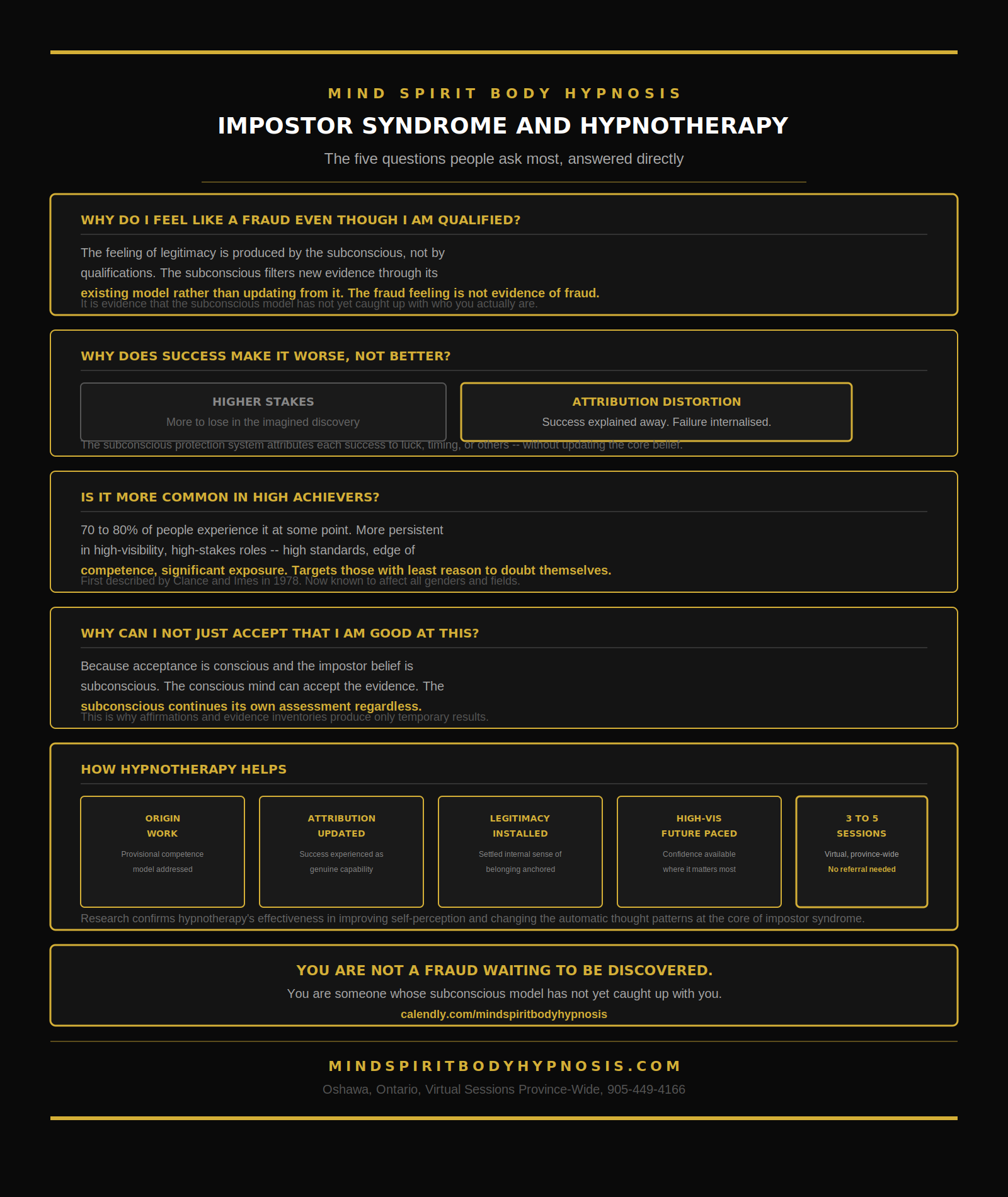
Because the feeling of legitimacy the settled internal sense that you belong in the room, that your competence is real, that your success reflects something genuine about you is not produced by qualifications. It is produced by the subconscious.
Qualifications, track records, promotions, and external recognition all operate at the conscious level. The rational mind can inventory them, point to them, present them as evidence. But the subconscious has its own accounting system, and it does not automatically update when the conscious ledger changes.
For people with impostor syndrome, the subconscious accounting system was established early from specific formative experiences that produced a particular kind of internal narrative about competence, belonging, and legitimacy. Perhaps early experiences of being praised for effort rather than ability, which teaches the subconscious that success is contingent and could easily be withdrawn. Perhaps environments in which high standards were the baseline and the gap between current performance and the required standard was always more prominent than the distance already travelled. Perhaps experiences of being the first, the youngest, or the only, carrying the additional weight of representing a category as well as being an individual.
Whatever the specific origin, the result is the same: the subconscious developed a model of the self as someone whose competence is uncertain, provisional, and subject to discovery. This model does not update automatically when new evidence arrives. It filters the new evidence through its existing framework, finding explanations for success that do not require updating the core belief.
The fraud feeling is not evidence that you are a fraud. It is evidence that the subconscious model of yourself as a potential fraud has not yet been updated. These are very different things.
⭐ Pro Tip: The clearest indicator that impostor syndrome is operating rather than genuine incompetence is the specificity of the fear. Impostor syndrome produces a fear of being discovered: a vague, anticipatory dread that someone will look more closely and find the inadequacy underneath. Genuine incompetence produces a fear of specific failure, identifiable gaps in specific knowledge or skill. If you can name what you are afraid of being discovered for but cannot actually identify a concrete knowledge gap that justifies that fear, what you are experiencing is impostor syndrome rather than a legitimate competence concern.
Why Does Success Make Impostor Syndrome Worse, Not Better?
This is the most counterintuitive feature of impostor syndrome, and the one that most reliably distinguishes it from ordinary self-doubt.
The intuitive expectation is that success would reduce the impostor feeling. Evidence of competence should update the belief in competence. Achievement should quiet the voice that says you do not belong.
For most people with impostor syndrome, the opposite happens. Each success intensifies the stakes. The higher the achievement, the more exposure there is to lose. The more people know about and expect from you, the more catastrophic the imagined discovery becomes. The voice that said you might be found out now says: you are even more exposed than you were before. The gap between who they think you are and who you fear you actually are has grown larger.
There is also a specific distortion that impostor syndrome applies to success: it systematically attributes achievement to external factors rather than internal ones. The promotion was because they needed someone. The successful project was because the team was strong. The good presentation was because the topic was interesting. Each success is accounted for without requiring an update to the underlying belief in the self's competence.
This attribution pattern is not random. It is the subconscious protection system working exactly as designed, maintaining the existing belief by explaining away evidence that would otherwise require it to change. The more successful the person becomes, the more the protection system has to work to maintain the belief, and the more vigilant the impostor monitoring becomes.
This is why telling someone with impostor syndrome to look at their achievements is often unhelpful. They can see the achievements. The impostor system has already processed them and found explanations that do not require a belief update.
⭐ Pro Tip: If you notice that you attribute your successes to luck, timing, or other people while attributing your failures or near-misses to your own inadequacy, this asymmetric attribution is a reliable marker of impostor syndrome. The pattern is not random; it is the subconscious maintaining a specific belief about competence by selectively processing evidence. Noticing the asymmetry is not the same as changing it, but it is the beginning of being able to see the pattern clearly enough to address it.
Is Impostor Syndrome More Common in High Achievers?
Yes, and the relationship between achievement and impostor syndrome is more specific than simply saying that high achievers are prone to self-doubt.
Research has consistently shown that impostor syndrome is particularly prevalent among people who are the first in their family or community to reach a particular level of achievement, people who are in environments where the bar is set extremely high, and people who have a perfectionist orientation toward their work. Studies suggest that between 70 and 80 percent of people experience impostor syndrome at some point, but that the experience is more persistent and more debilitating among those in high-visibility, high-stakes roles.
The reason high achievers are particularly susceptible involves the specific conditions that produce impostor syndrome in the first place. High achievement often requires the development of extremely high internal standards. It often involves operating at the edge of competence, doing new things, taking new risks, entering new domains. And it frequently involves significant visibility, which amplifies the stakes of the imagined exposure.
There is also a selection effect. People who have not developed impostor syndrome in their particular environment have often done so because they have found a way to feel genuine internal legitimacy that is not contingent on external standards. People who remain in high-achievement environments despite persistent impostor feelings are, by definition, people whose impostor feelings have not stopped them from performing. These are often the most capable, most driven people in a given field, which is one of the reasons impostor syndrome so reliably targets exactly the people who have the least objective reason to doubt their competence.
For more on how the self-esteem and legitimacy beliefs that underlie impostor syndrome are addressed at Mind Spirit Body Hypnosis, the hypnotherapy for self-esteem pillar page covers the subconscious belief architecture in detail.
Why Can I Not Just Accept That I Am Good at What I Do?
Because acceptance operates at the conscious level, and the impostor belief operates at the subconscious level. The conscious mind can accept the facts. The subconscious continues to run its own assessment regardless.
This produces one of the most demoralizing features of impostor syndrome: the experience of knowing, rationally and explicitly, that your competence is genuine and still not being able to feel it. The gap between knowing and feeling is not a gap in information or intelligence. It is a gap between the levels of the mind. The conscious mind knows. The subconscious continues to apply its existing model.
This is also why the standard approaches to impostor syndrome the evidence inventories, the accomplishment lists, the mantras, the affirmations produce such limited and temporary results. They are all working at the conscious level. They add information to a system that already has the information. The subconscious does not update from information. It updates from direct subconscious experience.
Research published in the International Journal of Clinical and Experimental Hypnosis documents hypnotherapy's effectiveness in reducing anxiety, improving self-perception, and creating lasting changes in the automatic thought patterns that sit at the core of impostor syndrome effects that surface-level cognitive approaches consistently produce only temporarily.
For more on how the self-sabotage patterns that accompany impostor syndrome the holding back, the deflection of recognition, the difficulty committing to high-visibility roles are addressed at Mind Spirit Body Hypnosis, the hypnotherapy for self-sabotage pillar page covers the mechanisms in detail.

Can Hypnotherapy Help With Impostor Syndrome?
Yes, and specifically because it addresses the subconscious belief architecture that no amount of conscious reasoning or evidence-gathering can reliably reach.
Here is how I work with impostor syndrome at Mind Spirit Body Hypnosis:
The belief architecture. In the intake conversation before the trance work, I build a precise map of the impostor belief for this person. When does it fire most strongly? What triggers it? What explanation does it offer for success? What does it say about what will eventually be discovered? This map is specific to the person and determines the most effective direction for the subconscious work.
Origin work. The specific experiences that established the subconscious model of provisional competence are identified and addressed in trance. The early environment that taught the subconscious that belonging was conditional, that success was attributed to circumstances rather than capability, or that high standards were a baseline rather than an achievement is visited with adult resources. The updated understanding is installed: that the competence is real, that the belonging is earned, and that the original model was formed in specific limiting conditions that no longer accurately describe the current situation.
Attribution pattern updating. The systematic misattribution of success to external factors and failure to internal ones the core mechanism of impostor syndrome is directly addressed. In trance, the subconscious is walked through specific successes and, with the critical filtering function reduced, allowed to experience them as evidence of genuine capability rather than as material to be explained away.
Legitimacy installation. A genuine internal experience of belonging, of being qualified to be where you are, of competence that is real rather than provisional is installed in trance and anchored. Not as a confident performance that might crack under pressure, but as a settled subconscious baseline. The experience of being in the room without the monitoring, without the waiting for discovery, without the voice running its assessment.
High-visibility future pacing. The specific situations in which impostor syndrome is most active the high-stakes presentation, the meeting where expertise is expected, the moment of visible recognition are visited in trance with the updated pattern already operating. These scenes are filed as expected experience, making the settled confidence more available precisely where the pattern previously fired most strongly.
In my practice, impostor syndrome work typically runs between three and five sessions, depending on the depth of the original belief formation and the range of contexts in which it is most active. All sessions are delivered virtually and are available to clients aged 10 and older across Ontario. More about my approach is available on the about page.
What My Clients Say
"Working with Fanis has changed my life. After years of therapy for anxiety and confidence issues, I wanted to try something different. This experience has transformed me from the inside out and continues to have an effect even after our sessions. I am now able to be myself, face my fears, surround myself with those who care about me and live a fulfilling and happy life. So grateful."
Kristen W. | Anxiety and Confidence | Five Stars
"Fanis has done so much for me in such a short period of time helped me quit smoking, and also helped me to believe and love myself. So professional and patient like no one I have ever met. He has given me hope and strength I have been needing for a long time. I could never thank him enough. Today I believe in myself!"
Natasha C. | Quit Smoking and Confidence | Five Stars
FAQ
Why do I feel like a fraud even though I am qualified? Because the feeling of legitimacy is produced by the subconscious, not by qualifications. The subconscious developed a model of provisional competence from specific formative experiences, and this model filters new evidence rather than updating from it. The fraud feeling is not evidence of fraud; it is evidence that the subconscious model has not yet been updated.
Why does success make impostor syndrome worse? Because success increases the stakes of the imagined exposure. The higher the achievement, the more catastrophic the imagined discovery becomes. Success is also systematically attributed to external factors by the impostor pattern, which explains it away without requiring the core belief to change. This is the subconscious protection system working as designed.
Is impostor syndrome more common in high achievers? Yes. Research suggests between 70 and 80 percent of people experience it at some point, but it is more persistent among those in high-visibility, high-stakes roles. High achievement environments involve exactly the conditions high standards, operating at the edge of competence, significant visibility -- that the impostor pattern responds to most strongly.
Why can I not just accept that I am good at what I do? Because acceptance is a conscious act and the impostor belief is a subconscious one. The conscious mind can accept the evidence. The subconscious continues to apply its existing model regardless. This is why evidence inventories and affirmations produce only temporary results; they add information to a system that already has the information and uses it differently.
Can hypnotherapy help with impostor syndrome? Yes. I work directly with the subconscious belief architecture: the origin, the attribution pattern, the legitimacy deficit, and the high-visibility triggering at the level where it actually operates. Research confirms hypnotherapy's effectiveness in improving self-perception and changing the automatic thought patterns at the core of impostor syndrome.
How many sessions will I need? In my practice, impostor syndrome work typically runs three to five sessions. The depth of the original belief formation and the range of contexts where it is most active determine the programme. An honest estimate is always given in the free strategy session.
Does this affect only professionals or also students and younger people? Impostor syndrome affects people at every stage and in every domain: academic, professional, creative, athletic, and personal. I work with clients aged 10 and older. The pattern appears early and can become well-established long before the person reaches their professional peak.
Can I do sessions virtually from anywhere in Ontario? Yes. All sessions are delivered virtually, province-wide, with no referral required.
How do I get started? Book a free 30-minute virtual strategy session at calendly.com/mindspiritbodyhypnosis. No referral needed.
Ready to Take the Next Step?
If you have been achieving and still waiting to feel like you belong, the problem is not your competence. It is a subconscious model that has not yet caught up with who you actually are.
I offer a free 30-minute virtual strategy session for new clients across Ontario. No pressure. Just an honest conversation about what the impostor pattern has been costing you and what a genuinely settled sense of legitimacy might feel like.
Book your free session:calendly.com/mindspiritbodyhypnosis
Call or text:905-449-4166
Email:info@mindspiritbodyhypnosis.com
Visit:mindspiritbodyhypnosis.com
Serving clients virtually across Ontario, including Durham Region, Toronto, Canada, and beyond.
Disclaimer: This article is for informational purposes only and does not constitute medical or psychological advice. Hypnotherapy and NLP are complementary approaches for self-improvement and are not a substitute for diagnosis or treatment by a qualified healthcare provider. Results vary by individual.
Written by Fanis Makrigiannis | Certified Hypnotherapist and NLP Master Practitioner | Mind Spirit Body Hypnosis.