Can Hypnotherapy improve body image?
Can Hypnotherapy Improve Body Image?
TL;DR: Negative body image is not an accurate perception of the body. It is a subconscious belief system built from years of comparison, criticism, and cultural messaging, and it runs as a distorted filter through which every reflection, photograph, and social interaction is processed. At Mind Spirit Body Hypnosis in Oshawa, Ontario, Fanis Makrigiannis uses hypnotherapy and NLP to work directly with the subconscious architecture of body image distortion, helping clients of all ages across the province build a more accurate, compassionate, and functional relationship with their own bodies.
Quick Answer
Hypnotherapy for body image is a subconscious-focused approach that addresses the negative beliefs, distorted perceptions, and emotional patterns that generate chronic dissatisfaction with the body by accessing the deeper layers of the mind where those patterns were established and updating them with more accurate and supportive internal representations. Research published in the International Journal of Clinical and Experimental Hypnosis found hypnotherapy effective in improving body image and self-esteem, with participants reporting significant reductions in negative self-evaluation. Fanis Makrigiannis, a Certified Hypnotherapist and NLP Master Practitioner at Mind Spirit Body Hypnosis in Oshawa, Ontario, offers virtual sessions across the province for clients of all ages ready to stop being at war with their own bodies.
Questions This Article Answers
Can hypnotherapy improve body image?
What causes negative body image?
How is body image different from actual appearance?
Why does negative body image persist even after weight loss?
What is the best treatment for body image issues?
In This Article:
You look in the mirror and see something different from what others see when they look at you. You avoid photographs. You plan your wardrobe around concealment rather than expression. You cancel social plans when your body does not feel acceptable enough for public view. You have lost weight and found that the way you feel about your body has barely changed.
This is not vanity, and it is not oversensitivity. It is a subconscious belief system that has been running a distorted filter over your body perception for so long that it feels like objective reality. It is not. And it can be changed.
In my practice, clients who come for body image work often arrive after years of trying to fix the body itself, hoping that reaching a specific weight or changing a specific feature would finally produce the feeling of acceptability they are looking for. Most have discovered that the number on the scale changes, and the internal experience does not. That is the clearest indicator that the issue is not physical. It is subconscious.
What Is Body Image and Why Does It Become Distorted?
Body image is the internal representation a person holds of their own body: the mental picture, the felt sense, the emotional experience of inhabiting a physical form. It is constructed from memory, emotion, comparison, and cultural input, and it is almost entirely subjective.
Healthy body image is flexible, reasonably accurate, and does not significantly interfere with daily functioning. It allows for normal variation in how the body looks and feels on different days without producing significant distress.
Negative body image is the persistent experience of the body as fundamentally flawed, unacceptable, or inadequate. It is characterized by a significant discrepancy between how the body actually appears and how the person perceives it, emotional distress in response to that perception, and behavioural changes driven by the need to manage, hide, or change the body.
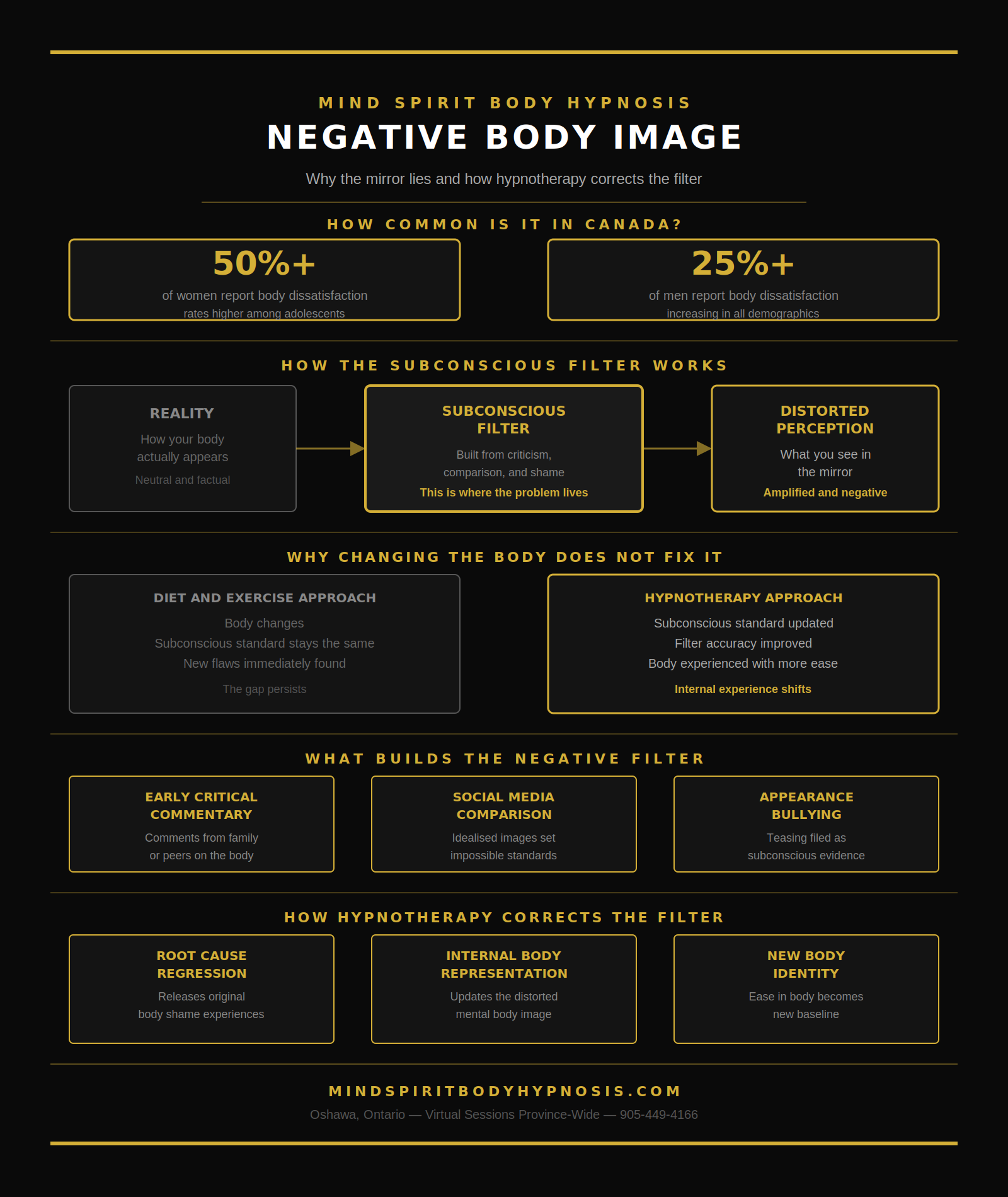
According to the National Eating Disorders Association, negative body image is one of the strongest predictors of disordered eating, low self-esteem, depression, and social anxiety across all age groups. In Canada, surveys consistently find that more than 50 percent of women and approximately 25 percent of men report dissatisfaction with their body appearance, with rates significantly higher among adolescents and young adults.
Body image becomes distorted through a combination of mechanisms that operate largely below conscious awareness. The subconscious files early experiences of criticism, comparison, or shame about the body as formative evidence. Cultural messaging about what constitutes an acceptable body is absorbed continuously and stored as an internal standard. And the perceptual system itself, influenced by these stored beliefs, begins to selectively process information that confirms the negative view while filtering out contradicting evidence.
⭐ Pro Tip: One reliable sign that negative body image is operating at the subconscious level rather than reflecting reality is when compliments from trusted people feel impossible to believe, but a single critical comment feels immediately and completely true. This asymmetry is the subconscious confirmation bias at work, and it is one of the most important patterns to address in hypnotherapy sessions.
What Causes Negative Body Image?
Negative body image is rarely caused by a single event. It almost always develops through a combination of the following:
Critical early commentary on the body. A parent, sibling, teacher, or peer commenting negatively on a child or adolescent's body weight, shape, or appearance. Even comments made without malicious intent can create powerful subconscious imprints that persist for decades.
Weight-focused environments. Growing up in a household where dieting, weight monitoring, or body commentary was frequent. When the body is treated as a problem to be managed in the formative years, the subconscious learns that the body's current state is perpetually inadequate.
Social comparison and media exposure. Chronic exposure to curated or idealized body images through social media, fashion, advertising, and entertainment creates an implicit comparison standard that most bodies cannot meet. The subconscious uses these images as reference points for self-evaluation without distinguishing between heavily edited content and reality.
Bullying or public humiliation related to appearance. A specific incident or sustained pattern of teasing, exclusion, or mockery about physical appearance can create a lasting subconscious template. The original experience is filed as evidence of unacceptability, and the subconscious applies that evidence to subsequent body-related situations.
Trauma and the body as unsafe. For people who have experienced sexual trauma, physical abuse, or medical trauma, the body can become a source of threat rather than a home. Negative body image in these cases is often a protective distancing from a body that is associated with harm.
Research published in Body Image Journal found that early teasing and negative commentary about appearance were the strongest predictors of body image disturbance in adulthood, operating primarily through subconscious belief formation rather than through conscious memory (Menzel et al., 2010).
For more on how self-esteem and body image intersect and how hypnotherapy addresses both, the hypnotherapy for self-esteem page at Mind Spirit Body Hypnosis covers the overlapping subconscious patterns in detail.
Why Negative Body Image Persists Even After Weight Loss
This is one of the most important things to understand about body image and one of the most common points of confusion for clients who have worked hard to change their bodies and found that the internal experience barely shifted.
The body changed. The subconscious belief about the body did not.
Negative body image is a belief system, not an accurate perceptual report. The subconscious holds a conclusion about the body's acceptability that was formed in a specific emotional and developmental context, and that conclusion does not automatically update when the physical reality changes. Research consistently confirms this: people who achieve significant weight loss through diet and exercise alone show minimal improvement in body image unless the subconscious patterns underlying it are directly addressed.
This is also why the goal of improving body image through changing the body rarely produces lasting results. The subconscious simply recalibrates its standard upward to maintain the same negative gap between the body as it is and the body as it is believed to be. The person reaches their goal weight and immediately begins seeing new perceived flaws.
Hypnotherapy works differently. It addresses the subconscious standard, the filter, and the emotional meaning attached to the body's appearance, rather than the appearance itself. The result is a shift in internal experience that does not depend on the body changing first.
⭐ Pro Tip: Keeping a body image journal for one week before beginning hypnotherapy sessions can be genuinely useful. Not a record of negative thoughts, but a simple log of the situations in which the negative body feelings are strongest: times of day, social contexts, activities, triggers. This mapping helps identify the specific subconscious associations driving the pattern, making the subsequent trance work more targeted and efficient.
How Hypnotherapy Addresses Body Image at the Subconscious Level
As a certified hypnotherapist trained through the American Board of Hypnotherapy, I approach negative body image as a subconscious belief pattern with identifiable origins and a specific internal structure that can be changed. The work is compassionate, carefully paced, and builds a genuine internal shift rather than a temporary improvement.
Root cause regression. Sessions trace the negative body image pattern back to its origins: the first experiences of critical commentary, the environments where the body first felt inadequate, the specific moments that established the belief that the body as it is is not acceptable. In trance, those origins are revisited with an adult perspective and resources. The emotional charge attached to them is released, and the subconscious receives an updated interpretation: those experiences say nothing reliable about the body's actual worth or acceptability.
Internal body representation work. The subconscious holds a mental image of the body that is often more distorted, more negative, and more prominent than the actual body. Using guided imagery and submodality work in trance, that internal representation is directly updated: made more accurate, more neutral, softer in its emotional quality. Many clients report experiencing their bodies differently in trance, with greater ease and less hostility, often for the first time in years.
Critical commentary neutralization. The internal critical voice that evaluates the body in negative terms has a specific structure, a location, a tone, and an authority that was given to it by specific historical experiences. Hypnotherapy and NLP work directly with that structure, reducing the authority and emotional weight of the critical commentary without requiring the person to argue with or suppress it.
New body identity installation. Body image is ultimately an identity issue. Who a person believes themselves to be in relation to their body determines how they experience it daily. Using direct suggestion and future pacing in trance, a new identity is installed: one in which the body is inhabited with greater ease, acceptance, and neutrality.
A review of hypnotherapy for body image and eating-related concerns found that hypnotherapy produced significant improvements in body satisfaction and reductions in negative self-evaluation, with effects maintained at follow-up and enhanced when combined with cognitive approaches (Alladin, 2016).
NLP Techniques That Shift the Internal Body Representation
NLP offers precise, practical tools for changing the internal architecture of negative body image. Clients I work with across Ontario find these particularly useful between sessions.
Submodality works on the body image. The internal representation of the body has specific qualities: its size in the mind's eye, its colour, its emotional tone, its position and prominence in mental space. Changing those qualities directly changes the emotional experience of the body. When the internal body image is made smaller, more neutral, less vivid, and less emotionally charged, the distress it generates reduces proportionally.
Perceptual positions for body perception. Most clients with negative body image are trapped in a first-person, emotionally charged experience of their body. Moving to a third-person, observing perspective, seeing the body as a kind friend or observer would, reduces the intensity of the negative self-evaluation and introduces a quality of compassion that is very difficult to access from inside the distress.
The mirror exercise in trance. A guided imagery exercise in which the client approaches a mental mirror and, for the first time in the experience of many, sees their body with genuine curiosity and neutrality rather than judgment. This exercise is conducted within the safety of trance and anchored to a physical cue for independent use.
Future pacing a new body relationship. The subconscious is walked through vivid scenes of the client moving through daily life with ease and neutrality in their body: getting dressed without distress, appearing in photographs without dread, being present in social settings without the constant internal monitoring that negative body image produces.
More about how these techniques are applied at Mind Spirit Body Hypnosis is available on the about page.

What to Expect in a Session
The first session is a conversation. When did the negative relationship with the body begin? Is there a specific event or was it gradual? What situations make it worse? What has already been tried? And importantly, what would change in your life if you felt genuinely at ease in your body?
This mapping shapes the subconscious work. The induction is gentle, and most clients reach a deeply relaxed trance state within minutes. The core work is carefully paced, beginning with nervous system regulation and building toward the deeper belief and identity work over subsequent sessions.
Most body image programmes at Mind Spirit Body Hypnosis run between four and six sessions, reflecting the layered nature of the pattern. Early sessions focus on emotional safety and the subconscious origins of the negative body belief. Later sessions address the internal representation and identity work.
All sessions are delivered virtually and are available to clients aged 10 and older across Ontario from the privacy of their own home. For adolescents and young people with body image concerns, the virtual format is particularly valuable as it removes the anxiety of attending a clinical setting.
What My Clients Say
"Fanis has literally changed my life! I came in for weight loss and stress eating and have lost 20 pounds in 3 months. I no longer reach for food when I am stressed and I finally feel in control around food for the first time in years. I cannot recommend him enough!"
Sandra M. | Weight Loss and Emotional Eating | Five Stars
FAQ
Can hypnotherapy improve body image? Yes. Hypnotherapy works directly with the subconscious beliefs, distorted internal representations, and critical patterns that generate negative body image. Research supports significant improvements in body satisfaction and reductions in negative self-evaluation through hypnotherapy, with effects maintained at follow-up.
What causes negative body image? Negative body image develops primarily through critical early commentary on the body, weight-focused environments in childhood, chronic social comparison and media exposure, appearance-related bullying or public humiliation, and in some cases, trauma that has made the body feel unsafe. It is a subconscious belief pattern, not an accurate perceptual report.
How is body image different from actual appearance? Body image is a subjective internal representation constructed from memory, emotion, comparison, and cultural input. It can and frequently does differ significantly from how the body actually appears. People with negative body image consistently perceive their bodies as larger, more flawed, or less acceptable than independent observers do.
Why does negative body image persist even after weight loss? Because negative body image is a subconscious belief about the body's acceptability, not a reflection of its actual appearance. The subconscious standard for acceptability does not automatically update when the body changes, which is why people often reach their goal weight and immediately begin perceiving new flaws. Hypnotherapy addresses the standard itself rather than the body.
What is the best treatment for body image issues? Approaches that work at the subconscious level, including hypnotherapy and NLP, are particularly effective for body image because they address the distorted beliefs and internal representations that drive the problem rather than relying on changing the body or managing conscious thoughts about it. At Mind Spirit Body Hypnosis, hypnotherapy and NLP are combined for a comprehensive result.
How many sessions will I need? Most clients at Mind Spirit Body Hypnosis working on body image complete four to six sessions. Many notice a meaningful shift in their internal experience of the body after the first two sessions. The timeline depends on the depth of the original pattern and whether there are compounding factors such as trauma, perfectionism, or disordered eating.
Is this suitable for younger clients? Yes. Mind Spirit Body Hypnosis works with clients aged 10 and older. Body image concerns in adolescents respond well to hypnotherapy and NLP, which are gentle, non-invasive, and medication-free. Early intervention is particularly valuable given how quickly negative body image can become entrenched in the teenage years.
Can I do sessions virtually from anywhere in Ontario? Yes. All sessions are delivered virtually, province-wide, with no referral required.
What if I have had a negative body image my whole life? Lifelong patterns can absolutely shift. The subconscious does not have an expiry date for change. Many clients who have been at war with their bodies for decades find that addressing the subconscious root produces a quality of ease in their own skin that they did not believe was possible.
How do I get started? Book a free 30-minute virtual strategy session at calendly.com/mindspiritbodyhypnosis. No referral needed.
Ready to Take the Next Step?
If you have been trying to fix your body so that you can finally accept it, and the acceptance keeps not arriving, the body is not the problem. The subconscious belief about the body is. And that can change.
I offer a free 30-minute virtual strategy session for new clients across Ontario. There is no pressure, just a conversation about what is happening and how hypnotherapy or NLP may help you build a genuinely different relationship with your own body.
Book your free session: calendly.com/mindspiritbodyhypnosis
Call or text: 905-449-4166
Email: mindspiritbodyhypnosis@gmail.com
Visit: mindspiritbodyhypnosis.com
Serving clients virtually across Ontario, including Durham Region, Toronto, Ottawa, and beyond.
Disclaimer: This article is for informational purposes only and does not constitute medical or psychological advice. Hypnotherapy and NLP are complementary approaches and are not a substitute for medical or clinical treatment. If you are experiencing disordered eating, body dysmorphic disorder, or a related condition, please consult a qualified healthcare provider. Results vary by individual.
Written by Fanis Makrigiannis | Certified Hypnotherapist & NLP Master Practitioner | Mind Spirit Body Hypnosis.