Hypnotherapy for Sleep Anxiety
Hypnotherapy for Sleep Anxiety in Ontario: Your Questions Answered
TL;DR: Sleep anxiety is not a willpower problem, a discipline problem, or something that more sleep hygiene tips will resolve. It is the nervous system stuck in alert mode at the exact moment it needs to shift into rest, and the more you try to force sleep, the more the trying becomes its own obstacle. At Mind Spirit Body Hypnosis in Oshawa, Ontario, the five questions people ask most about sleep anxiety and hypnotherapy are answered here, directly.
Quick Answer
Sleep anxiety is a pattern in which the nervous system associates bedtime with threat rather than safety, producing a conditioned stress response at the exact moment sleep requires the opposite. The anxiety prevents sleep, the poor sleep raises anxiety the next day, and the anticipatory dread of another sleepless night becomes its own obstacle to sleeping. Hypnotherapy addresses sleep anxiety by working directly with the conditioned nervous system response, the subconscious threat association with bed and sleep, and the racing thought patterns that activate at night, not by teaching the person to try harder to relax, but by changing the subconscious operating state that makes genuine relaxation unavailable. I offer virtual sessions province-wide for clients of all ages at Mind Spirit Body Hypnosis in Oshawa, Ontario.
Questions This Article Answers
Why does my brain turn on the moment I try to sleep?
Why do I wake up at 3 am with racing thoughts?
Why does trying harder to sleep make it worse?
Why do I start dreading bedtime before it even arrives?
Can hypnotherapy help with sleep anxiety?
In This Article:
There is a particular quality to sleep anxiety that distinguishes it from ordinary difficulty sleeping. It is not just that sleep does not come. It is the quality of the wait. The watching of the clock. The calculation of how many hours remain. The awareness, somewhere underneath everything else, that the very fact of paying this much attention to whether sleep is coming is probably going to prevent it from coming.
And then sleep does eventually arrive, often fitfully, and the next evening the whole thing begins again, sometimes even before getting into bed. The dread arrives before the bedroom does.
People with sleep anxiety are not weak sleepers or poor relaxers. Most of them sleep perfectly well when they are away from home, when the pressure is off, when nobody is expecting them to sleep. The nervous system can produce sleep. The problem is that the subconscious has learned to treat the specific context of bedtime as a threat, and the threat response is physiologically incompatible with sleep.
Why Does My Brain Turn On the Moment I Try to Sleep?
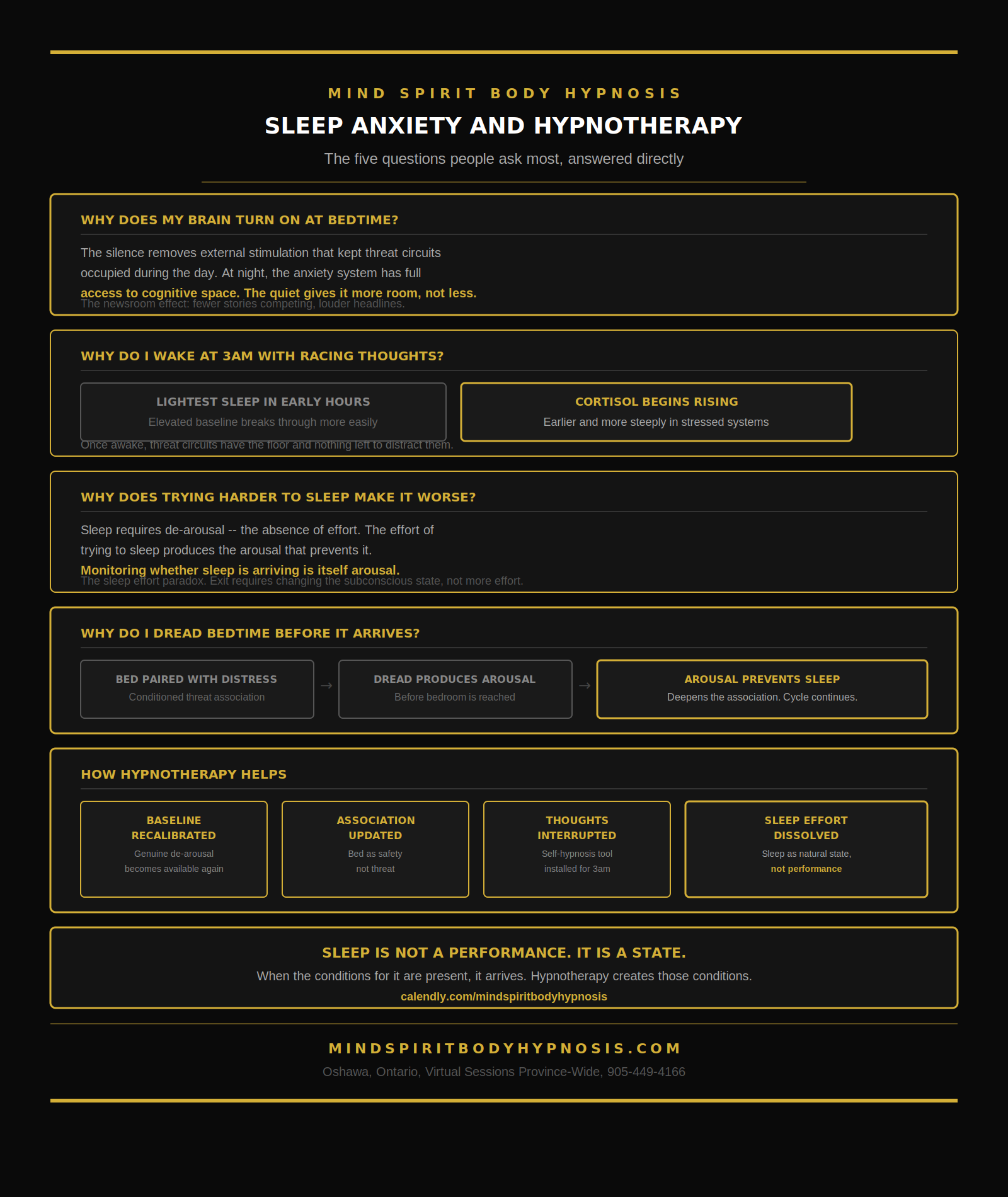
Because the silence and the absence of external demand give the nervous system's threat-detection circuits more capacity, not less.
During the day, the brain is occupied. Tasks, conversations, decisions, sensory input all of these compete for cognitive resources and dilute the internal narrative. The anxiety is present during the day too, but it has competition. The background monitoring, the low-level worry, the unprocessed emotional material all of it is there, but the day's demands keep it from fully surfacing.
At night, the day ends. The tasks stop. The external noise quiets. And the internal noise, which has been running underneath everything all day, now has the floor.
This is sometimes called the newsroom effect: during the day the newsroom is full, and any single story is one of many. At night the newsroom empties, and the editor, the amygdala, the threat-monitoring circuits, the planning and review functions of the prefrontal cortex keep running their stories without competition. The worries that were present but manageable during the day become, in the silence, the only thing in the room.
This is compounded by the body's position. Lying still with eyes closed removes the vestibular and visual input that otherwise anchors the nervous system in the present moment. The mind, deprived of its normal sensory anchoring, turns inward. In a calm nervous system, this produces sleep. In an anxious one, it produces rumination.
The subconscious then does what it always does with the material that surfaces: it tries to resolve it. It runs through scenarios, anticipates consequences, rehearses responses. This is the problem-solving function of the default mode network, and it is genuinely useful during waking hours. At bedtime, it is a generator of wakefulness rather than resolution.
Research confirms that anxiety-related hyperarousal, the elevation of the nervous system's baseline activation level, is the primary mechanism underlying sleep-onset difficulties, and that this hyperarousal is maintained by subconscious threat associations rather than by conscious thought alone (Harvey, 2002).
⭐ Pro Tip: One of the most effective short-term strategies for the brain-turning-on phenomenon is deliberate cognitive engagement with something sufficiently interesting to occupy the narrative-generating circuits without being stimulating enough to increase arousal. Not television, not a phone, not work material something that occupies without activating. A repetitive mental task, a slow review of a familiar and pleasant scene, or a structured breathing practice that gives the planning circuits a job that is not threat-related. The goal is not to stop the thoughts but to give the threat circuits something else to do. This is also one of the tools I install in session as a self-hypnosis technique.
Why Do I Wake Up at 3 am With Racing Thoughts?
The 3 am waking is one of the most universally reported features of anxiety-driven sleep disruption, and it has a specific physiological explanation.
Human sleep occurs in cycles of roughly 90 minutes, moving through lighter and deeper stages. In the first half of the night, sleep is dominated by slow-wave deep sleep, the most physically restorative stage. In the second half, sleep becomes lighter, and REM sleep predominates. By the early hours of the morning, typically between 3 am and 5 am, sleep is at its lightest and transitions between cycles are most frequent.
This means that the 3 am waking is not random. It occurs at a point in the sleep architecture where arousal is physiologically most likely. For a nervous system running at a baseline of heightened activation, the thin membrane between sleep and waking at this point becomes easier to break through.
There is also a cortisol dimension. Cortisol, the primary stress hormone, follows a natural circadian rhythm, beginning to rise in the early morning hours in preparation for waking. In people with chronic stress or anxiety, this cortisol rise can begin earlier and rise more steeply, contributing to the early-morning arousal that characterizes the 3 am waking pattern.
Once awake at 3 am, the conditions are uniquely hostile to returning to sleep. The house is dark and quiet. There is nothing external to engage with. The threat circuits, having surfaced the person from sleep, now have complete access to the available cognitive space. The rumination that follows the review of yesterday's events, the anticipation of tomorrow's demands, the calculations about how much sleep remains if sleep returns right now, is the default mode network doing exactly what it does in the absence of external engagement, but in conditions of physiological arousal that make returning to sleep increasingly difficult.
For more on how the chronic nervous system activation that drives this pattern is addressed through hypnotherapy, the hypnotherapy for sleep and insomnia pillar page covers the full approach.
⭐ Pro Tip: The worst response to the 3 am waking is clock-watching. Each glance at the clock produces a calculation (I have X hours left if I fall asleep right now), which is a cognitive and emotional activation event exactly the opposite of the conditions required for returning to sleep. One of the simplest practical changes that consistently improves the 3 am waking pattern is removing the clock from sight entirely. The time does not change what you need to do (return to sleep), and knowing the time adds only the anxiety of the calculation. What changes the 3 am pattern durably is changing the subconscious baseline that makes the waking so frequent and the return to sleep so difficult.
Why Does Trying Harder to Sleep Make It Worse?
Because sleep is not a performance. It is a physiological state that requires the absence of effort, and the effort of trying to sleep produces the very arousal that prevents it.
This is sometimes called the sleep effort paradox, and it is one of the most frustrating features of sleep anxiety. The person who is anxious about not sleeping is, by definition, monitoring whether sleep is arriving. Monitoring is a form of arousal. Arousal prevents sleep. The monitoring therefore prevents the very thing it is monitoring for.
Sleep requires what researchers call de-arousal: a genuine lowering of the nervous system's activation level to the threshold at which sleep can occur. This de-arousal happens automatically in a nervous system that feels safe and is not preoccupied with monitoring its own state. It cannot be forced. The instruction to relax is itself a task, and completing a task requires a level of engagement that is incompatible with the de-arousal required for sleep.
This is why the standard advice for sleep try to relax, practise good sleep hygiene, avoid screens before bed, keep a consistent schedule produces partial and often temporary results for people with genuine sleep anxiety. These interventions address the surface conditions of sleep without changing the subconscious threat association that is maintaining the hyperarousal. The nervous system continues to treat bedtime as a monitoring situation. The effort of applying the sleep hygiene recommendations becomes its own source of monitoring pressure.
The exit from the sleep effort paradox is not found through more effortful relaxation techniques. It is found through changing the subconscious state that makes effort feel necessary in the first place.
For more on how the anxiety system that drives the hyperarousal is addressed alongside the sleep work, the hypnotherapy for anxiety and stress pillar page covers the nervous system foundations.
Why Do I Start Dreading Bedtime Before It Even Arrives?
Because the nervous system has learned, through repeated experience of lying in bed unable to sleep, to associate bed and bedtime with threat.
This is a conditioned response in the classical sense. The bed and the bedtime routine have been repeatedly paired with the experience of distress: the watching of the clock, the racing thoughts, the frustration of wakefulness, the dread of another bad night. The nervous system, which learns through experience, has updated its threat map: bed = potential distress.
Once this association is established, the nervous system begins to activate the stress response in anticipation of the perceived threat before the bedroom is reached, sometimes hours before bedtime. The person notices anxiety rising in the evening. A tightening, a restlessness, a low-level dread that is difficult to name but unmistakably present. The body is preparing for the anticipated threat of another sleepless night.
This anticipatory anxiety is the same mechanism that produces any conditioned fear response: the person who dreads a social situation begins to feel anxious before they leave the house, not at the moment of arrival. The nervous system is not responding to what is happening now. It is responding to what its associations tell it is about to happen.
The consequence is that the sleep difficulty becomes self-perpetuating. The dread produces arousal. The arousal makes sleep harder. The harder sleep is, the stronger the dread. The conditioned association deepens with each repetition.
Breaking this cycle requires more than changing the sleep environment or the evening routine. It requires changing the subconscious association, updating what the nervous system expects to happen when bed and bedtime are encountered.
Can Hypnotherapy Help With Sleep Anxiety?
Yes, and specifically because it works at the subconscious level where the conditioned threat association, the baseline hyperarousal, and the racing thought patterns all originate and are maintained.
Here is how I work with sleep anxiety at Mind Spirit Body Hypnosis:
Nervous system baseline recalibration. The trance state produces genuine parasympathetic activation, the physiological state that is the opposite of the hyperarousal driving the sleep difficulty. In trance, you experience a quality of physical and mental quietness that your nervous system may not have accessed in some time. Repeated across sessions, this experience begins to update the subconscious baseline, making genuine de-arousal more available when it is needed.
Conditioned association updating. The specific associations between bed, bedtime, and threat are directly addressed in trance. The subconscious is walked through the bedtime sequence with the new physiological state calm, safe, unhurried replacing the conditioned threat response at each point. New associations are installed: bed as a place of safety and rest, bedtime as a transition to genuine restoration rather than a monitoring situation.
Racing thought pattern interruption. The specific patterns of thought that activate at night the review loops, the anticipatory worry, the problem-solving that cannot solve anything are addressed directly. The subconscious is provided with an alternative default for the night-time mental state: not forced blankness, which is another form of monitoring, but a gentle, engaging mental activity that occupies the threat circuits without producing arousal. This is installed as self-hypnosis that you can use in the moment.
Sleep effort reduction. The subconscious belief that sleep must be pursued, monitored, and achieved is directly changed. The updated operating assumption that sleep is a natural state that arrives when the conditions for it are present, not a performance to be evaluated, is installed in trance and future-paced into the specific bedtime sequence.
In my practice, sleep anxiety work typically runs between two and four sessions, depending on the depth of the conditioned associations and the presence of any underlying anxiety or stress driving the hyperarousal. All sessions are delivered virtually and are available to clients aged 10 and older across Ontario. More about my approach is available on the about page.
What My Clients Say
"I began seeing Fanis after a long battle with trauma and grief. I suffered from severe anxiety, panic attacks, insomnia and self harm. After 3 months of weekly hypnotherapy sessions done online, I no longer suffer from panic attacks, insomnia, or self harm and have learned how to better regulate my emotions and find peace. Fanis helped me process many childhood traumas and confront my overwhelming grief. I am eternally grateful to Fanis and his wonderful work."
Sara V. | Trauma and Grief | Five Stars
"I cannot say enough about how amazing Fanis is! He has truly changed my life. I was always an anxious person and always overthinking everything. After seeing Fanis I feel like a completely different person. The anxiety is gone and my mind is actually quiet for the first time in my life. I am forever grateful."
Amanda B. | Anxiety and Overthinking | Five Stars
FAQ
Why does my brain turn on at bedtime? Because the silence removes the external stimulation that keeps threat circuits occupied during the day. At night, with fewer distractions, the anxiety system has full access to cognitive space and runs its monitoring and problem-solving functions without competition. The quiet that should enable sleep gives the anxious nervous system room to be louder.
Why do I wake at 3 am? Because sleep is lightest in the second half of the night and transitions between cycles are most frequent. A nervous system running at elevated baseline activation breaks through this thin membrane more easily. Cortisol also begins rising in the early hours, and in chronically stressed nervous systems this rise begins earlier and more steeply.
Why does trying harder to sleep make it worse? Because sleep requires de-arousal, the absence of effort, and the effort of trying to sleep produces the very arousal that prevents it. Monitoring whether sleep is approaching is itself a form of arousal. The sleep effort paradox cannot be exited through more effortful relaxation. It requires changing the subconscious state that makes effort feel necessary.
Why do I dread bedtime before it arrives? Because through repeated experiences of distress at bedtime, the nervous system has learned to associate bed and the evening routine with anticipated threat. The stress response begins before bedtime arrives, in anticipation. This conditioned association deepens with each repetition and requires direct subconscious updating to change.
Can hypnotherapy help with sleep anxiety? Yes. I work directly with the conditioned threat association, the nervous system baseline, the racing thought patterns, and the sleep-effort belief at the subconscious level, where they are all maintained.
How many sessions will I need? In my practice, sleep anxiety work typically runs two to four sessions. An honest estimate for your specific situation is always given in the free strategy session.
Will this also help with the underlying anxiety driving the sleep problems? Yes. The sleep anxiety and the anxiety system that maintains it are addressed together. Most clients notice broader anxiety reduction alongside the sleep improvements.
Can I do sessions virtually from anywhere in Ontario? Yes. All sessions are delivered virtually, province-wide, with no referral required.
How do I get started? Book a free 30-minute virtual strategy session at calendly.com/mindspiritbodyhypnosis. No referral needed.
Ready to Take the Next Step?
If bedtime has become something you approach with dread rather than ease, this is a nervous system pattern. And nervous system patterns can change.
I offer a free 30-minute virtual strategy session for new clients across Ontario. No pressure. Just an honest conversation about how long this has been happening and what genuinely restful sleep might look like for you.
Book your free session: calendly.com/mindspiritbodyhypnosis
Call or text: 905-449-4166
Email: info@mindspiritbodyhypnosis.com
Visit: mindspiritbodyhypnosis.com
Serving clients virtually across Ontario, including Durham Region, Toronto, Canada, and beyond.
Disclaimer: This article is for informational purposes only and does not constitute medical or psychological advice. Hypnotherapy and NLP are complementary approaches for self-improvement and stress management and are not a substitute for medical assessment or treatment. If sleep difficulties are significantly affecting your daily functioning, please also speak with your doctor. Results vary by individual.
Written by Fanis Makrigiannis | Certified Hypnotherapist and NLP Master Practitioner | Mind Spirit Body Hypnosis.