Can hypnotherapy help with grief and loss
Hypnotherapy for Grief and Loss in Ontario: Your Questions Answered
TL;DR: Grief that feels stuck is not grief that has gone wrong. It is grief that has not yet found a way through, often because the loss is stored in the subconscious in a way that keeps it raw and present-tense rather than allowing it to be integrated as something that happened in the past. Hypnotherapy helps not by erasing the loss or shortcutting the grief, but by addressing the subconscious loops that keep grief circling without moving. At Mind Spirit Body Hypnosis in Oshawa, Ontario, the five questions people ask most about grief and hypnotherapy are answered here, directly.
Quick Answer
Grief is the natural response to loss, and there is no timeline for it, no correct way to do it, and no point at which it should be over. What hypnotherapy addresses is not grief itself, but the pattern of grief that has become stuck: the emotional loops that cycle without resolving, the nervous system that cannot find its way back to a functional baseline, the identity disruption that follows significant loss and leaves the person unsure of who they are without the person, role, or future they have lost. Grief hypnotherapy does not erase the memory of what was lost. It helps the subconscious release what it is holding in ways that allow the grief to move, rather than circle. I offer virtual sessions province-wide for clients of all ages at Mind Spirit Body Hypnosis in Oshawa, Ontario.
Questions This Article Answers
Why does grief feel like it is stuck and will not move?
Is it normal to still feel grief years later?
Why does grief come in waves out of nowhere?
What does hypnotherapy actually do for grief?
Can grief be healed, or do you just learn to live with it?
In This Article:
Before anything else, it is worth saying clearly: grief is not a problem to be fixed. It is the other side of love. The depth of grief is proportionate to the depth of what was valued and lost, and that is not a malfunction. It is one of the most essentially human experiences.
What hypnotherapy addresses is not grief that is present and moving through its natural process. It is grief that has become stuck that is circling without progressing, that is keeping the nervous system in a chronic state of loss-related activation, and interfering significantly with daily life not because the loss is recent, but because something in the subconscious has not been able to let the grief move.
The distinction matters because grief hypnotherapy is not about arriving at a point where the loss no longer matters or is no longer felt. It is about allowing what was held rigid and unmoving to become fluid again so that the loss can be carried differently, with less raw immediacy, and with more room for the rest of life alongside it.
Why Does Grief Feel Like It Is Stuck?
Because the subconscious has filed the loss as unresolved, as an open event rather than a closed one and keeps returning to it in the same way it returns to any unfinished business.
When a loss occurs, particularly a sudden, traumatic, or deeply significant one, the subconscious sometimes cannot complete the process of integrating it. The loss is too large, too sudden, or too threatening to the person's identity and sense of safety for the subconscious to process and file it as something that has happened and is now in the past.
Instead, it keeps the loss active. The emotional response stays raw. The memory stays present-tense rather than past-tense. The person finds themselves not grieving a loss that happened, but experiencing the loss as if it is still happening, as if the nervous system has not received the message that the acute phase is over.
This produces the characteristic experience of stuck grief: the feeling that no matter how much time passes, the loss does not feel further away. The emotional response does not soften with time the way it is supposed to. The grief circles without moving, returning to the same feelings, the same memories, the same questions, without the sense of progression that would indicate integration is occurring.
Stuck grief is not a character weakness or an inability to cope. It is a subconscious filing problem. The loss has not been able to move from the active, unresolved category to the integrated, held-in-the-past category. And the subconscious will continue to keep it active until it receives what it needs to complete the integration.
Research confirms that between 10 and 15 percent of bereaved individuals develop what is sometimes called prolonged grief, a pattern in which the grief does not follow the expected trajectory of gradual easing over time, and in which the subconscious remains stuck in the acute loss response significantly beyond what the individual or their support network would consider reasonable (Prigerson et al., 2009).
⭐ Pro Tip: One of the most reliable indicators that grief has become stuck rather than simply present is what happens when you try to think about the person, role, or future that was lost. In grief that is moving, thinking about the loss produces a range of emotional responses: sadness, warmth for the memory, sometimes both simultaneously. In stuck grief, the same thought produces the same acute emotional response every time, without variation, without the sense that time has passed, without the warmth that begins to accompany memory as grief integrates. The sameness of the response is the indicator. Integration is happening when the emotional texture of the memory begins to vary and includes warmth alongside the loss.
Is It Normal to Still Feel Grief Years Later?
Yes, and this question deserves a careful answer because the word "normal" can be used in two different ways that lead to very different understandings.
It is normal to still feel the loss of someone or something significant years, decades, and even a lifetime later. Love does not have an expiry date, and neither does the sense of absence that follows the loss of someone or something that mattered deeply. A person who lost a parent twenty years ago may still feel that loss acutely on certain days, significant occasions, anniversaries, moments when the parent's presence is particularly missed. This is not stuck grief. It is the ongoing reality of having loved something that is no longer present.
What is not inevitable is for the grief to feel as raw and unintegrated years later as it did in the immediate aftermath of the loss. If the grief has not softened, has not become easier to carry, has not allowed room for the rest of life alongside it, this is worth paying attention to not because the grief is wrong or excessive, but because it may be indicating that something in the integration process has not been able to complete.
Grief is also not only about the death of a loved one. Significant losses of any kind can produce grief that gets stuck. The end of a marriage or a significant relationship. The loss of a career, an identity, or a version of the future that was expected. A health diagnosis that changes what is possible. The loss of a pregnancy. The estrangement of a family member. These losses are often less socially recognized than bereavement, which can make the grief associated with them harder to acknowledge and harder to process because the social permission to grieve has not been clearly given.
In my practice, grief work encompasses the full range of significant losses, not only bereavement, and not only the losses that others readily understand. All grief is grief. All loss deserves the same quality of attention.
For more on how the trauma dimension of sudden or significant loss is addressed through hypnotherapy, the EMDR and trauma therapy pillar page covers the clinical approach.
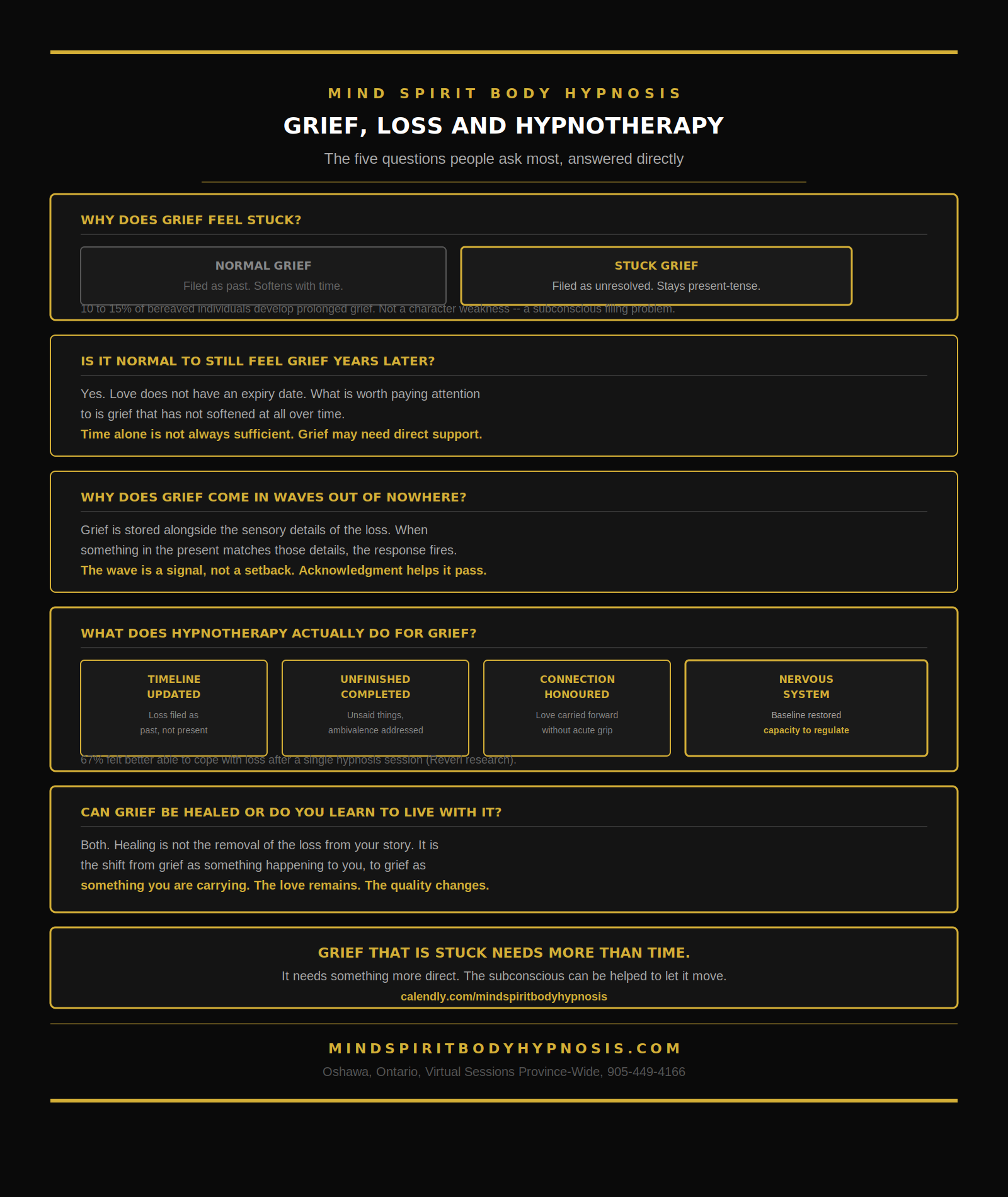
Why Does Grief Come in Waves Out of Nowhere?
Because grief is stored in the subconscious alongside the sensory and contextual details of the loss, and when something in the present matches those stored details, the emotional response fires.
This is the same mechanism that produces trauma responses in other contexts. The subconscious has stored the loss alongside its sensory texture: the time of year, certain sounds or smells, a particular quality of light, a familiar piece of music, a place, a phrase someone uses. When the present moment contains something that matches these stored details closely enough, the subconscious retrieves the associated emotional content.
The wave of grief that arrives apparently out of nowhere is rarely actually without a cause. There is almost always a match -- a trigger that the person may or may not be consciously aware of. The trigger may be subtle: a certain slant of afternoon light that belongs to the season of the loss, a phrase a stranger uses that was characteristic of the person who was lost, a smell that is associated with a particular memory.
This is why grief can be intense and unexpected even years after a loss, and why it often intensifies around anniversaries, significant occasions, and transitions even when the person thought they had reached a point of relative stability. The subconscious is not responding to the calendar. It is responding to the accumulation of contextual cues that resemble the stored experience.
Understanding this changes the relationship to the waves. They are not evidence that the grief is regressing or that something has gone wrong. They are evidence that something in the present has touched the stored loss. The wave is a signal, not a setback.
⭐ Pro Tip: When a wave of grief arrives unexpectedly, rather than trying to suppress it or to understand immediately where it came from, a more useful first response is simply to acknowledge it by saying internally, or even aloud, that something has touched the grief. This simple acknowledgment has two functions: it reduces the secondary distress of the unexpected emotional experience (the confusion and alarm at the wave's arrival), and it keeps the conscious mind from fighting the response, which reduces the overall intensity and duration of the wave. The grief needs to be felt, not managed. Acknowledgment allows the feeling without amplifying it.
What Does Hypnotherapy Actually Do for Grief?
This is the most important question to answer clearly, because there are significant misunderstandings about what grief hypnotherapy does and does not do.
Hypnotherapy does not erase the memory of what was lost. It does not remove the love that produced the grief. It does not force the person to feel better before they are ready or to arrive at acceptance before the acceptance is genuine. It does not bypass the grief or shortcut the process.
What it does is address the subconscious filing and processing dimensions of grief that prevent it from moving naturally.
It helps the subconscious distinguish between then and now. Stuck grief is often stored in a way that feels present-tense rather than past-tense. In trance, the subconscious is helped to update its understanding of the timeline to locate the loss as something that happened, rather than something that is happening. This does not reduce the significance of the loss. It changes the quality of how it is held, from raw and immediate to carried and integrated.
It completes unfinished emotional business. Grief often gets stuck when there is something unresolved something that was not said, something that could not be expressed at the time of the loss, a quality of the relationship that was complex and has left ambivalence alongside the grief. In trance, these unresolved elements can be addressed in ways that feel genuinely complete rather than forced.
It honours what was lost while releasing the grip of the acute response. The connection to what was lost does not need to end for the grief to ease. In trance, I help distinguish between the love and connection which can be carried forward and honoured and the acute loss response, which is a nervous system state that does not need to be permanent. This distinction, made at the subconscious level, allows the grief to integrate without requiring the person to feel they have let go of the person or thing they lost.
It supports the nervous system in returning to a functional baseline. Grief, particularly when prolonged, keeps the nervous system in a state of chronic activation and depleted regulation. In trance, the nervous system is helped to access a state of genuine calm, not as a bypass of the grief, but as a restoration of the capacity to regulate that chronic grief has eroded.
Research from Reveri confirms that 67 percent of individuals who engaged with a single hypnosis session for grief felt better able to cope with loss immediately after the session, a finding that reflects the direct subconscious access that hypnotherapy provides to the emotional material of grief.
For more on how the anxiety and nervous system dimensions that accompany significant grief are addressed, the hypnotherapy for anxiety and stress pillar page covers the foundational mechanisms.

Can Grief Be Healed, or Do You Just Learn to Live With It?
Both things can be true simultaneously, and the framing of the question shapes what feels possible.
"Learning to live with it" when it means learning to carry the loss in a way that allows room for the rest of life, that honours what was lost without being consumed by it, that makes space for warmth alongside the sadness this is a form of healing. Not the healing that removes the loss from the story of who you are, but the healing that allows the story to continue being written.
What hypnotherapy supports is the shift from grief as something that is happening to you to grief as something you are carrying. The loss remains. The love remains. What changes is the relationship to the loss from a state of being caught inside it to a state of being able to hold it while also holding the rest of life.
In practical terms, what people describe after grief hypnotherapy is not the absence of grief but a different quality of it. The waves still come, but they pass faster. The memory of the person or thing lost still produces emotion, but the emotion includes warmth alongside the sadness. The daily life that felt impossible to re-enter begins to feel accessible again, not because the loss has been forgotten, but because the nervous system is no longer consumed by the acute response.
This is healing that is honest about what loss means. It does not promise the removal of grief. It promises the restoration of the capacity to live alongside it.
In my practice, grief work typically runs between three and five sessions, depending on the nature of the loss, how long the grief has been stuck, and the specific dimensions of the unfinished emotional business, the identity disruption, and the nervous system activation that need to be addressed. All sessions are delivered virtually, available to clients aged 10 and older across Ontario. More about my approach is available on the about page.
What My Clients Say
"I began seeing Fanis after a long battle with trauma and grief. I suffered from severe anxiety, panic attacks, insomnia and self harm. After 3 months of weekly hypnotherapy sessions done online, I no longer suffer from panic attacks, insomnia, or self harm and have learned how to better regulate my emotions and find peace. Fanis helped me process many childhood traumas and confront my overwhelming grief. I am eternally grateful to Fanis and his wonderful work."
Sara V. | Trauma and Grief | Five Stars
"Working with Fanis has changed my life. After years of therapy for anxiety and confidence issues, I wanted to try something different. This experience has transformed me from the inside out and continues to have an effect even after our sessions. I am now able to be myself, face my fears, surround myself with those who care about me and live a fulfilling and happy life. So grateful."
Kristen W. | Anxiety and Confidence | Five Stars
FAQ
Why does grief feel stuck? Because the subconscious has filed the loss as unresolved, as an active, open event rather than something integrated into the past. It keeps returning to it the way it returns to any unfinished business, producing a grief that circles without moving rather than progressing through natural integration.
Is it normal to still feel grief years later? Yes. Love does not have an expiry date, and neither does the sense of absence. What is worth paying attention to is whether the grief has not softened at all over time, if it remains as raw and unintegrated years later as it was immediately after the loss. This may indicate that the integration process has gotten stuck and needs direct support.
Why does grief come in waves out of nowhere? Because grief is stored alongside sensory and contextual details of the loss. When something in the present matches those stored details a smell, a piece of music, a time of year the emotional response fires. The wave is not random. It is the subconscious responding to a match. It is a signal, not a setback.
Does hypnotherapy erase memories of the loss? No. Hypnotherapy does not erase the memory or the love. It helps the subconscious locate the loss as something that happened rather than something still happening, completes unfinished emotional business, and restores the nervous system's capacity to function alongside the grief.
Can hypnotherapy help with grief that is not bereavement? Yes. Grief hypnotherapy addresses the full range of significant losses: relationship endings, career loss, health diagnosis, pregnancy loss, estrangement, identity loss, and the loss of an expected future. All grief is grief, and all of it deserves the same quality of attention.
How many sessions will I need? In my practice, grief work typically runs three to five sessions, depending on the nature of the loss, how long the grief has been stuck, and the dimensions that need to be addressed. An honest estimate is always given in the free strategy session.
Can grief be healed or do you just learn to live with it? Both. Healing in grief is not the removal of the loss from your story. It is the shift from grief as something happening to you to grief as something you are carrying with room for the rest of life alongside it. The love remains. The memory remains. What changes is the quality of how they are held.
Can I do sessions virtually from anywhere in Ontario? Yes. All sessions are delivered virtually, province-wide, with no referral required.
How do I get started? Book a free 30-minute virtual strategy session at calendly.com/mindspiritbodyhypnosis. No referral needed.
Ready to Take the Next Step?
If grief has been circling without moving, if time has passed but the loss feels no further away, this is not a failure of your capacity to heal. It is an indication that the subconscious needs something more direct than time alone can provide.
I offer a free 30-minute virtual strategy session for new clients across Ontario. No pressure. No expectations. Just a conversation about what the loss has been like and whether this approach might help.
Book your free session: calendly.com/mindspiritbodyhypnosis
Call or text: 905-449-4166
Email: info@mindspiritbodyhypnosis.com
Visit: mindspiritbodyhypnosis.com
Serving clients virtually across Ontario, including Durham Region, Toronto, Canada, and beyond.
Disclaimer: This article is for informational purposes only and does not constitute medical or psychological advice. Hypnotherapy and NLP are complementary approaches for self-improvement and are not a substitute for medical or mental health assessment or treatment. If you are experiencing a grief-related mental health crisis, please contact the 988 Suicide Crisis Helpline or go to your nearest emergency room. Results vary by individual.
Written by Fanis Makrigiannis | Certified Hypnotherapist and NLP Master Practitioner | Mind Spirit Body Hypnosis.