Does Hypnotherapy work for sugar addiction?
Hypnotherapy for Sugar Addiction in Ontario: Your Questions Answered
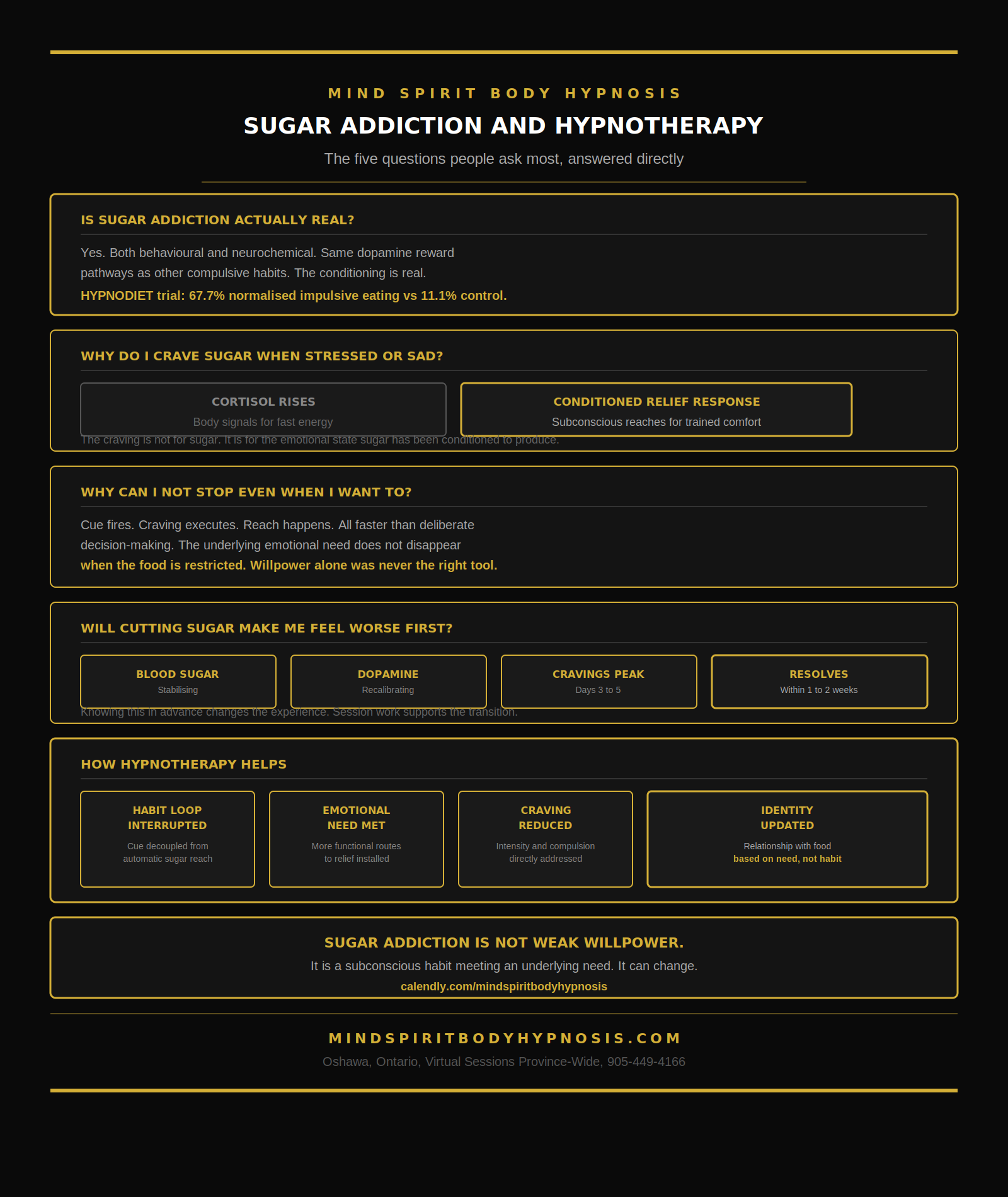
TL;DR: Sugar addiction is a real behavioural pattern driven by the same dopamine reward system that underlies other compulsive habits, and the stress and emotion that reliably trigger it mean that willpower alone is rarely sufficient to change it. A clinical trial (HYPNODIET) found that hypnosis plus self-hypnosis normalized impulsive eating in 87.7 percent of participants compared to 11.1 percent in the control group. At Mind Spirit Body Hypnosis in Oshawa, Ontario, the five questions people ask most about sugar addiction and hypnotherapy are answered here directly.
Quick Answer
Sugar addiction is a compulsive pattern of sugar-seeking behaviour driven by a dopamine-based reward loop and reinforced by emotional and stress-related triggers, not simply a lack of willpower or self-discipline. The craving is real, the compulsion is real, and the cycle of craving, consuming, brief relief, and return of craving is a subconscious habit pattern that operates below the level where conscious intention can reliably change it. Hypnotherapy addresses sugar addiction by working directly with the habit loop, the emotional triggers, and the subconscious beliefs about food, reward, and comfort that maintain the pattern. I offer virtual sessions province-wide for clients of all ages at Mind Spirit Body Hypnosis in Oshawa, Ontario.
Questions This Article Answers
Is sugar addiction actually real?
Why do I crave sugar when I am stressed or sad?
Why can I not stop eating sugar even when I want to?
Will cutting sugar make me feel worse before I feel better?
Can hypnotherapy help with sugar cravings?
In This Article:
Most people who arrive for sugar addiction work have already tried restriction. They know what they should be eating. They have read the research, tracked the macros, done the Whole30. They have had the experience of cutting sugar for a week or two and feeling genuinely better, and then the craving returns, often more intensely than before, and the cycle restarts.
The most common thing people say when this happens is some version of: I have no willpower. I know exactly what I am doing, and I cannot stop.
That second sentence is the important one. Knowing what you are doing is a conscious function. The craving and the compulsive reach that follows it are subconscious functions. The gap between what you consciously know and what you automatically do is not a willpower gap. It is a gap between the levels of the mind, and it requires a different kind of intervention to close.
Is Sugar Addiction Actually Real?
Yes, and the research on this has become considerably clearer in the past decade.
Sugar addiction is both behavioural and neurochemical. Behaviourally, it follows the same pattern as other compulsive habits: craving, consuming, brief relief, return of craving, and escalating amounts needed over time to produce the same effect. Neurochemically, sugar triggers dopamine release in the brain's reward circuitry in a structurally similar way, though not identical to the response produced by addictive substances.
Animal studies have confirmed that sugar may act on dopamine and opioid systems in ways that parallel other addictive substances. In human research, brain imaging studies have shown that sugar consumption activates the same reward pathways in the nucleus accumbens, the prefrontal cortex, and the dopaminergic reward system that respond to other reward stimuli, and that these responses can become conditioned to the cues associated with sugar consumption (the packet, the texture, the time of day) even before consumption occurs.
This conditioning is important. It means that a person with an established sugar habit is not simply responding to hunger or taste preference. They are responding to a conditioned reward signal that has been reinforced through hundreds or thousands of repetitions. The subconscious has learned that sugar is a highly reliable route to a specific neurochemical state: brief comfort, reduced anxiety, increased energy, and it pursues that route automatically when the relevant cues appear.
Whether this meets the clinical threshold for "addiction" in the formal psychiatric sense is a question researchers continue to debate. For hypnotherapy work, the clinical question that matters is simpler: is the behaviour compulsive, is it driven by subconscious habit rather than conscious choice, and is it producing consequences you want to change? In practice, the answer is almost always yes to all three.
⭐ Pro Tip: The most useful self-assessment for sugar habit versus sugar addiction is not about the quantity of sugar consumed. It is about the relationship between intention and behaviour. If you regularly consume sugar past the point you decided to stop, if you feel a quality of compulsion when the craving arrives that overrides conscious decision-making, and if attempts to reduce consumption produce more anxiety or difficulty than seems proportionate, these are the markers of a subconscious habit pattern that operates below the reach of willpower. That is the pattern hypnotherapy is designed to address.
Why Do I Crave Sugar When I Am Stressed or Sad?
Because the subconscious has learned that sugar reliably relieves the specific physiological state that stress and sadness produce, and it reaches for reliable relief automatically.
When the body is under stress, cortisol rises. Cortisol suppresses insulin sensitivity and increases the body's drive for quick energy. The body under stress genuinely craves fast-burning fuel- glucose- as part of the physiological response to perceived threat. This is not imagined. It is a real metabolic signal.
But for most people with a significant sugar habit, the craving goes beyond the metabolic signal. The subconscious has also learned a behavioural association: when I feel this way, sugar makes it better. This association was formed through repeated experience: the difficult afternoon followed by the sweet thing, the emotional upset followed by the comforting food, the boredom or loneliness that reliably leads to the kitchen. Each repetition strengthens the association. Each strengthened association makes the automatic reach more powerful.
Over time, the sugar is not just responding to the metabolic signal. It is responding to the emotional state that the metabolic signal accompanies. The subconscious has recruited sugar as the primary available tool for emotional regulation in states of stress, sadness, boredom, or anxiety. The reach is not for fuel. It is for the emotional relief that fuel has been conditioned to provide.
This is why restriction alone does not address the sugar habit effectively. Removing the sugar removes the tool without addressing the emotional regulation need the tool was meeting. The subconscious finds another route to the same relief -- often another food, sometimes another behaviour, or it intensifies the reaching for the removed food until the restriction breaks.
For more on how emotional eating and the subconscious emotional regulation patterns that drive it are addressed at Mind Spirit Body Hypnosis, the hypnotherapy for habits pillar page covers the broader habit change mechanisms.
⭐ Pro Tip: One of the most informative questions to ask when a sugar craving arrives is: what am I actually feeling right now? Not what do I want to eat, but what is happening in my body and emotional state in this exact moment. Stress craving has a specific quality: urgency, a narrowing of attention, a quality of needing relief rather than needing food. Genuine hunger has a different quality -gradual, body-wide, without the urgency or emotional charge. Learning to distinguish the two is the beginning of creating a genuine choice rather than an automatic reach.
Why Can I Not Stop Eating Sugar Even When I Want To?
For the same reason that any established subconscious habit is difficult to stop through conscious intention alone: the habit operates faster than deliberate decision-making, and the underlying need it is meeting does not disappear when the behaviour is restricted.
The sugar habit has a specific neurological structure. The cue fires (stress, boredom, the familiar time of day, the sight of a specific food), the craving follows automatically, and the reach for sugar occurs before the conscious mind has time to evaluate whether this is what you want to do. This sequence cue, craving, automatic response is a conditioned reflex that the basal ganglia, the brain region managing habitual behaviour, executes independently of the prefrontal cortex, where deliberate decision-making occurs.
By the time the conscious mind registers that the craving is present and deliberates about how to respond, the emotional urgency of the craving has already peaked. Resisting at this point is experienced as depriving the nervous system of something it has learned to rely on for emotional regulation -- which is why the experience of craving feels so much more distressing than the experience of ordinary hunger, and why restriction is experienced as genuinely difficult rather than simply inconvenient.
Research published in the American Journal of Clinical Hypnosis confirms that hypnosis reduces the intensity of food cravings by working directly with the subconscious systems that generate them, bypassing the need to resist through willpower alone (Montgomery et al., 2013). A clinical trial (HYPNODIET) found that hypnosis plus self-hypnosis normalized impulsive eating in 67.7 percent of participants compared to 11.1 percent in the control group, a finding that reflects the mechanism precisely: addressing the impulsive, subconscious dimension of the habit rather than the conscious dimension where willpower operates.
For more on how the anxiety dimension of compulsive eating the craving as anxiety relief is addressed alongside the habit pattern, the hypnotherapy for anxiety and stress pillar page covers the nervous system foundations in detail.
Will Cutting Sugar Make Me Feel Worse Before I Feel Better?
Possibly, and it is worth understanding why, because the discomfort of early reduction is one of the most common reasons people abandon attempts to change the habit before the pattern has genuinely shifted.
When sugar consumption is significantly reduced, several things happen simultaneously:
Blood sugar stabilization. The nervous system that has been running on repeated glucose spikes and crashes has to adapt to a more stable blood sugar pattern. During this adaptation, energy levels may feel lower and less predictable than before. This is temporary, typically resolving within one to two weeks, but it can feel significant during the adjustment period, particularly in the first few days.
Dopamine adjustment. The reward system that has been receiving regular dopamine stimulation from sugar consumption begins to recalibrate. During this recalibration, the person may experience a quality of flatness or reduced pleasure in other activities, a muted reward response that reflects the system adjusting to a lower and more stable stimulation baseline. Again, this is temporary.
Cravings intensification before reduction. In the early days of reduction, the subconscious habit pattern, which has not yet updated its expectations, continues to generate cravings at or above normal intensity. The body is requesting the relief it has learned to expect. These cravings do not continue to escalate indefinitely. They typically peak within three to five days and then begin to reduce as the subconscious updates its expectations. But the peak period can feel like the restriction is making things worse rather than better.
Mood and irritability changes. The emotional regulation function that sugar was serving does not disappear when the sugar is removed. In the short term, the person may notice more emotional reactivity, more irritability, or more awareness of the underlying emotional states that sugar was previously managing. This is valuable information; it reveals the emotional need that the subconscious habit was meeting, and it is also genuinely uncomfortable.
Understanding these early effects before they occur changes the experience of them significantly. When a person knows that the intensity of the craving in the first three to five days is the pattern peaking before it reduces, they can relate to it differently than if they interpret it as evidence that cutting sugar is not working. In my practice, the early reduction period is supported through session work that addresses both the craving intensity and the emotional regulation need directly -- reducing the discomfort of the transition and making the initial reduction period significantly more manageable.

Can Hypnotherapy Help With Sugar Cravings?
Yes, and specifically because it addresses the dimensions of sugar addiction that restriction and willpower cannot reliably reach.
Here is how I work with sugar addiction at Mind Spirit Body Hypnosis:
Habit loop interruption. The automatic cue-craving-reach sequence is identified and directly changed in trance. The internal cue that currently triggers the craving the stress signal, the emotional state, the time-of-day association is decoupled from the automatic sugar response. A new and more functional automatic response is installed: a breath, a genuine internal check-in, something that meets the actual underlying need without the sugar.
Emotional regulation update. The emotional states that have been managed through sugar stress, sadness, boredom, anxiety are addressed directly in trance. The subconscious is provided with more functional routes to the emotional relief that sugar has been delivering. When the underlying need can be met without sugar, the compulsive reach for sugar loses its urgency.
Craving intensity reduction. Direct suggestion in trance works with the subconscious systems that generate craving intensity. Research consistently confirms that hypnosis reduces craving intensity for food and other substances, and that this reduction can persist beyond the session. The craving does not necessarily disappear immediately, but its intensity and its quality of compulsion reduce significantly.
Identity and relationship with food. The subconscious identity around food the person who needs something sweet after dinner, the person who cannot get through a stressful afternoon without a chocolate bar is addressed and updated. A new and more accurate identity is installed: someone whose relationship with food is based on genuine need rather than conditioned habit.
Future pacing. The specific situations in which the sugar habit is most reliably triggered the stressful afternoon, the evening on the couch, the social situation with available sweets are visited in trance with the new pattern already operating. These scenes are filed as expected experience, so that when they occur, the new response is what is available.
In my practice, sugar addiction work typically runs between two and four sessions, depending on the depth of the emotional regulation pattern and the range of triggering situations. All sessions are delivered virtually, available to clients aged 10 and older across Ontario. More about my approach is available on the about page.
What My Clients Say
"Fanis has done so much for me in such a short period of time helped me quit smoking, and also helped me to believe and love myself. So professional and patient like no one I have ever met. He has given me hope and strength I have been needing for a long time. I could never thank him enough. Today I believe in myself!"
Natasha C. | Quit Smoking and Confidence | Five Stars
"I cannot say enough about how amazing Fanis is! He has truly changed my life. I was always an anxious person and always overthinking everything. After seeing Fanis I feel like a completely different person. The anxiety is gone and my mind is actually quiet for the first time in my life. I am forever grateful."
Amanda B. | Anxiety and Overthinking | Five Stars
FAQ
Is sugar addiction actually real? Yes. Sugar addiction is both behavioural and neurochemical, following the same compulsive pattern as other habit-based addictions and activating the same dopamine reward pathways in the brain. Whether it meets the formal psychiatric threshold for addiction continues to be debated, but the compulsive pattern it produces is real and responds well to direct subconscious intervention.
Why do I crave sugar when stressed or sad? Because the subconscious has learned that sugar reliably relieves the specific emotional and physiological state that stress and sadness produce. This association was formed through repeated experience and has been reinforced until the reach for sugar is automatic when the relevant emotional state is present.
Why can I not stop even when I want to? Because the habit operates at the subconscious level, faster than deliberate decision-making, and the underlying emotional need it is meeting does not disappear when the behaviour is restricted. Conscious intention operates too slowly to intercept the cue-craving-reach sequence before it has already executed.
Will cutting sugar make me feel worse at first? Possibly, and temporarily. Blood sugar stabilization, dopamine recalibration, craving intensification before reduction, and increased emotional reactivity are all normal features of early sugar reduction. They typically resolve within one to two weeks. Understanding them in advance makes them significantly more manageable
Can hypnotherapy help with sugar cravings? Yes. I work at the subconscious level where the habit loop, the emotional triggers, the craving intensity, and the identity patterns all operate, decoupling the automatic reach, addressing the underlying need, reducing craving intensity, and future-pacing the new pattern into the specific situations where the old habit fired most reliably.
How many sessions will I need? In my practice, sugar addiction work typically runs two to four sessions, depending on the depth of the emotional regulation pattern and the range of triggering situations. An honest estimate is always given in the free strategy session.
Is this different from general weight loss hypnotherapy? Yes. The focus here is specifically on the compulsive sugar pattern the craving, the emotional trigger, the automatic reach- rather than on general eating behaviour or weight management. Many clients find that addressing the sugar pattern directly produces broader changes in their relationship with food as a secondary effect.
Can I do sessions virtually from anywhere in Ontario? Yes. All sessions are delivered virtually, province-wide, with no referral required.
How do I get started? Book a free 30-minute virtual strategy session at calendly.com/mindspiritbodyhypnosis. No referral needed.
Ready to Take the Next Step?
If you have already tried restriction and found that the craving always comes back, this is not a willpower problem. It is a subconscious habit pattern meeting an underlying need. And subconscious patterns, with the right intervention, can change.
I offer a free 30-minute virtual strategy session for new clients across Ontario. No pressure. Just an honest conversation about what the sugar pattern has been costing you and what a different relationship with food might feel like.
Book your free session: calendly.com/mindspiritbodyhypnosis
Call or text: 905-449-4166
Email: info@mindspiritbodyhypnosis.com
Visit: mindspiritbodyhypnosis.com
Serving clients virtually across Ontario, including Durham Region, Toronto, Ontario, and beyond.
Disclaimer: This article is for informational purposes only and does not constitute medical or psychological advice. Hypnotherapy and NLP are complementary approaches for habit change and self-improvement and are not a substitute for medical assessment or nutritional advice. If you have concerns about blood sugar regulation or metabolic health, please see your doctor. Results vary by individual.
Written by Fanis Makrigiannis | Certified Hypnotherapist and NLP Master Practitioner | Mind Spirit Body Hypnosis.