Why do I always second-guess myself?
Hypnotherapy for Self-Doubt in Ontario: Your Questions Answered
TL;DR: Chronic self-doubt is not a lack of knowledge or capability. It is a subconscious pattern that questions your judgement, second-guesses your decisions, and searches for external confirmation before allowing action, regardless of what your actual competence tells you. It operates below the level where knowing you are capable makes a difference, which is exactly why it requires a different kind of intervention. At Mind Spirit Body Hypnosis in Oshawa, Ontario, the five questions people ask most about self-doubt and hypnotherapy are answered here, directly.
Quick Answer
Chronic self-doubt is a persistent pattern of questioning your own judgement, perception, and decisions driven by subconscious beliefs about your reliability as a thinker and decider, formed from specific experiences in which your judgement was criticized, dismissed, or proven wrong in ways that left a lasting mark. It is not a rational assessment of your actual capability. It is a subconscious operating assumption that continues to run regardless of evidence, regardless of track record, and regardless of what you consciously know about your own competence. I work with self-doubt at the subconscious level at Mind Spirit Body Hypnosis in Oshawa, Ontario, in virtual sessions province-wide for clients of all ages.
Questions This Article Answers
Why do I second-guess myself even when I know I am right?
Where does chronic self-doubt come from?
Why does self-doubt get worse under pressure?
What is the difference between self-doubt and low self-esteem?
Can hypnotherapy help with chronic self-doubt?
In This Article:
There is a specific quality to chronic self-doubt that distinguishes it from ordinary uncertainty. It is not that you do not have an opinion or a judgement. You do. It arrives clearly and quickly. And then, almost immediately, another voice arrives. Are you sure? What if you are wrong? What did that look like to other people? What if there is something you are missing?
The external situation has not changed. The information available has not changed. Your actual competence has not changed. But the inner certainty has collapsed, not because the original judgement was wrong, but because the doubt system fired automatically and replaced the judgement with a question.
People with chronic self-doubt are often highly capable individuals. The doubt is not produced by a genuine lack of ability or knowledge. It is produced by a subconscious pattern that treats their own judgement as an unreliable source regardless of what that judgement actually contains.
Why Do I Second-Guess Myself Even When I Know I Am Right?
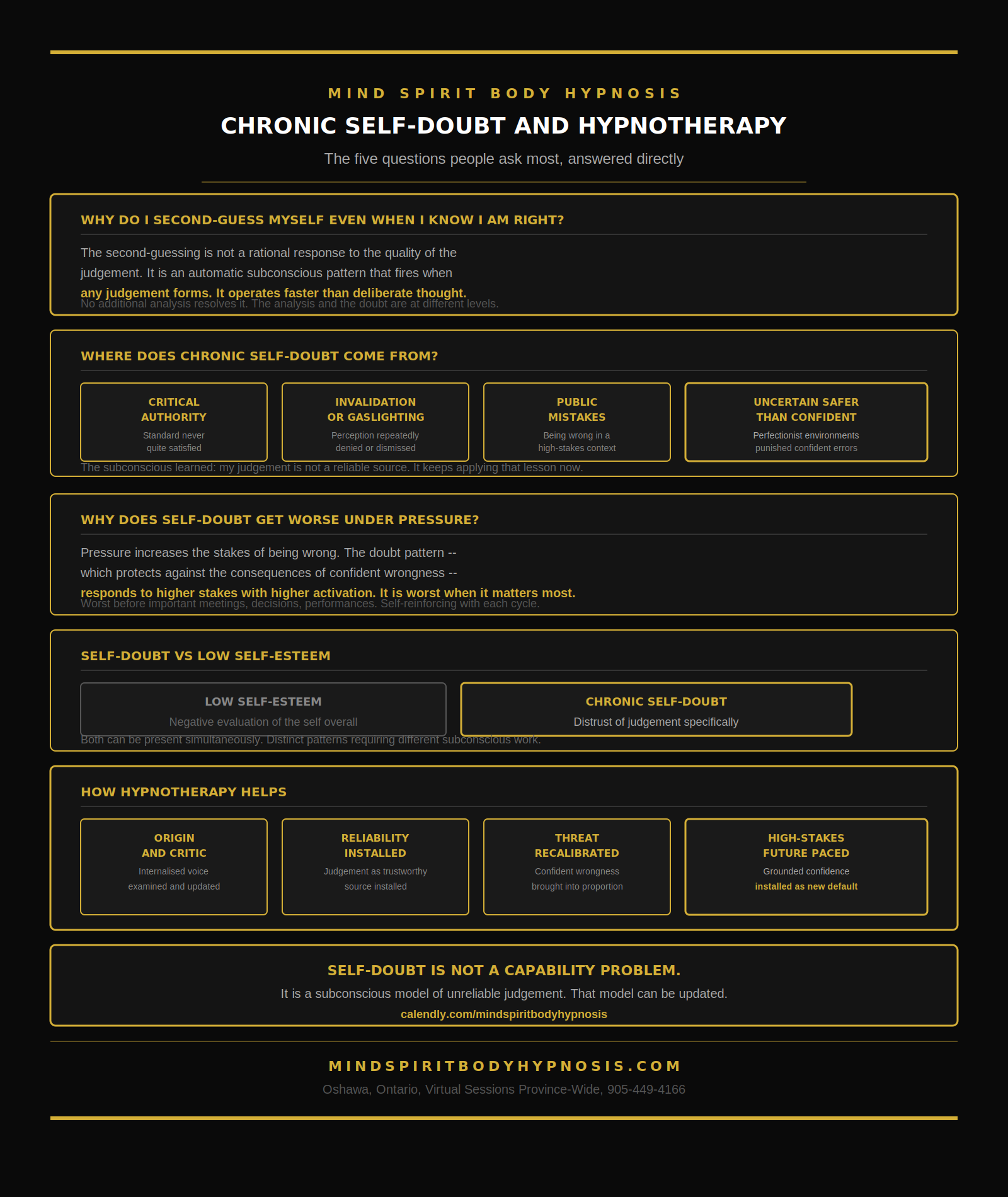
Because the second-guessing is not a rational response to the quality of your judgement. It is an automatic subconscious response to the experience of having formed a judgement, and that response fires before the rational mind has had time to evaluate whether this particular judgement is actually uncertain.
Chronic self-doubt operates as a subconscious habit. The sequence is: a situation arises, a judgement forms, the doubt pattern fires automatically. This sequence happens faster than deliberate thought. By the time the rational mind is engaged, the doubt is already present and already producing its characteristic experience: the unsettling of certainty, the search for external confirmation, the loop of reconsidering what was already decided.
The rational mind then tries to resolve the doubt using the tools it has: analysis, reconsideration, seeking reassurance. But because the doubt was not produced by a genuine uncertainty about the quality of the judgement, these tools do not resolve it. The analysis produces new material for the doubt to work with. The reconsideration does not reach a stable conclusion. The reassurance from others provides temporary relief, but the doubt returns because its source has not been addressed.
This produces one of the most demoralizing features of chronic self-doubt: the feeling that no amount of thinking resolves it. This is because the doubt is subconscious and the thinking is conscious. They are operating at different levels. The conscious effort to reach certainty does not reach the subconscious pattern that is producing uncertainty.
Research on decision confidence consistently shows that people with high chronic self-doubt often make decisions of equivalent objective quality to those with high self-confidence but take longer, experience more distress in the process, and feel less satisfied with their decisions after making them. The doubt is about the process, not the outcome.
⭐ Pro Tip: One of the most useful distinctions to practise with chronic self-doubt is the difference between content uncertainty and process uncertainty. Content uncertainty is genuine uncertainty about the facts or the situation -- there is missing information, the situation is genuinely ambiguous, the stakes are high enough to warrant careful deliberation. Process uncertainty is the self-doubt system firing regardless of the content; the certainty collapses not because the judgement is weak but because the pattern has activated. When you notice second-guessing, it is worth asking: am I uncertain about this specific situation, or am I uncertain because I always feel uncertain? The answer changes what the useful next step is.
Where Does Chronic Self-Doubt Come From?
Chronic self-doubt is always a learned pattern, and it develops from specific experiences in which the person's judgement, perception, or perspective was consistently treated as unreliable.
The most common origins in clinical practice:
Consistent overriding or dismissal of the child's perspective. Environments in which the child's judgements, preferences, opinions, and perceptions were regularly dismissed, contradicted, or overridden by adults. The message, explicit or implicit: your read on things is not to be trusted. The child internalizes this as a subconscious operating assumption and carries it forward as the automatic response to their own formed judgements.
Gaslighting or invalidation. Experiences in which the child's or adolescent's perceptions were actively denied, being told that what they clearly experienced did not happen, that they were overreacting, that their emotional response was wrong or excessive. Repeated invalidation of perception produces a deep uncertainty about the reliability of one's own inner experience. If what I felt is regularly wrong, how can I trust what I feel?
Significant public mistakes or embarrassments. Experiences of being clearly wrong in a public or high-stakes context that produced a lasting mark. The subconscious updates its threat map: being wrong in public is dangerous; therefore, err on the side of uncertainty rather than expressed confidence. The protection strategy is doubt; it feels safer to question than to commit.
Critical authority figures whose standards were impossibly high. Parents, teachers, or supervisors whose critical assessment was more consistent than their affirmation, and whose standards for correctness were so high that the child rarely felt the security of being reliably right. The internalized critic continues to apply the same impossibly high standard to every subsequent judgement.
Perfectionist environments where uncertainty was the only safe position. Contexts in which being wrong carried significant consequences and being uncertain was less costly than being confidently wrong. The doubt became a protection strategy in an environment where confident wrongness was punished more than tentative correctness.
For more on how the subconscious belief systems formed in early experience operate as self-sabotage patterns in adult life, the hypnotherapy for self-sabotage pillar page covers the foundational mechanisms.
⭐ Pro Tip: A useful way to begin understanding the specific origin of your self-doubt is to notice whose voice it sounds like when it fires. Most people, when they listen carefully to the internal critic that produces the second-guessing, can identify a specific person or type of relationship it resembles -a parent who always knew better, a teacher whose corrections were unpredictable, a partner whose emotional responses made the person feel perpetually misread. That voice is not your voice. It is an internalized model of someone else's relationship to your judgment. And that model can be updated.
Why Does Self-Doubt Get Worse Under Pressure?
Because pressure increases the stakes of being wrong, and the self-doubt system, which is fundamentally a protection system designed to prevent the consequences of confident wrongness, responds to higher stakes with higher activation.
This produces one of the most practically frustrating features of chronic self-doubt: it is worst precisely when the ability to act with confidence matters most. Before an important conversation, a high-stakes decision, a performance, a presentation. The doubt that might be a mild background noise in ordinary situations becomes acute and destabilizing in situations where the consequences of confidence feel most significant.
The mechanism is straightforward. The self-doubt pattern was established as a protection against the specific consequences of being wrong: criticism, embarrassment, loss of belonging or approval. In low-stakes situations, the perceived threat is low, and the pattern activates moderately. As stakes increase, the perceived threat increases, and the protection pattern intensifies its response. More doubt, more searching for certainty, more delay, more need for external confirmation.
This is also why self-doubt is so self-reinforcing in high-stakes situations. The doubt produces hesitation. The hesitation produces a performance that is less confident than the person's actual capability. The less confident performance produces results that the self-doubt system uses as evidence that the doubt was warranted. The next high-stakes situation arrives with a slightly stronger doubt response.
This cycle is not broken by trying harder to be confident in the moment. Confidence cannot be manufactured through effort, and the effort of trying to override the doubt often produces additional strain that reduces performance further. The cycle is broken by changing the subconscious threat assessment around confident wrongness, which is the work hypnotherapy does.
What Is the Difference Between Self-Doubt and Low Self-Esteem?
These two patterns are related and frequently co-occur, but they are distinct in their primary mechanism and the most effective approach to addressing them.
Low self-esteem is a negative evaluation of the self: a judgement that you are less capable, less worthy, less valuable than others or than some standard. It affects how you feel about yourself overall and tends to be relatively stable across contexts.
Chronic self-doubt is specifically about the reliability of your judgement, perception, and decision-making. It is not necessarily that you think you are a bad person or lack worth; it is that you do not trust yourself to read situations accurately, to make good decisions, or to be reliably right. A person can have relatively healthy self-esteem in general while experiencing intense and debilitating self-doubt in specific domains.
The distinction in practice: someone with low self-esteem thinks poorly of themselves. Someone with chronic self-doubt thinks poorly of their judgement specifically. The first is a problem of self-evaluation. The second is a problem of epistemic confidence confidence in one's own capacity to know.
Both respond well to hypnotherapy, but the work is aimed at different layers. Low self-esteem work addresses the core identity and worth beliefs. Self-doubt work addresses the specific subconscious model of one's own judgement as an unreliable source and installs a more accurate and functional relationship with the person's own inner knowing.
For more on how the self-esteem dimension of confidence work is addressed at Mind Spirit Body Hypnosis, the hypnotherapy for self-esteem pillar page covers the approach in detail.

Can Hypnotherapy Help With Chronic Self-Doubt?
Yes, and for the same reason hypnotherapy works well with all subconscious patterns: it operates directly at the level where the self-doubt is maintained, rather than at the conscious level where trying to reason with it produces limited results.
Here is how I work with chronic self-doubt at Mind Spirit Body Hypnosis:
Origin work and critic updating. The specific experiences that established the subconscious model of unreliable judgement are identified and addressed in trance. The internalized critical voice whose voice it is, what it says, and the authority it carries is examined and changed. Its ownership is clarified as borrowed rather than inherent. A more functional internal relationship with one's own judgement is installed.
Subconscious reliability installation. The operating assumption that one's own judgement is an unreliable source is directly updated. In trance, the experience of forming a judgement and trusting it, of the inner knowing settling rather than immediately being questioned, is installed as a felt sense and anchored as a new subconscious default. Not infallibility. A functional, grounded relationship with one's own perspective.
Threat assessment recalibration. The subconscious threat around confident wrongness the sense that being wrong in public or being confidently incorrect carries catastrophic consequences is addressed and brought into proportion. The updated understanding: mistakes are information, confident wrongness is survivable, the cost of chronic self-doubt is higher than the cost of occasional incorrect confidence.
High-stakes future pacing. The specific situations in which self-doubt is most activated the important meeting, the high-stakes decision, the performance context are visited in trance with the updated pattern already operating. The person experiences these situations from a place of grounded confidence rather than automatic doubt, filing the new response as the expected default.
In my practice, self-doubt work typically runs between three and five sessions, depending on the depth of the origin and the range of contexts in which the doubt pattern is most active. All sessions are delivered virtually and are available to clients aged 10 and older across Ontario. More about my approach is available on the about page.
What My Clients Say
"Working with Fanis has changed my life. After years of therapy for anxiety and confidence issues, I wanted to try something different. This experience has transformed me from the inside out and continues to have an effect even after our sessions. I am now able to be myself, face my fears, surround myself with those who care about me and live a fulfilling and happy life. So grateful."
Kristen W. | Anxiety and Confidence | Five Stars
"Fanis has done so much for me in such a short period of time helped me quit smoking, and also helped me to believe and love myself. So professional and patient like no one I have ever met. He has given me hope and strength I have been needing for a long time. I could never thank him enough. Today I believe in myself!"
Natasha C. | Quit Smoking and Confidence | Five Stars
FAQ
Why do I second-guess myself even when I know I am right? Because the second-guessing is not a rational response to the quality of your judgement. It is an automatic subconscious pattern that fires when a judgement forms regardless of what that judgement contains. It operates faster than deliberate thought, and no amount of additional analysis reaches it reliably.
Where does chronic self-doubt come from? From specific experiences in which your judgement, perception, or perspective was consistently dismissed, invalidated, or proved wrong in ways that left a lasting mark: critical authority figures, gaslighting or invalidation, significant public mistakes, perfectionist environments where uncertain was safer than confident.
Why does self-doubt get worse under pressure? Because pressure increases the stakes of being wrong, and the doubt pattern, which is a protection against the consequences of confident wrongness, responds to higher stakes with higher activation. It is worst when confident action matters most, which makes it self-reinforcing.
What is the difference between self-doubt and low self-esteem? Low self-esteem is a negative evaluation of the self overall. Chronic self-doubt is specifically about the reliability of your judgement and decision-making. Both can be present simultaneously, but they are distinct patterns that address different layers of the subconscious.
Can hypnotherapy help with chronic self-doubt? Yes. I work directly with the origin, the internalized critical voice, the subconscious model of unreliable judgement, the threat around confident wrongness, and the high-stakes triggering situations at the subconscious level where the pattern actually operates.
How many sessions will I need? In my practice, self-doubt work typically runs three to five sessions, depending on the depth of the origin and the range of contexts in which the pattern is most active. An honest estimate is always given in the free strategy session.
Is this different from confidence work? Confidence work addresses the broader sense of self-assurance. Self-doubt work specifically targets the mechanism of second-guessing the automatic questioning of one's own formed judgements and perceptions. Both are addressed at Mind Spirit Body Hypnosis; the emphasis depends on what is most prominent in your specific experience.
Can I do sessions virtually from anywhere in Ontario? Yes. All sessions are delivered virtually, province-wide, with no referral required.
How do I get started? Book a free 30-minute virtual strategy session at calendly.com/mindspiritbodyhypnosis. No referral needed.
Ready to Take the Next Step?
If you know what you think and you know it is probably right and you still cannot let it land, this is a subconscious pattern, not a knowledge problem. And subconscious patterns can change.
I offer a free 30-minute virtual strategy session for new clients across Ontario. No pressure. Just an honest conversation about what the self-doubt has been costing you and what trusting yourself might feel like.
Book your free session: calendly.com/mindspiritbodyhypnosis
Call or text: 905-449-4166
Email: info@mindspiritbodyhypnosis.com
Visit: mindspiritbodyhypnosis.com
Serving clients virtually across Ontario, including Durham Region, Toronto, Canada and beyond.
Disclaimer: This article is for informational purposes only and does not constitute medical or psychological advice. Hypnotherapy and NLP are complementary approaches for self-improvement and are not a substitute for diagnosis or treatment by a qualified healthcare provider. Results vary by individual.
Written by Fanis Makrigiannis | Certified Hypnotherapist and NLP Master Practitioner | Mind Spirit Body Hypnosis.