Can Hypnotherapy help me stop biting my nails?
Hypnotherapy for Nail Biting and Skin Picking in Ontario: Your Questions Answered
TL;DR: Nail biting and skin picking are not signs of weakness, poor hygiene, or a lack of self-control. They are body-focused repetitive habits driven by anxiety, boredom, or the need for sensory stimulation, and they operate largely automatically, below the level where conscious decision-making can reliably intervene. At Mind Spirit Body Hypnosis in Oshawa, Ontario, the five questions people ask most about these habits and hypnotherapy are answered here, directly.
Quick Answer
Nail biting and skin picking are repetitive self-grooming habits that have become automatic responses to specific internal states, most commonly anxiety, stress, boredom, or a need for sensory regulation. They feel momentarily calming or satisfying because they genuinely provide a brief physiological relief from the tension that triggered them. This relief reinforces the habit, making it increasingly automatic and increasingly resistant to willpower-based attempts to stop. Hypnotherapy addresses these habits by working directly with the subconscious automaticity, the underlying trigger states, and the need the habit is meeting at the level where the habit actually operates. I offer virtual sessions province-wide for clients of all ages at Mind Spirit Body Hypnosis in Oshawa, Ontario.
Questions This Article Answers
Why do I bite my nails or pick my skin without realizing I am doing it?
Why does it feel calming or satisfying in the moment?
Why is it so hard to stop even when I know I am doing it?
Is nail biting or skin picking related to anxiety?
Can hypnotherapy help me stop nail biting or skin picking?
In This Article:
The moment people usually notice they are doing it is after they have already been doing it for some time. They look down and realize their nails are being bitten, or their skin is being picked, and they cannot quite identify when it started. The action was already well underway before any conscious awareness arrived.
This is one of the most disorienting features of these habits and one of the most telling. The habit is not a conscious choice that got out of hand. It is an automatic behaviour that runs independently of conscious awareness, recruited by the nervous system to manage a specific internal state, and now embedded deeply enough that it executes without the thinking mind being involved at all.
Understanding this changes the conversation from why can I not just stop to what is the habit doing, and what does the nervous system need instead.
Why Do I Bite My Nails or Pick My Skin Without Realizing I Am Doing It?
Because the habit has become a subconscious automatic response, a conditioned behaviour that the nervous system executes in response to a specific internal trigger without any deliberate initiation.
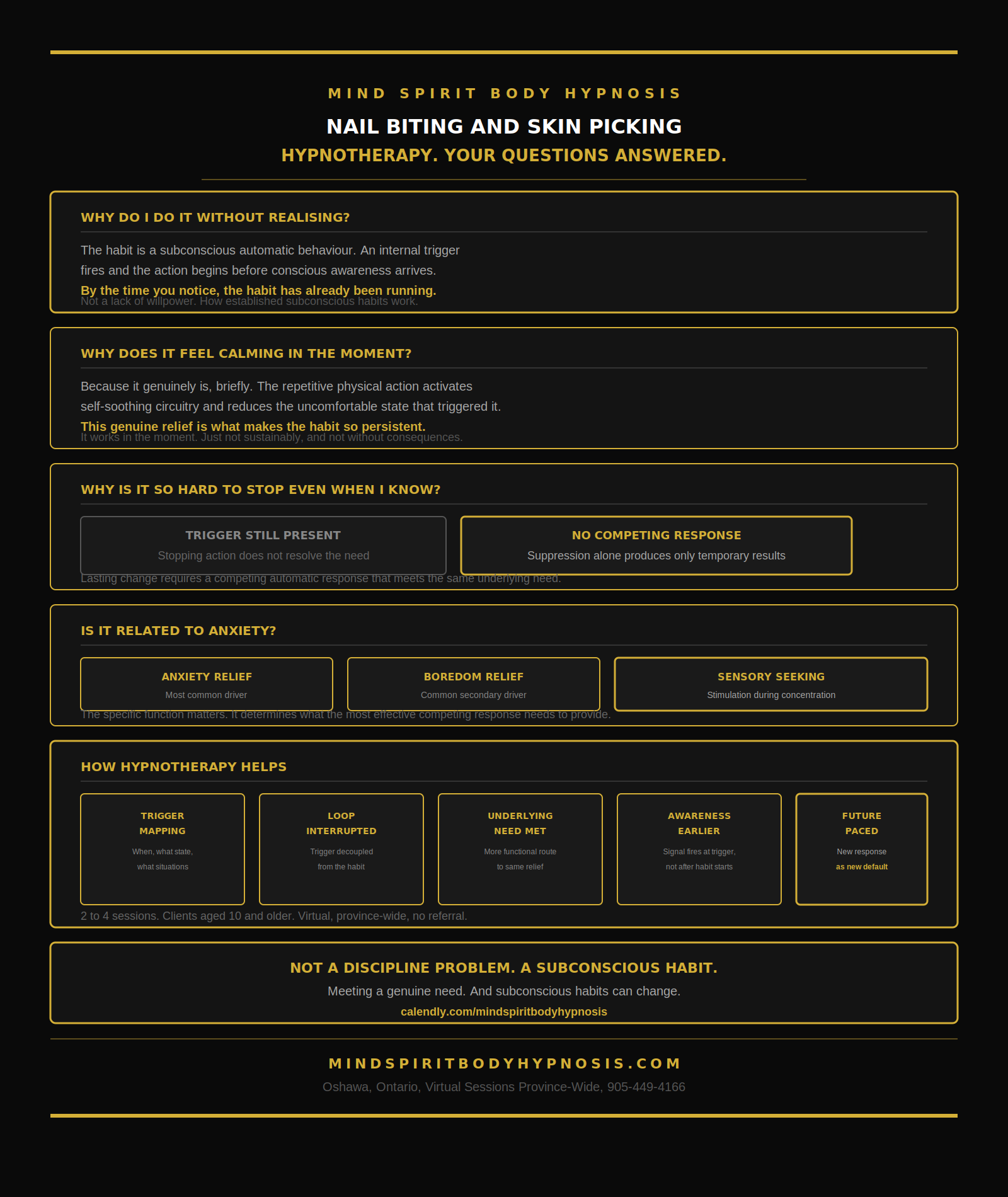
All habits follow the same basic structure: a cue triggers a routine which produces a reward. In the case of nail biting and skin picking, the cues are almost always internal states rather than external situations. The specific internal trigger might be anxiety, stress, boredom, a particular texture or imperfection noticed on the nails or skin, mental effort or concentration, or the vague restlessness that arises in the absence of sufficient stimulation.
When one of these internal states arises, the habit fires. The hands move toward the mouth or the skin. The action begins. All of this happens below the threshold of conscious awareness because the basal ganglia, the brain region responsible for habitual behaviour, executes the sequence automatically, without requiring input from the prefrontal cortex, where deliberate decision-making occurs.
By the time the conscious mind notices what is happening, the habit has already been running for some time. The awareness arrives late to a party that started without it.
This also explains why simply deciding to stop does not work reliably. The decision is made at the conscious level. The habit fires at the subconscious level. These are different systems, and the subconscious system is faster.
⭐ Pro Tip: One of the most effective ways to begin building awareness of when the habit fires is to place a gentle environmental cue at the point where the habit most commonly occurs. This is not about punishment or shame; it is about inserting a moment of noticing between the trigger and the automatic response. A coloured dot on the back of the hand, a particular ring worn specifically to catch awareness, a bracelet on the wrist. When the hand moves to the face and the cue is noticed, it creates a brief window of conscious awareness in a sequence that previously had none. This awareness is the beginning of choice, not yet the change, but the foundation for it.
Why Does It Feel Calming or Satisfying in the Moment?
Because it genuinely is, briefly, and that brief genuine relief is exactly what makes the habit so persistent.
Nail biting and skin picking serve a real physiological function. The repetitive physical action, the pressure, the texture, the focused sensory input activates the nervous system's self-soothing circuitry. The action reduces the activation level of the anxious or restless nervous system in a measurable way, providing a brief genuine reduction in the uncomfortable internal state that triggered it.
This is not imagined comfort. The relief is real. The problem is that it is brief, that it addresses the symptom rather than the cause, and that the relief reinforces the habit, teaching the nervous system that this is a reliable and effective way to manage the uncomfortable state. The more reliably the habit produces relief, the more automatically the nervous system reaches for it when the next uncomfortable state arises.
There is also a sensory dimension that is distinct from the anxiety-relief function. For some people, the habit is driven not primarily by anxiety but by sensory seeking through the tactile experience of the action itself, which provides a kind of stimulation that the nervous system finds satisfying in the moment. This is particularly common in situations of boredom, low stimulation, or high concentration, when the nervous system seeks sensory input.
Understanding which function the habit is primarily serving anxiety relief, boredom relief, or sensory stimulation is important for designing the most effective hypnotherapy approach, because the underlying need being met determines what a functional replacement needs to provide.
⭐ Pro Tip: Notice which internal state most reliably precedes the habit. Is it anxiety or stress? Does the habit increase when things are difficult, uncertain, or demanding? Is it boredom or low stimulation? Does it happen more when you are sitting still, watching something passive, or in a long meeting? Is it concentration? Does it happen specifically when you are thinking hard, reading, or doing focused work? The answer tells you what the nervous system is trying to regulate. And that is the starting point for finding a replacement that actually meets the same need.
Why Is It So Hard to Stop Even When I Know I Am Doing It?
Because knowing and stopping are different systems operating at different speeds, and because the habit is meeting a genuine need that does not disappear when the behaviour is suppressed.
When conscious awareness of the habit arrives at the moment of noticing, most people feel a combination of recognition and mild self-reproach. They stop the action. And then, minutes or sometimes seconds later, the hand has moved again, and the habit is running again before the conscious mind has had time to intervene.
This happens for two reasons.
First, the trigger that initiated the habit is still present. The anxiety, the boredom, the sensory need none of these are resolved by stopping the action. The nervous system is still experiencing the state that recruited the habit in the first place. With the habit suppressed, the uncomfortable state intensifies slightly, which increases the drive to execute the habit. Stopping is fighting directly against the momentum of a nervous system that has learned that this particular action reliably provides relief.
Second, the habit has been practised so many times that the neural pathway executing it is extremely well-established. Interrupting a well-established habit through conscious willpower requires sustained attention and effort, and the attention and effort required to do this compete directly with whatever else the person is trying to think about or do. In the moment of distraction, the habit fires again.
Research on body-focused repetitive habits consistently shows that awareness alone, without a competing response installed to replace the habit, produces only temporary suppression. The habit returns as soon as sustained attention is withdrawn. What produces lasting change is the installation of a competing automatic response a new habit that fires in response to the same cues and meets the same underlying need, without the physical consequences of the original.
For more on how anxiety as the primary driver of compulsive habits is addressed at Mind Spirit Body Hypnosis, the hypnotherapy for anxiety and stress pillar page covers the nervous system foundations.
Is Nail Biting or Skin Picking Related to Anxiety?
For most people, yes, though the relationship takes different forms in different people, and the anxiety dimension is not always the only one.
The most common relationship is the one described above: the habit functions as an automatic anxiety-relief mechanism. The nervous system, experiencing the physiological state of anxiety the elevated heart rate, the muscle tension, the restlessness, the need to discharge the activation somewhere has learned that the repetitive physical action of biting or picking reliably reduces that activation. The habit is recruited automatically whenever anxiety rises above a certain threshold.
For some people, the anxiety is more specific: the habit intensifies during particular types of stressful situations, under particular kinds of pressure, or in specific social or professional contexts. For others, it runs as a steady background habit that increases in frequency during generally elevated periods of stress without being tied to specific situations.
There is also a loop that works in the opposite direction: the consequences of the habit damaged nails, marked skin, and the visibility of the results can produce their own anxiety. Social self-consciousness about the appearance of hands or skin, embarrassment in professional or intimate contexts, and the frustration of not being able to stop. This secondary anxiety can become an additional trigger for the habit itself, creating a self-reinforcing cycle in which the habit that relieves anxiety also produces more of it.
It is worth noting that not all nail biting and skin picking is primarily anxiety-driven. For some people, boredom or the need for sensory stimulation is the primary function, with anxiety playing a secondary role. For others, the habit has a significant automatic or unconscious dimension that has largely decoupled from any obvious emotional trigger and simply runs in the background of daily life. In my practice, the first session always includes careful mapping of the specific triggers and functions for this particular person, because the approach that works best depends on understanding what the habit is actually doing.

Can Hypnotherapy Help With Nail Biting or Skin Picking?
Yes, and specifically because these habits are subconscious automatic behaviours, and hypnotherapy works directly at the subconscious level where automatic behaviours are stored, triggered, and changed.
Here is how I work with these habits at Mind Spirit Body Hypnosis:
Trigger identification and mapping. In the intake conversation before the trance work, I build a detailed map of the specific triggers for this person's habit. When does it happen? What internal state most reliably precedes it? What situations, contexts, or activities are most associated with it? This map determines where the subconscious work needs to be directed.
Habit loop interruption. The automatic cue-response sequence is identified and directly changed in trance. The internal trigger that currently initiates the habit is decoupled from the automatic response. A new, functional automatic response is installed something that fires in response to the same cue, meets the same underlying need, and is incompatible with the biting or picking action.
Underlying state addressing. The internal state the habit is managing the anxiety, the boredom, the sensory need is addressed directly. In trance, the nervous system is provided with more functional routes to the regulation it has been seeking through the habit. When the underlying state is more effectively managed, the urgency of the habit reduces.
Awareness installation. The moment of noticing, which currently arrives too late to interrupt the automatic sequence, is moved earlier in the chain. Post-hypnotic suggestion is used to install a reliable signal that fires at the point of trigger rather than after the habit has already begun. This creates the window for conscious choice that the automatic habit currently bypasses.
Future pacing. The specific situations in which the habit is most reliably triggered are visited in trance with the new pattern already operating. The experience of feeling the familiar trigger and responding differently is filed as expected experience, making the new response more available in real situations.
In my practice, nail biting and skin picking work typically runs between two and four sessions, depending on the depth of the anxiety pattern driving the habit and the range of triggering situations involved. All sessions are delivered virtually and are available to clients aged 10 and older across Ontario. More about my approach is available on the about page.
For more on how habit change mechanisms work across different presentations at Mind Spirit Body Hypnosis, the hypnotherapy for habits pillar page covers the approach in detail.
What My Clients Say
"I cannot say enough about how amazing Fanis is! He has truly changed my life. I was always an anxious person and always overthinking everything. After seeing Fanis I feel like a completely different person. The anxiety is gone and my mind is actually quiet for the first time in my life. I am forever grateful."
Amanda B. | Anxiety and Overthinking | Five Stars
"Fanis has done so much for me in such a short period of time helped me quit smoking, and also helped me to believe and love myself. So professional and patient like no one I have ever met. He has given me hope and strength I have been needing for a long time. I could never thank him enough. Today I believe in myself!"
Natasha C. | Quit Smoking and Confidence | Five Stars
FAQ
Why do I bite my nails or pick my skin without realizing it? Because the habit is a subconscious, automatic behaviour a conditioned response that fires in response to a specific internal trigger without requiring conscious initiation. The conscious mind arrives after the habit has already begun. This is not a lack of awareness. It is how established habits work.
Why does it feel calming in the moment? Because it genuinely is, briefly. The repetitive physical action activates the nervous system's self-soothing circuitry and produces a real, brief reduction in the uncomfortable internal state that triggered it. This genuine relief is what makes the habit so persistent; it works, just not in a way that is sustainable or consequence-free.
Why is it so hard to stop even when I know I am doing it? Because the trigger that initiated the habit is still present when you stop. The underlying need the anxiety, the boredom, the sensory seeking has not been addressed by stopping the action. The nervous system still needs regulation and reaches for the habit again. Stopping without a competing response produces only temporary suppression.
Is it related to anxiety? For most people, yes. The habit most commonly functions as an automatic anxiety-relief mechanism. But for some people, boredom and sensory seeking are primary drivers, with anxiety playing a secondary role. The specific function varies by person and is mapped carefully in the first session.
Can hypnotherapy help? Yes. I work at the subconscious level where the habit's automatic trigger-response sequence is maintained, decoupling the trigger from the habit, installing a competing automatic response, addressing the underlying state, moving the awareness signal earlier in the chain, and future-pacing the new pattern into specific triggering situations.
How many sessions will I need? In my practice, these habits typically resolve in two to four sessions, depending on the depth of the underlying anxiety and the range of triggering situations. An honest estimate is always given in the free strategy session.
Can children and teenagers be helped with these habits? Yes. I work with clients aged 10 and older. These habits are very common in younger people and respond well to hypnotherapy when the approach is appropriately adapted for the age and developmental stage of the person.
Can I do sessions virtually from anywhere in Ontario? Yes. All sessions are delivered virtually, province-wide, with no referral required.
How do I get started? Book a free 30-minute virtual strategy session at calendly.com/mindspiritbodyhypnosis. No referral needed.
Ready to Take the Next Step?
If you have been trying to stop through willpower and awareness alone, and the habit keeps finding its way back, the pattern is subconscious. And subconscious patterns respond to a different kind of intervention.
I offer a free 30-minute virtual strategy session for new clients across Ontario. No pressure. Just an honest conversation about what the habit has been like and what a different automatic response might feel like.
Book your free session: calendly.com/mindspiritbodyhypnosis
Call or text: 905-449-4166
Email: info@mindspiritbodyhypnosis.com
Visit: mindspiritbodyhypnosis.com
Serving clients virtually across Ontario, including Durham Region, Toronto, Ontario, and beyond.
Disclaimer: This article is for informational purposes only and does not constitute medical or psychological advice. Hypnotherapy and NLP are complementary approaches for habit change and self-improvement and are not a substitute for medical or mental health assessment or treatment. Results vary by individual.
Written by Fanis Makrigiannis | Certified Hypnotherapist and NLP Master Practitioner | Mind Spirit Body Hypnosis.