HYPNOSIS FOR I AM ENOUGH
Feeling Like You Are Not Enough? Your Questions Answered
TL;DR: The feeling of not being enough is not an accurate assessment of who you are. It is a subconscious conclusion drawn from specific experiences, usually early ones, and reinforced by everything that came after. It is not a personality trait, not a life sentence, and not something that has to be reasoned away one thought at a time. Hypnotherapy works directly with the belief that generates this feeling at the level where it lives, not the level where you already know it is wrong. At Mind Spirit Body Hypnosis in Oshawa, Ontario, this is some of the most significant work done in the practice.
Quick Answer
The feeling of not being enough is a subconscious core belief, one of the most common and most consequential beliefs that hypnotherapy addresses. It was formed from specific experiences of being criticized, overlooked, compared, shamed, or simply not seen for who you were, and it has been filtering every subsequent experience through its lens ever since. Hypnotherapy addresses it not by arguing against it but by accessing the subconscious directly and updating the belief at its root. At Mind Spirit Body Hypnosis in Oshawa, Ontario, Fanis Makrigiannis, a Certified Hypnotherapist and NLP Master Practitioner, offers virtual sessions province-wide for clients of all ages who are ready to stop carrying a conclusion that was never true.
Questions This Article Answers
Where does the feeling of not being enough come from?
Why do I feel not enough even when I achieve things?
Is feeling not enough the same as low self-esteem?
Can hypnotherapy change a belief I have held my whole life?
What does it actually feel like to finally feel enough?
In This Article:
There is a particular quality to the feeling of not being enough. It is not loud. It is not dramatic. It sits quietly underneath everything - the achievements, the relationships, the professional success, the good days. It is the reason the compliment does not land the way it should. The reason the accomplishment feels hollow almost immediately. The reason you can be surrounded by people who love you and still feel fundamentally, privately alone in your inadequacy.
The people who carry this belief most intensely are often the people who look most put-together from the outside. Because the feeling of not being enough does not produce paralysis. It produces enormous, sustained, often brilliant effort to prove, through achievement, that the belief is wrong. And the effort works, objectively. The career advances. The relationships form. The goals are reached. And the belief does not update.
This is the most important thing to understand about the not-enough belief: it is not responsive to evidence. No amount of achievement, approval, or reassurance sustainably changes it, because it is not a conscious conclusion that evidence can overturn. It is a subconscious operating assumption. And it requires a different kind of intervention.
Where Does the Feeling of Not Being Enough Come From?
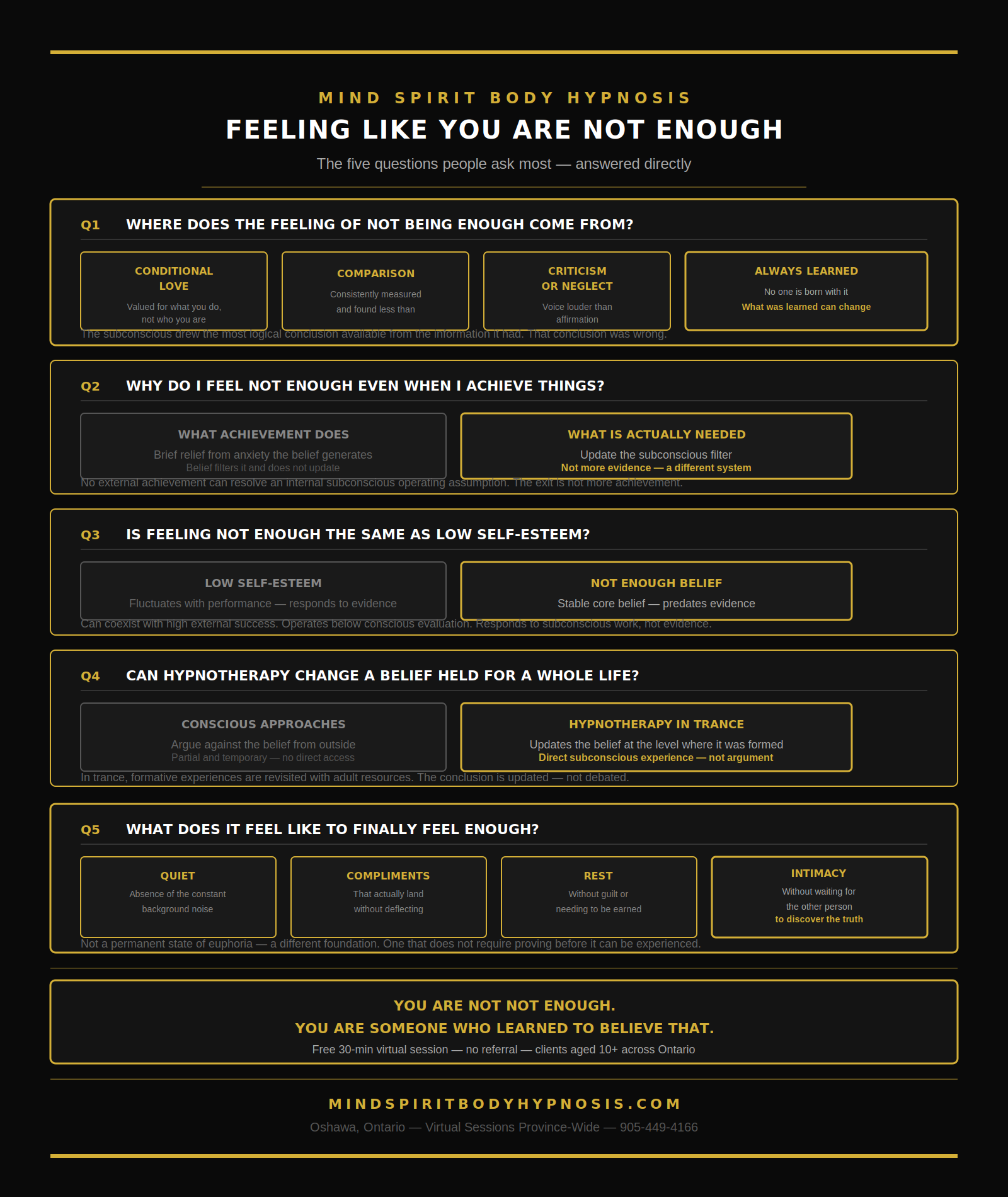
The feeling of not being enough is always learned. No one is born with it. Every child arrives with an inherent, unquestioned sense of their own value. The belief that they are not enough is produced by specific experiences that the subconscious interpreted as evidence of fundamental inadequacy.
The most common origins in clinical practice are:
Conditional love or approval. When love, affection, or approval was consistently contingent on performance - being good enough, smart enough, well-behaved enough, successful enough the subconscious concludes: I am valued for what I do, not for what I am. Without the performance, there is no value. This is one of the most deeply rooted versions of the not-enough belief because it is tied to the earliest and most fundamental human need for unconditional connection.
Comparison. Being consistently compared to a sibling, a peer, an ideal, or a standard that was never quite met. The comparison does not have to be explicitly critical to produce the belief. A parent who consistently praised a sibling's achievements without noticing the child's equally significant ones, a school environment where one type of intelligence was valued and others were not, a family system in which success was defined so narrowly that the child never fit comfortably within its definition. The subconscious conclusion is: I am less than.
Criticism that was not proportionate. A parent, teacher, or significant other whose critical voice was louder, more consistent, or more emotionally charged than their affirming voice. The subconscious remembers criticism with greater intensity than praise, partly because criticism carries threat and threat activates the nervous system more strongly. A childhood in which the critical voice was predominant produces an internal critical voice that continues the work of that parent or teacher long after they are no longer present.
Neglect or invisibility. Not being seen, not having feelings acknowledged, not mattering enough to be fully present for. Emotional neglect does not produce a belief of not being lovable in the way that explicit criticism does. It produces something quieter and often harder to identify: the sense that one simply is not significant enough to warrant full attention. The child who learns that their needs are not important enough to respond to draws the most obvious available conclusion: I am not important enough.
Trauma and shame. Specific experiences of humiliation, exposure, or shame that were witnessed by others. The subconscious files these experiences as evidence not just of a mistake or a difficult moment but of the fundamental quality of the self. The shame is not about what happened. It is about what the person concludes it reveals about who they are.
Research in developmental psychology consistently confirms that the most fundamental self-concept beliefs including the belief in one's own worth and adequacy, are established in the first seven years of life, during which the subconscious is in a highly receptive state analogous to a light hypnotic trance and absorbs the emotional and relational environment as literal fact rather than one possible interpretation (Lipton, 2005, The Biology of Belief).
⭐ Pro Tip: The clearest way to identify where your not-enough belief originated is to notice whose voice it speaks in. When the internal critic fires the quiet voice that says not good enough, not smart enough, not worthy enough, whose voice does it most closely resemble? Most people, when they listen carefully, can identify a specific person or a specific type of situation. That voice is not your voice. It is a voice you absorbed, in a context where you had no way to evaluate its accuracy. And it can be returned.
Why Do I Feel Not Enough Even When I Achieve Things?
This is the question that reveals the most important thing about the not-enough belief: it is immune to evidence.
The subconscious belief operates as a filter. Every incoming experience is processed through it. When something positive arrives - a promotion, a compliment, an achievement, an expression of love the belief does not update. Instead, it filters the positive experience through its lens. The achievement is attributed to luck, to circumstances, to the effort rather than to any inherent quality. The compliment is dismissed, suspected, or temporarily accepted and then forgotten. The love is held at a slight distance, because the belief insists that if this person really knew you, they would not feel this way.
This is the mechanism of impostor syndrome, of achievement-that-does-not-satisfy, of the relentless next goal that is always just slightly out of reach. The belief requires that achievement prove something that it cannot prove, because the belief is not about achievement. It is about the fundamental adequacy of the self. And no external achievement can address an internal belief.
What the achievement does is provide temporary relief from the anxiety the belief generates. The promotion arrives, and for a moment the voice is quieter. Then a new standard appears, and the voice resumes. The book is published and the sense of being exposed, of people eventually seeing through, intensifies. The relationship deepens and the fear that the other person will discover the inadequacy underneath grows.
This cycle is not a personality trait. It is the predictable behaviour of a subconscious filter that has not been updated. The work of hypnotherapy is not to add more achievements or more affirmations to compete with the filter. It is to change the filter.
For more on how the not-enough belief operates as a self-sabotage pattern and how hypnotherapy addresses the belief architecture underlying it, the hypnotherapy for self-sabotage pillar page covers the foundational mechanisms.
⭐ Pro Tip: If the pattern you notice is achievement followed by a very brief sense of satisfaction followed by the return of the drive toward the next goal, and the satisfaction never quite accumulates -- this is the not-enough belief running the achievement system. The belief is using achievement as the only available route to self-worth, and because no achievement can deliver permanent self-worth, the cycle continues indefinitely. The exit from this cycle is not more achievement. It is addressing the belief that made achievement necessary in the first place.
Is Feeling Not Enough the Same as Low Self-Esteem?
These two experiences are related but distinct, and understanding the distinction changes how the work is approached.
Self-esteem is typically understood as the evaluation of the self against standards of performance, achievement, or comparison. It fluctuates with circumstances. When things go well, self-esteem rises. When things go badly, it falls. People with low self-esteem tend to evaluate themselves negatively against these external standards and have difficulty maintaining a positive self-assessment when circumstances are challenging.
The feeling of not being enough is a deeper and more stable layer than self-esteem. It is a core belief about the fundamental value and adequacy of the self, not in relation to specific standards or achievements, but as a given. It does not fluctuate significantly with circumstances because it is not primarily responsive to circumstances. It predates most of the circumstances that self-esteem responds to.
This is why people with the not-enough belief can have objectively high self-esteem in some domains professional, intellectual, creative while still carrying the quiet, persistent sense that there is something fundamentally inadequate about who they are underneath the competence.
Self-esteem work often targets the conscious evaluation, building evidence of competence, challenging negative self-assessments, and developing standards that are more realistic and self-compassionate. This work is valuable. But it operates at a different level from the not-enough belief, which is subconscious and predates conscious evaluation.
Hypnotherapy addresses the not-enough belief at the level where it lives. The trance state provides access to the subconscious operating assumption, the filter through which all experience is processed and directly updates it. Not by arguing that the belief is wrong. By accessing the original experience that produced it, revisiting that experience with the resources and perspective unavailable at the time it was formed, and installing an updated subconscious conclusion: that the worth was always there, that the belief was a conclusion reached under specific limiting conditions, and that a different and more accurate conclusion is now available.
Can Hypnotherapy Change a Belief I Have Held My Whole Life?
Yes. And this is worth saying clearly, because the not-enough belief is so persistent, so immune to conscious effort, and so often resistant to years of therapy that many people have concluded it is simply who they are.
It is not who they are. It is a belief formed in specific circumstances and maintained by a subconscious filter that has never been directly addressed at the level where it operates.
Here is why hypnotherapy can change it when other approaches have not.
Most approaches to the not-enough belief operate at the conscious level. They involve understanding where the belief came from, recognizing when it is firing, challenging the thought, generating counter-evidence, and developing self-compassion practices. All of these are valuable, and all of them produce partial and temporary change. But they are addressing a subconscious operating system from the conscious mind, and the conscious mind does not have direct write access to the subconscious operating system.
Hypnotherapy provides that access. In the trance state, the critical gatekeeping function of the conscious mind relaxes, and the subconscious becomes genuinely receptive to updated information. Not as an argument to evaluate. Not as an affirmation to decide whether to believe. As direct experience, the same way that the original formative experiences were received, absorbed directly as fact rather than filtered through conscious evaluation.
In trance, the specific experiences that established the not-enough belief are visited with adult resources. The child who concluded they were not enough because a parent's attention was consistently elsewhere is revisited by the adult self, who can understand what the parent's limitations were, can see the child clearly, and can offer the acknowledgment that was unavailable at the time. The subconscious, receiving this updated experience, updates its conclusion.
This is not magical thinking. It is the deliberate application of the same process by which the belief was originally formed direct subconscious experience to install a more accurate and functional operating assumption.
In my practice, addressing the not-enough belief is among the most meaningful and most durable work done with clients. The change is not immediate in every case, and the depth of it depends on the layers involved. But the quality of change the genuinely felt sense of being enough that does not require constant maintenance is qualitatively different from anything that conscious effort alone has produced.

What Does It Actually Feel Like to Finally Feel Enough?
This question is the one people are most afraid to ask, because asking it feels like hoping for something that might not exist.
It does exist. And clients who have done this work describe it in remarkably consistent ways.
The absence of the background noise. The not-enough belief produces a constant, low-level hum of inadequacy that becomes so familiar it is mistaken for normal. When it lifts, the first thing most people notice is not the presence of something new but the absence of something they had carried so long they stopped feeling it as a weight. A quality of quiet that they had not experienced before, or had not experienced since very early childhood.
Compliments that actually land. When someone says something affirming and the response is not immediate dismissal, automatic deflection, or suspicious acceptance followed by forgetting when the words arrive and are simply received, absorbed, felt, this is one of the most reliable signs that the belief has updated. Many clients describe the first time this happens as genuinely surprising, as if something they had always considered impossible had quietly become ordinary.
Achievement that satisfies. Not every achievement, not every time. But the quality of satisfaction that follows doing something well, without the immediate pivot to the next goal, without the sense that this one does not really count, without the exposure anxiety that someone will now look more closely and find the inadequacy underneath.
Rest that does not require justification. One of the quieter but most significant changes. When worth is not contingent on productivity, rest is simply rest. Not a gap in the achievement schedule. Not something to feel guilty about. Not something that needs to be earned. This shift, for many clients, is the most profound one.
The capacity to be loved without waiting for it to end. When the belief that fundamental inadequacy will eventually be discovered is no longer present, intimacy changes in quality. The relationship that was always held at a slight distance because real closeness would eventually expose what you feared was underneath becomes genuinely available.
None of this is a permanent state of euphoria. It is not the absence of difficulty or self-doubt. It is a different foundation. One that does not require proving before it can be experienced.
More about how the combined hypnotherapy and NLP approach at Mind Spirit Body Hypnosis addresses the belief and identity dimensions of the not-enough experience is available on the about page.
How the Work Is Done at Mind Spirit Body Hypnosis
At Mind Spirit Body Hypnosis, the feeling of not being enough is understood as a core subconscious belief with specific origins, a specific filter function, and a specific pattern of expression in the client's life. It is not addressed with generic self-worth suggestions. The work is targeted, precise, and built from the specific history, specific formative experiences, and specific expression of this belief in this particular person.
The approach has several components, all woven into a coherent programme:
Origin work. In trance, the earliest identifiable experiences of the not-enough belief are accessed and revisited with adult resources. The child self who drew the inadequacy conclusion is met by the adult self who can see them clearly, acknowledge them fully, and offer the response that was unavailable at the time. This is not revisiting trauma in a retraumatizing way. It is revisiting the moment of conclusion with the perspective that was missing then.
Belief updating. The subconscious operating assumption is directly addressed. Not through argument but through guided experience in trance: the experience of being enough, unconditionally, not contingent on performance or approval, not subject to review. This experience, delivered in the receptive trance state, is received and integrated at the same level where the original belief was formed.
Voice work. The internal critical voice whose voice it sounds like, what it says, how automatically it fires is identified and systematically changed in its authority, its volume, its ownership. The voice is returned to its source, recognized as borrowed rather than inherent, and replaced with a genuinely internal voice that speaks from the updated belief.
Identity installation. A new and accurate identity is installed in trance: someone who is enough, unconditionally. Not someone trying to be enough. Someone who is. The felt sense of this identity, experienced in trance, becomes the new subconscious default rather than the aspirational conscious goal.
Future pacing. The client is walked through the specific situations in which the not-enough belief has been most active: the professional evaluation, the intimate conversation, the moment of achievement, the period of rest, experiencing each one from the updated belief. These scenes are filed as expected experience, so that when they occur in life, the new belief is what is available rather than the old one.
What to Expect at Mind Spirit Body Hypnosis
The first session is a conversation. When did you first remember the feeling? What triggers it most reliably now? What has it cost you in relationships, in the quality of achievement, in the capacity for rest, in what you have not allowed yourself? And what would be different if you no longer carried it.
This conversation is thorough because the work that follows is built from it. The not-enough belief is not addressed generically. It is addressed as it exists in this person, with these specific origins, this specific expression, and these specific consequences.
Most programmes for the not-enough belief at Mind Spirit Body Hypnosis run between four and six sessions. All sessions are delivered virtually, available to clients aged 10 and older across Ontario from the privacy of their own home.
What My Clients Say
"Working with Fanis has changed my life. After years of therapy for anxiety and confidence issues, I wanted to try something different. This experience has transformed me from the inside out and continues to have an effect even after our sessions. I am now able to be myself, face my fears, surround myself with those who care about me and live a fulfilling and happy life. So grateful."
Kristen W. | Anxiety and Confidence | Five Stars
"Fanis has done so much for me in such a short period of time -- helped me quit smoking, and also helped me to believe and love myself. So professional and patient like no one I have ever met. He has given me hope and strength I have been needing for a long time. I could never thank him enough. Today I believe in myself!"
Natasha C. | Quit Smoking and Confidence | Five Stars
FAQ
Where does the feeling of not being enough come from? From specific formative experiences: conditional love or approval, comparison, disproportionate criticism, emotional neglect, or shame that the subconscious interpreted as evidence of fundamental inadequacy. It is always learned. No one is born with it. And because it was learned, it can be changed.
Why do I feel not enough even when I achieve things? Because the not-enough belief is a subconscious filter, not a conscious conclusion. It processes positive evidence through its lens and dismisses, deflects, or temporarily accepts it without updating. Achievement provides temporary relief from the anxiety the belief generates but cannot address the belief itself. No external achievement can resolve an internal subconscious operating assumption.
Is feeling not enough the same as low self-esteem? Related but distinct. Low self-esteem fluctuates with circumstances and is primarily responsive to performance and comparison. The not-enough belief is a deeper, more stable subconscious core belief about the fundamental value of the self, predating conscious evaluation and not primarily responsive to evidence. It can coexist with high functional self-esteem in specific domains.
Can hypnotherapy change a belief I have held my whole life? Yes. Hypnotherapy provides direct access to the subconscious operating system, the level where the belief is stored and from which it operates. In trance, the original formative experiences are revisited with adult resources, the belief is updated through direct subconscious experience, and a new operating assumption is installed. This is different in kind from conscious reasoning against the belief.
What does it feel like to finally feel enough? The absence of the background noise of inadequacy. Compliments that land rather than deflect. Achievement that produces satisfaction without immediate pivot to the next goal. Rest without guilt. The capacity to be fully present in intimacy without the waiting for exposure. A quieter, more grounded way of being in the world that does not require constant maintenance.
How many sessions will I need? Most programmes for the not-enough belief at Mind Spirit Body Hypnosis run four to six sessions. The depth and complexity of the belief's origins and the number of life areas it affects determine the programme length. An honest estimate is always given in the free strategy session.
Is this different from therapy I have already done? Hypnotherapy works at the subconscious level where beliefs operate, rather than at the conscious level where they are understood. Many clients have significant conscious understanding of where the not-enough belief came from and why it is inaccurate. Hypnotherapy addresses the layer beneath the understanding: the subconscious filter that continues to operate regardless of what the conscious mind knows.
Can I do sessions virtually from anywhere in Ontario? Yes. All sessions are delivered virtually, province-wide, with no referral required.
How do I get started? Book a free 30-minute virtual strategy session at calendly.com/mindspiritbodyhypnosis. No referral needed.
Ready to Take the Next Step?
If you have spent years trying to feel enough through achievement, approval, and effort, and the feeling has not arrived as you hoped, the work that remains undone is at the subconscious level. That is where the belief lives. And that is where it can change.
I offer a free 30-minute virtual strategy session for new clients across Ontario. No pressure. Just an honest conversation about what it has cost you to carry this belief and what becoming free of it might actually look like.
Book your free session: calendly.com/mindspiritbodyhypnosis
Call or text: 905-449-4166
Email: info@mindspiritbodyhypnosis.com
Visit: mindspiritbodyhypnosis.com
Serving clients virtually across Ontario, including Durham Region, Toronto, Ontario, and beyond.
Disclaimer: This article is for informational purposes only and does not constitute medical or psychological advice. Hypnotherapy and NLP are complementary approaches and are not a substitute for diagnosis or treatment by a qualified healthcare provider. Results vary by individual.