Hypnotherapy for perfectionism anxiety
Can Hypnotherapy Help With Perfectionism and Anxiety?
TL;DR: Perfectionism and anxiety are closely linked: perfectionism keeps the nervous system running a low-level threat response almost continuously, because the standard is never quite met and the gap is always present. Hypnotherapy addresses this at the subconscious level where the impossible standard was formed, not at the conscious level where knowing the standard is unrealistic has already proven insufficient. Fanis Makrigiannis at Mind Spirit Body Hypnosis in Oshawa, Ontario, offers virtual hypnotherapy for perfectionism and anxiety across the province.
Quick Answer
Hypnotherapy for perfectionism and anxiety is a subconscious-focused approach that works directly with the belief that your value depends on meeting an impossibly high standard, reducing the chronic nervous system activation this belief produces. A Brock University study found that 2 in 5 young adults in Ontario report experiencing perfectionistic thoughts regularly (Horizon Therapy Toronto, 2026), and 2025 intake data from Wellnest Canada shows anxiety is the leading concern for 63.8% of therapy-seekers in Ontario. Fanis Makrigiannis, a Certified Hypnotherapist and NLP Master Practitioner at Mind Spirit Body Hypnosis in Oshawa, Ontario, offers virtual sessions across Ontario for clients whose perfectionism is driving chronic stress, anxiety, and the persistent feeling that nothing is ever quite enough.
Questions This Article Answers
Why does perfectionism cause anxiety even when everything is going well?
What is the difference between healthy high standards and perfectionism?
Why does knowing the standard is unrealistic not make it easier to meet?
Does perfectionism ever go away on its own, or does it need direct work?
Can hypnotherapy help reduce the anxiety that perfectionism creates?
In This Article:
There is a particular kind of exhaustion that comes with perfectionism. It is not the tiredness that follows a hard effort. It is the tiredness of a nervous system that never fully relaxes. There is always one more thing to check, one more revision to make, one more standard to meet before rest feels earned.
In my practice, clients who arrive for perfectionism and anxiety work often say the same thing: they know the standard is impossible. They know the anxiety is disproportionate. They can see the pattern clearly. And none of that knowing changes what happens the next time a piece of work lands on their desk or a social situation requires them to perform.
That gap between knowing and feeling is exactly where hypnotherapy works.
Why Does Perfectionism Cause Anxiety Even When Everything Is Going Well?
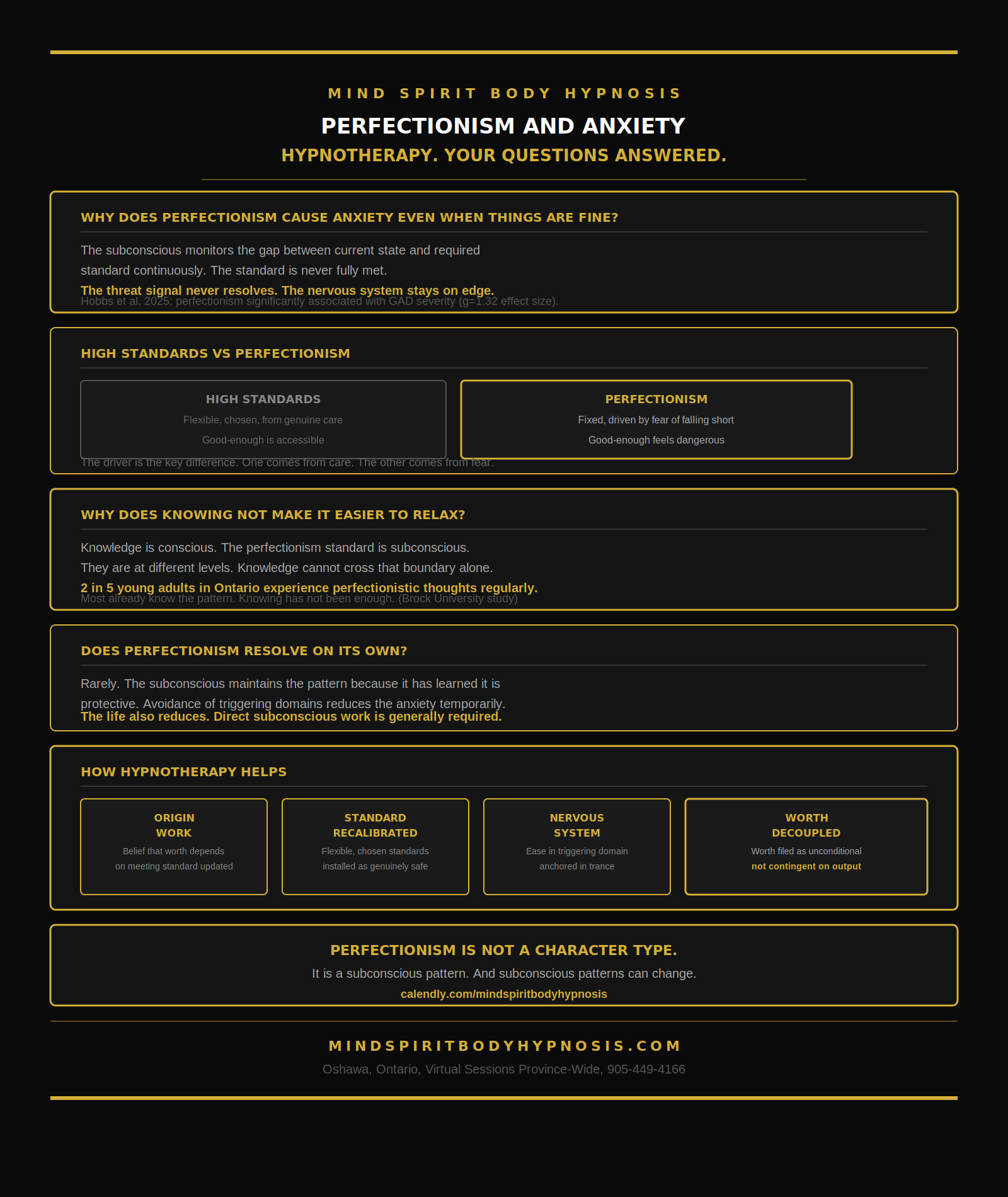
Perfectionism creates anxiety not because things are going badly, but because the subconscious is permanently monitoring for the gap between the current state and the required standard. The gap is always there, because the required standard is always slightly beyond reach. That is the defining feature of perfectionism: the standard moves.
The nervous system experiences this persistent gap as a low-level threat. Not a dramatic crisis, but a chronic low-level activation that keeps the body just slightly on edge. Heart rate slightly elevated. Muscles slightly tight. The mind running slightly faster than it needs to, checking, reviewing, anticipating. This is not a personality type. It is a physiological state that perfectionism reliably produces.
Research published in Cognitive Behaviour Therapy (Hobbs et al., 2025) found that perfectionism is significantly associated with pre-treatment severity of generalized anxiety symptoms, with Hedges' g of 1.32 for anxiety symptom reduction when treatment addressed both, one of the larger effect sizes observed in anxiety treatment research. The relationship between perfectionism and anxiety is not incidental. It is structural.
The anxiety is also self-perpetuating. The perfectionist becomes anxious about the work. The anxiety impairs performance slightly. The impaired performance falls short of the standard. The gap widens. The anxiety intensifies. The next piece of work begins with a higher baseline of activation, and the cycle tightens.
For more on how chronic anxiety operates at the nervous system level and how hypnotherapy addresses the baseline activation that drives it, the hypnotherapy for anxiety and stress in Ontario page covers the foundational mechanisms.
What Is the Difference Between Healthy High Standards and Perfectionism?
This is the question I hear most often in a first session. People want to know whether changing the perfectionism pattern will make them less careful, less diligent, less committed to quality. The short answer is no. Understanding why requires a clear distinction.
High standards are driven by genuine interest in the work. Perfectionism is driven by fear of the consequences of falling short. High standards allow for curiosity and adjustment after a mistake. Perfectionism responds with self-criticism and shame. High standards allow satisfaction after completion, even briefly. Perfectionism rarely does. The mind is already on the next gap. High standards are flexible and allow for good-enough in lower-stakes contexts. Perfectionism treats good-enough as genuinely dangerous. High standards enhance performance through clarity and focus. Perfectionism impairs it at the extremes, through paralysis and procrastination. And crucially, high standards are chosen and proportionate to context. The perfectionism standard is imposed, often formed in early experience, and applied regardless of whether the context warrants it.
The key difference is the driver. High standards that come from genuine care for the work feel different from the inside. They flex. They allow for good-enough in low-stakes contexts. They do not attach the person's worth to every outcome.
Perfectionism is different because the standard is not really about the work. It is about safety. The subconscious has learned, from specific formative experiences, that meeting the standard keeps you safe: from criticism, from rejection, from a particular kind of shame that those experiences produced. The standard is maintained not because the person consciously chooses it but because the subconscious is running a protection programme built from those early lessons.
This is why perfectionism persists even when people consciously want to relax it. The conscious mind can accept that the standard is unrealistic. The subconscious cannot accept the perceived risk of not maintaining it.
Why Does Knowing the Standard Is Unrealistic Not Make It Easier to Meet?
Because knowledge is conscious and the perfectionism standard is subconscious. They are at different levels of the mind, and knowledge at one level does not automatically update the other.
This is the most frustrating feature of perfectionism for most people. They have often spent considerable time in therapy, in reflection, or in self-examination. They can describe the pattern accurately. They know where it came from. They can identify the specific situations that trigger it most reliably. And then the next situation arrives, and the standard fires and the anxiety follows, and the knowing makes no difference at all.
The subconscious that is running the perfectionism programme is not doing so because it has not received the information that the standard is unrealistic. It is doing so because it has learned, from direct experience in formative contexts, that maintaining the standard is what keeps you safe. Information about the standard's unreasonableness does not change the threat assessment. It does not reach the level where the threat assessment is made.
A Brock University study found that 2 in 5 young adults in Ontario report experiencing perfectionistic thoughts regularly. This figure suggests the pattern is widespread and that most people experiencing it have had access to considerable knowledge about its effects without that knowledge producing lasting change.
This is precisely the leverage point for hypnotherapy. In trance, the prefrontal cortex (the seat of critical evaluation) becomes less active. The subconscious becomes more directly accessible. The threat assessment that maintains the perfectionism standard can be reached and updated directly, without the information having to pass through the evaluative layer that it bounces off in ordinary waking consciousness.
For more on how the self-sabotage patterns that accompany perfectionism, including procrastination, overworking, and holding back from high-visibility opportunities, are addressed at the subconscious level, the hypnotherapy for confidence and self-sabotage in Ontario page covers the mechanisms in detail.
Does Perfectionism Ever Go Away on Its Own?
Rarely, and usually not without significant life events that force a recalibration. Perfectionism is a pattern the subconscious maintains because it has learned that the pattern is protective. In the absence of something that updates that learning, there is no natural mechanism by which the pattern reduces.
What sometimes happens is that the costs of perfectionism become high enough that the person begins to avoid the domains where perfectionism is most active. The perfectionist who cannot tolerate the anxiety of public performance stops performing publicly. The one who cannot tolerate the risk of a piece of work being criticized stops submitting work. The anxiety reduces in the short term because the trigger has been removed. Life also reduces.
What also sometimes happens is that perfectionism shifts domains. The person who manages to relax the standard in one area (typically one where the stakes have genuinely dropped, through experience or through the domain becoming less threatening) finds that the standard has intensified in another area. The perfectionism has not reduced. It has relocated.
Direct work at the subconscious level where the standard is maintained is generally required to change the pattern rather than simply manage its effects or contain its domains.
How Does Hypnotherapy Address Perfectionism Anxiety?
The approach at Mind Spirit Body Hypnosis addresses perfectionism anxiety across four specific dimensions. As a Certified Hypnotherapist trained through the American Board of Hypnotherapy and an NLP Master Practitioner, my work with perfectionism goes well beyond relaxation. The trance state is used precisely and purposefully.
Origin work. The specific experiences that established the perfectionism standard are identified and visited in trance. The lesson the subconscious drew from those experiences- that meeting the standard keeps you safe and that falling short is dangerous- is updated. The adult understanding that the original context is no longer the current context is installed as subconscious experience, not just conscious knowledge.
Standard recalibration. The impossibly high internal benchmark is directly addressed. In trance, the subconscious is walked through what proportionate, context-sensitive standards would look and feel like, and experiences them as genuinely safe rather than threatening. This is not the installation of lowered standards. It is the installation of flexible, chosen standards.
Nervous system baseline. The chronic low-level activation that perfectionism maintains is addressed through deep trance relaxation anchored to specific future situations. The perfectionist's nervous system learns, experientially, that ease in the domain of the standard is possible without catastrophe following.
Self-worth decoupling. The subconscious link between the quality of output and the person's worth, safety, and belonging is directly addressed and updated. The most durable change in perfectionism work comes when the person's subconscious genuinely files their worth as unconditional rather than contingent. It's not because they decided it should be; the trance work updated the operating assumption at the level where it runs.
Clients I work with in Ontario who have carried perfectionism for decades often notice a meaningful shift within the first two sessions. Not a complete resolution, but a different quality in the anxiety. A loosening of the grip. A moment, in a situation that would previously have been highly activating, where the response is proportionate rather than automatic.

What to Expect in Sessions
Sessions at Mind Spirit Body Hypnosis follow a structured approach:
Session 1: Detailed intake mapping the specific shape of the perfectionism for this person. What domains. What triggers. What the standard sounds like internally. What the feared consequence of not meeting it is. This map shapes all subsequent trance work.
Sessions 2--3: Origin work and standard recalibration in trance. Direct work with the subconscious belief that worth depends on meeting the standard.
Sessions 4--5: Nervous system baseline work, self-worth decoupling, and future pacing into the specific situations where perfectionism is most active.
In my practice, perfectionism and anxiety work typically runs between three and five sessions. An honest estimate for your specific situation is always given in the free strategy session.
All sessions are virtual, available across Ontario, and open to clients aged 10 and older. No referral is required.
WHAT MY CLIENTS SAY:
“Fanis was referred to me by a family friend. I had been carrying something heavy for a long time, a trauma I had buried so deep I barely acknowledged it anymore, but that was quietly affecting everything. My sleep, my relationships, my ability to feel settled in my own skin. I was not expecting much. What happened surprised me completely. Fanis got to the core of it faster than I thought was possible, and the sessions felt nothing like the therapy I had tried years ago. Within two weeks, I noticed things shifting real shifts, not just feeling temporarily better after a good conversation. I felt past it in a way I genuinely did not think was available to me anymore. Highly recommended. If someone in your family or friends has pointed you here, listen to them.” — Abdia A.
Frequently Asked Questions
Why does perfectionism make me so anxious even when things are going fine? Because perfectionism keeps the nervous system running a chronic threat response. The subconscious is permanently monitoring the gap between the current state and the required standard. Since the standard is never quite reached, the threat signal never fully resolves. The anxiety is not about what is happening now. It is about the perpetual gap the perfectionism standard creates.
What is the difference between perfectionism and simply having high standards? High standards are flexible, chosen, and proportionate to context. They come from genuine care for the work and allow for good-enough in lower-stakes situations. Perfectionism is a fixed, non-negotiable standard driven by the subconscious belief that falling short is genuinely dangerous. The driver is the key difference: care versus fear.
Why does knowing my standard is unrealistic not help me relax it? Because knowing is conscious and the perfectionism standard is subconscious. Knowledge does not automatically cross the boundary between the two levels. The subconscious maintains the standard because it has learned it is protective, and that learning is not updated by receiving information. It is updated by direct subconscious experience, which is what hypnotherapy provides.
Is perfectionism a mental health condition? Perfectionism is a subconscious pattern that significantly affects wellbeing, anxiety levels, and daily functioning. It is not in itself a clinical diagnosis, but it is strongly associated with anxiety, depression, and burnout. Hypnotherapy addresses it as a habit and self-improvement concern, firmly within the stress management and confidence lane.
Does perfectionism ever resolve without direct work? Rarely. The subconscious maintains the perfectionism standard because it has learned the pattern is protective. Without something that directly updates that learning, there is no natural mechanism for reduction. Avoidance of triggering domains can reduce the anxiety temporarily, but it also reduces life.
How is hypnotherapy for perfectionism different from CBT? CBT works primarily at the conscious level, identifying thought patterns, challenging them, and practising new responses. This can be effective but requires sustained conscious effort and does not always reach the subconscious level where the perfectionism standard is maintained. Hypnotherapy works directly at the subconscious level, addressing the origin, the threat assessment, and the standard itself without requiring the person to consciously override the pattern each time it fires.
Will reducing perfectionism make me less capable or less driven? No. The goal is not lower standards but more flexible, genuinely chosen ones. Clients consistently report that work quality is maintained or improves after perfectionism anxiety reduces, because the anxiety itself was impairing performance at the extremes, through procrastination, overworking, and paralysis at high-stakes moments.
How many sessions will I need for perfectionism and anxiety? In my practice, this work typically runs between three and five sessions, depending on the depth of the original belief formation and the range of contexts where perfectionism is most active. An honest, specific estimate is always given in the free 30-minute strategy session.
Can children and teenagers be helped with perfectionism? Yes. I work with clients aged 10 and older. Perfectionism often develops early and is particularly common in academic and performance contexts among younger people. Working with it early, before it becomes deeply entrenched, tends to produce faster results.
Can I access sessions from anywhere in Ontario? Yes. All sessions at Mind Spirit Body Hypnosis are delivered virtually, province-wide. No referral is required, and no in-person visit is needed.
Ready to Take the Next Step?
If perfectionism has been keeping you anxious, stuck, or permanently exhausted by a standard that never quite lets you rest, I'd love to help.
I offer a free 30-minute virtual strategy session for new clients across Ontario. There's no pressure. Just a conversation about what you're going through and how hypnotherapy, NLP, or EMDR might support you.
Book your free session: calendly.com/mindspiritbodyhypnosis
Call or text: 905-449-4166
Email: mindspiritbodyhypnosis@gmail.com
Visit: mindspiritbodyhypnosis.com
Serving clients virtually across Ontario, including Durham Region, Toronto, Canada, and beyond.
Disclaimer: This article is for informational purposes only and does not constitute medical or psychological advice. Hypnotherapy, NLP, and EMDR are complementary approaches and are not a substitute for diagnosis or treatment by a qualified healthcare provider. Please consult a licensed professional if you have concerns about your mental or physical health.
Written by Fanis Makrigiannis | Certified Hypnotherapist & NLP Master Practitioner | Mind Spirit Body Hypnosis.