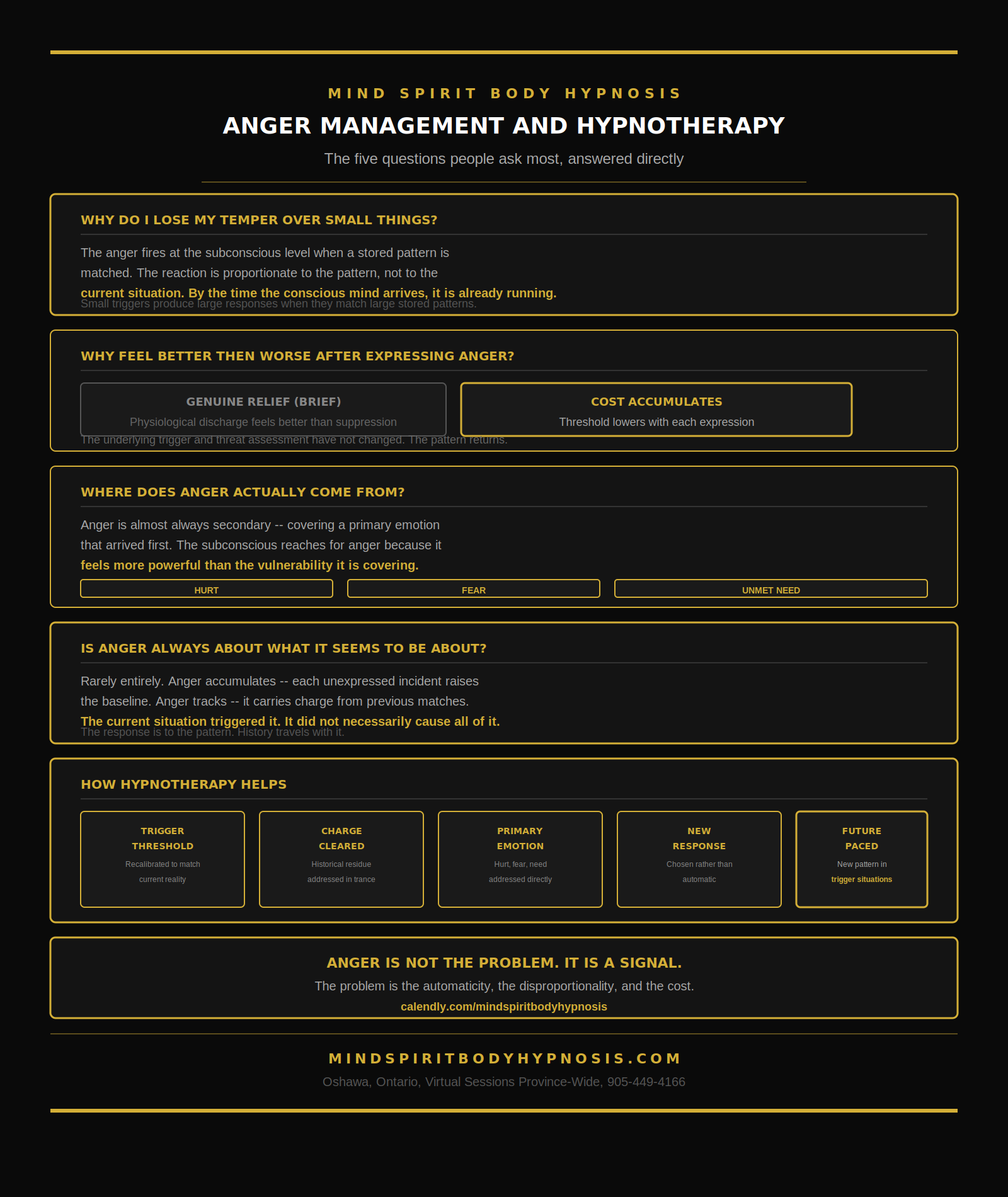
Why do I lose my temper so quickly, even over small things?
Hypnotherapy for Anger Management in Ontario: Your Questions Answered
TL;DR: Anger is not the problem. Anger is a signal one of the most honest emotional responses available. The problem is when anger arrives automatically, disproportionately, and in ways that cost the person relationships, opportunity, and their own sense of who they are. Hypnotherapy addresses anger at the subconscious level where the automatic trigger response operates, not to suppress the anger, but to change what fires it, how intensely, and what becomes available in the space where the automatic reaction used to be. At Mind Spirit Body Hypnosis in Oshawa, Ontario, the five questions people ask most about anger and hypnotherapy are answered here, directly.
Quick Answer
Anger is a natural, useful emotional response to perceived threat, injustice, or violation. The issue is not the emotion itself; it is the automaticity of the response, the disproportionality to the situation, and the secondary emotions and behaviours the anger produces. Hypnotherapy works with anger at the subconscious level where the trigger threshold is calibrated and where the underlying unmet needs that anger is covering are stored. It does not produce people who do not feel anger. It produces people who have a different relationship with it one in which they respond rather than react, and in which the anger is informative rather than automatic. I offer virtual sessions province-wide for clients of all ages at Mind Spirit Body Hypnosis in Oshawa, Ontario.
Questions This Article Answers
Why do I lose my temper so quickly even over small things?
Why do I feel better after expressing anger but worse afterwards?
Where does anger actually come from?
Is anger always about what it seems to be about?
Can hypnotherapy help with anger?
In This Article:
Most people who come for anger work are not people who are violent or out of control in the dramatic sense. They are people who know their anger is costing them something: a relationship, a professional reputation, their own sense of themselves as the person they want to be. The flash of heat that was disproportionate to the situation. The thing that came out in a moment that took days to repair. The pattern of escalating quickly in situations that, in retrospect, did not warrant that level of intensity.
And often the most distressing part is not the anger itself. It is the gap. The gap between the person they are in the moment of anger and the person they know themselves to be most of the time. The sense that something else took over something faster, hotter, and less careful than who they usually are.
That gap is real. And it has a specific explanation.
Why Do I Lose My Temper So Quickly Even Over Small Things?
Because the response is not proportionate to the current situation; it is proportionate to what the subconscious has been trained to interpret the situation as.
Anger is the nervous system's response to perceived threat, injustice, or violation. The key word is perceived. The perception happens at the subconscious level, faster than conscious assessment. When the subconscious perceives a match with a stored threat or violation pattern, the anger response fires immediately before the conscious mind has had time to evaluate whether the current situation actually warrants the level of response.
For people with a low anger threshold, the subconscious has learned to be highly sensitive to specific categories of perceived threat. Perhaps it has learned that being criticized, dismissed, interrupted, or made to wait represents a genuine threat to dignity or safety. Perhaps it has learned that certain tones of voice, certain facial expressions, or certain conversational dynamics are reliable precursors to something threatening. The pattern-matching happens in milliseconds. The anger arrives before deliberate thought can engage.
This is why the advice to just stay calm or count to ten produces limited results with established anger patterns. By the time the counting begins, the physiological anger response is already running: heart rate elevated, adrenaline circulating, the prefrontal cortex partially suppressed by the stress response. The advice is addressed to the conscious mind, and the conscious mind has arrived late.
The small things that trigger disproportionate anger are usually not really about the small things. They are about the pattern the small thing matched. The traffic that prompted the outsize reaction may have matched a stored pattern of being trapped, disrespected, or controlled. The comment that landed badly may have matched a stored pattern of being criticized or found wanting. The reaction is to the pattern, not to the current situation.
Research on anger consistently identifies that a low anger threshold is associated with elevated baseline stress, a history of environments in which anger was the primary available response to threat, and unresolved emotional material that keeps the threat-detection system in a state of heightened readiness.
⭐ Pro Tip: The most useful short-term practice for a low anger threshold is not to suppress the anger when it arrives, but to notice the specific quality of sensation that immediately precedes it. Most people, when they slow down enough to observe, find a very brief window, sometimes less than a second, between the trigger and the full anger response. A tightening in the chest. A heat in the face. A specific physical location in the body where the activation first appears. Learning to notice that pre-anger signal creates a fraction of additional space between trigger and response. That space is where the choice begins to live.
Why Do I Feel Better After Expressing Anger But Worse Afterwards?
Because expressing anger provides genuine physiological relief in the short term and reinforces the pattern in the medium term.
When anger activates the stress response, the body mobilizes for action. Adrenaline rises. Heart rate increases. Muscles prime. This is the fight-or-flight physiology, the body preparing to confront or escape a threat. Expressing the anger in speech, in volume, in physical movement provides a discharge for this physiological activation. The tension releases. The body returns toward a lower activation state. The relief is genuine.
This is why expressing anger feels so much better than suppressing it in the moment. Suppression keeps the physiological activation running without discharge. Expression discharges it. The body genuinely feels better.
The problem is twofold. First, the expression of anger in the way that provides the best short-term relief the raised voice, the sharp words, the forceful response frequently damages something in the external world: a relationship, a professional interaction, a person's sense of safety around the angry person. The relief is personal; the cost is relational.
Second, and more significantly for lasting change: the discharge of anger through expression does not address the underlying trigger that produced the anger. The situation that was perceived as threatening or violating is still there. The subconscious threat assessment has not changed. What has changed is only the physiological state. The next time a similar trigger appears, the same response will fire.
Expression-as-release also tends to lower the threshold for the next expression. The nervous system learns that this is the appropriate response to this category of trigger, and the pattern becomes more automatic with each repetition. The person may feel better immediately after an angry outburst, and find that their anger is easier to trigger in subsequent situations.
⭐ Pro Tip: The distinction between expression and discharge is worth understanding. Discharge is the release of physiological activation, and it does not require expression directed at the source of the anger to be effective. Physical movement, controlled breathing, bilateral stimulation, and deliberate physical grounding all discharge the physiological component of anger without directing the expression at a person or situation. Learning to discharge the physiology of anger through means that do not damage relationships is one of the most practically significant early changes that comes from this work.
Where Does Anger Actually Come From?
Anger is a secondary emotion. It is almost always covering something that arrived first: something more vulnerable, more uncertain, or more painful than the anger that presents over it.
The emotion that most commonly sits underneath anger is hurt. The comment that produced the sharp reply first produced a wound: a sense of being dismissed, undervalued, or not seen. The anger arrived immediately over the hurt as a form of protection. Anger is outward-facing and activating. Hurt is inward-facing and vulnerable. The subconscious that has learned that vulnerability is unsafe will frequently convert hurt to anger so quickly that the hurt itself is never consciously experienced.
Fear is the second most common primary emotion underneath anger. The situation that appears to provoke irritation or rage often first produced a moment of anxiety or threat, and the anger is the fight response to that threat, the activation that feels more powerful and more in control than the vulnerability of fear.
Unmet need is the third. The person who consistently becomes angry when plans change, when they feel unheard, or when their standards are not matched by those around them is often responding to a pattern of a specific need going unmet: for predictability, for acknowledgment, for quality. The anger is the nervous system's protest at the repeated non-fulfilment of the need.
Understanding this does not make the anger wrong. Anger is an honest emotion. But it changes the question from how do I manage my anger to what is the anger telling me? And that question leads to a much more productive place.
For more on how the anxiety and threat system that underlies anger responses is addressed through hypnotherapy, the hypnotherapy for anxiety and stress pillar page covers the nervous system mechanisms.
Is Anger Always About What It Seems to Be About?
Rarely entirely, and sometimes not at all.
The traffic that produced the disproportionate reaction. The colleague whose comment escalated into something the person spent the evening replaying. The family member whose small habit produces a reliable flash of irritation that seems wildly out of proportion to its actual significance. These are rarely purely about what they appear to be about.
Anger accumulates. Each incident of unexpressed or inadequately processed anger, each moment of frustration or violation that did not get to completion, leaves a small residue in the nervous system. Over time, this residue raises the baseline activation level and lowers the threshold at which new triggers produce a full anger response. The small thing that produces the outsized reaction is often the last straw rather than the genuine cause the trigger that finally exceeded the available holding capacity.
Anger also tracks. The anger at a colleague may be partly tracking the anger at a parent who had the same quality of dismissiveness. The anger at a partner may be partly tracking the anger at an early relationship in which the same dynamic was established. The subconscious does not distinguish between old anger and new anger. When a present situation matches a stored threat pattern, the anger that fires includes all the accumulated charge from every previous matching experience.
This is why people sometimes experience anger that feels much larger than the situation warrants because it is much larger. The anger is carrying history. The current situation just opened the door.
For more on how the self-sabotage patterns that accompany chronic anger, the apologies that do not change the behaviour, and the aftermath that repeats are addressed at Mind Spirit Body Hypnosis, the hypnotherapy for self-sabotage pillar page covers the subconscious mechanisms.
Can Hypnotherapy Help With Anger?
Yes, and it is one of the presentations where hypnotherapy produces some of the most practically significant and visible change in my practice, because it works directly at the subconscious level where the trigger threshold and the accumulated charge both operate.
Here is how I work with anger at Mind Spirit Body Hypnosis:
Trigger threshold recalibration. The subconscious threat assessment that is calibrated too sensitively and fires the anger response at inputs that do not genuinely warrant it is directly addressed. In trance, the specific categories of triggers that are most reliably activating are examined, and the threshold is updated. The situations that produce a 9-out-of-10 anger response when a 3 would be appropriate are addressed at the level where that calibration is maintained.
Accumulated charge clearing. The stored residue of unexpressed or unprocessed anger and the historical experiences that have contributed to the elevated baseline are addressed in trance. The old hurt, the old injustice, the old violation that has been carrying charge is acknowledged and discharged in a way that does not require confronting the source directly. Many clients notice a significant and immediate reduction in overall anger intensity after this work, even before the specific triggers have been addressed.
Secondary emotion work. The hurt, fear, or unmet need that anger is covering is identified and addressed directly. When the primary emotion is met, when the hurt is acknowledged, the fear is reduced, and the need is more effectively communicated, the anger that was covering it loses much of its urgency. This is the most durable component of anger work because it addresses the fuel rather than the flame.
Response installation. The automatic anger-response sequence is interrupted, and a new automatic sequence is installed. The trigger still arrives. The emotion still registers. But the response that follows is chosen rather than automatic: a breath, a pause, an internal acknowledgment of the primary emotion before the reactive expression can occur.
Future pacing. The specific situations in which anger most reliably fires the particular contexts, dynamics, or types of interaction are visited in trance with the updated response already operating. The experience of encountering the familiar trigger and responding differently is filed as an expected experience, making it more available when the actual situation occurs.
In my practice, anger management work typically runs between three and five sessions, depending on the depth of the accumulated charge and the range of triggering situations. All sessions are delivered virtually, available to clients aged 10 and older across Ontario. More about my approach is available on the about page.
What My Clients Say
"Working with Fanis has changed my life. After years of therapy for anxiety and confidence issues, I wanted to try something different. This experience has transformed me from the inside out and continues to have an effect even after our sessions. I am now able to be myself, face my fears, surround myself with those who care about me and live a fulfilling and happy life. So grateful."
Kristen W. | Anxiety and Confidence | Five Stars
"I began seeing Fanis after a long battle with trauma and grief. I suffered from severe anxiety, panic attacks, insomnia and self harm. After 3 months of weekly hypnotherapy sessions done online, I no longer suffer from panic attacks, insomnia, or self harm and have learned how to better regulate my emotions and find peace. Fanis helped me process many childhood traumas and confront my overwhelming grief. I am eternally grateful to Fanis and his wonderful work."
Sara V. | Trauma and Grief | Five Stars
FAQ
Why do I lose my temper so quickly? Because the anger response fires at the subconscious level, faster than conscious assessment, when the subconscious perceives a match with a stored threat or violation pattern. The reaction is proportionate to what the pattern represents, not to the current situation. Small triggers produce large responses when they match large stored patterns.
Why does expressing anger feel good in the moment but worse afterwards? Because expression provides genuine physiological discharge of the stress response activation, which feels better than suppression. But the underlying trigger and subconscious threat assessment have not changed; the relationship cost of the expression arrives after the physiological relief, and the expression tends to lower the threshold for the next episode.
Where does anger actually come from? Anger is almost always secondary, covering a primary emotion that arrived first. The most common primary emotions underneath anger are hurt, fear, and the frustration of an unmet need. Understanding what the anger is covering is more useful than managing the anger itself.
Is anger always about what it appears to be about? Rarely entirely. Anger accumulates; each unexpressed or unprocessed incident raises the baseline and lowers the threshold. Anger also tracks the anger in a current situation often carries charge from previous situations that matched the same pattern. The current situation triggered the response; it did not necessarily cause all of it.
Can hypnotherapy help with anger? Yes. I work with the trigger threshold, the accumulated charge from historical experiences, the primary emotion underneath the anger, and the installation of a new automatic response at the subconscious level where all of these operate.
How many sessions will I need? In my practice, anger management work typically runs three to five sessions, depending on the depth of the accumulated charge and the range of triggering situations. An honest estimate is always given in the free strategy session.
Will this make me less assertive or less able to stand up for myself? No. The goal is not to suppress anger but to change the relationship with it from automatic to chosen, from reactive to responsive. Appropriate anger at genuine injustice or violation remains fully available. What changes is the automatic firing at mismatched situations and the disproportionate intensity that damages relationships and the person's sense of themselves.
Can I do sessions virtually from anywhere in Ontario? Yes. All sessions are delivered virtually, province-wide, with no referral required.
How do I get started? Book a free 30-minute virtual strategy session at calendly.com/mindspiritbodyhypnosis. No referral needed.
Ready to Take the Next Step?
If you know the anger is costing you something a relationship, a reputation, your own sense of who you want to be and knowing has not been enough to change the pattern, this is a subconscious automatic response. And automatic responses can be changed.
I offer a free 30-minute virtual strategy session for new clients across Ontario. No pressure. Just an honest conversation about what the anger has been like and what a different relationship with it might feel like.
Book your free session: calendly.com/mindspiritbodyhypnosis
Call or text: 905-449-4166
Email: info@mindspiritbodyhypnosis.com
Visit: mindspiritbodyhypnosis.com
Serving clients virtually across Ontario, including Durham Region, Toronto, Canada, and beyond.
Disclaimer: This article is for informational purposes only and does not constitute medical or psychological advice. Hypnotherapy and NLP are complementary approaches for self-improvement and stress management and are not a substitute for medical assessment or treatment. Results vary by individual.
Written by Fanis Makrigiannis | Certified Hypnotherapist and NLP Master Practitioner | Mind Spirit Body Hypnosis.