Can you really stop overthinking everything with hypnosis?
Can Hypnotherapy Stop Overthinking?
TL;DR: Overthinking is not a thinking problem. It is a nervous system problem, and the subconscious is running a hypervigilance programme that keeps the analytical mind cycling through scenarios, possibilities, and what-ifs long after any useful thinking has been done. At Mind Spirit Body Hypnosis in Oshawa, Ontario, Fanis Makrigiannis uses hypnotherapy and NLP to quiet the overthinking pattern at the level where it actually lives, helping clients of all ages across the province finally experience the mental quiet that relaxation techniques alone rarely provide.
Quick Answer
Hypnotherapy for overthinking is a subconscious-focused approach that addresses the underlying hyperarousal, anxiety patterns, and control-seeking beliefs that keep the analytical mind cycling compulsively through thoughts, by retraining the nervous system and updating the subconscious programmes driving the pattern. Research suggests hypnotherapy significantly reduces cognitive arousal and rumination in adults. Fanis Makrigiannis, a Certified Hypnotherapist and NLP Master Practitioner at Mind Spirit Body Hypnosis in Oshawa, Ontario, offers virtual sessions across the province for clients of all ages who cannot seem to turn their minds off.
Questions This Article Answers
Why do I overthink everything?
Can hypnotherapy stop overthinking?
What is the difference between overthinking and anxiety?
Why does overthinking get worse at night?
What is the best treatment for chronic overthinking?
In This Article:
You have been lying in bed for forty minutes. Or sitting at your desk, staring at the same paragraph. Or driving the same route you have driven a hundred times, barely registering any of it. Because your mind is elsewhere, running through something that already happened, something that might happen, something someone said, something you should have said, something you need to do, something you might have done wrong.
One thought leads to the next. The next leads to the next. And before you know it, you are three analytical layers deep into a hypothetical situation that may never occur, wondering how you got there and how to get out.
In my practice, clients who come for overthinking often describe it not as a thought problem but as an exhaustion problem. They are not confused. They understand, intellectually, that the thoughts are not productive. They are simply unable to stop. And that inability, that sense of being trapped in the machinery of their own mind, is what finally brings them to seek help.
What Is Overthinking and Why Does It Happen?
Overthinking is the tendency to analyze, replay, or catastrophize beyond any useful purpose, to continue processing a situation long after all productive thinking has been completed. It is repetitive, it is exhausting, and despite consuming enormous mental energy, it rarely produces useful outcomes.
Research published in the Journal of Abnormal Psychology found that repetitive negative thinking, of which overthinking is a primary form, is a transdiagnostic process present across anxiety, depression, and stress disorders, predicting psychological distress above and beyond the symptoms of any single condition (Ehring & Watkins, 2008). In other words, overthinking is not just a symptom of anxiety. It is its own driver of mental health difficulty, compounding whatever else is present.
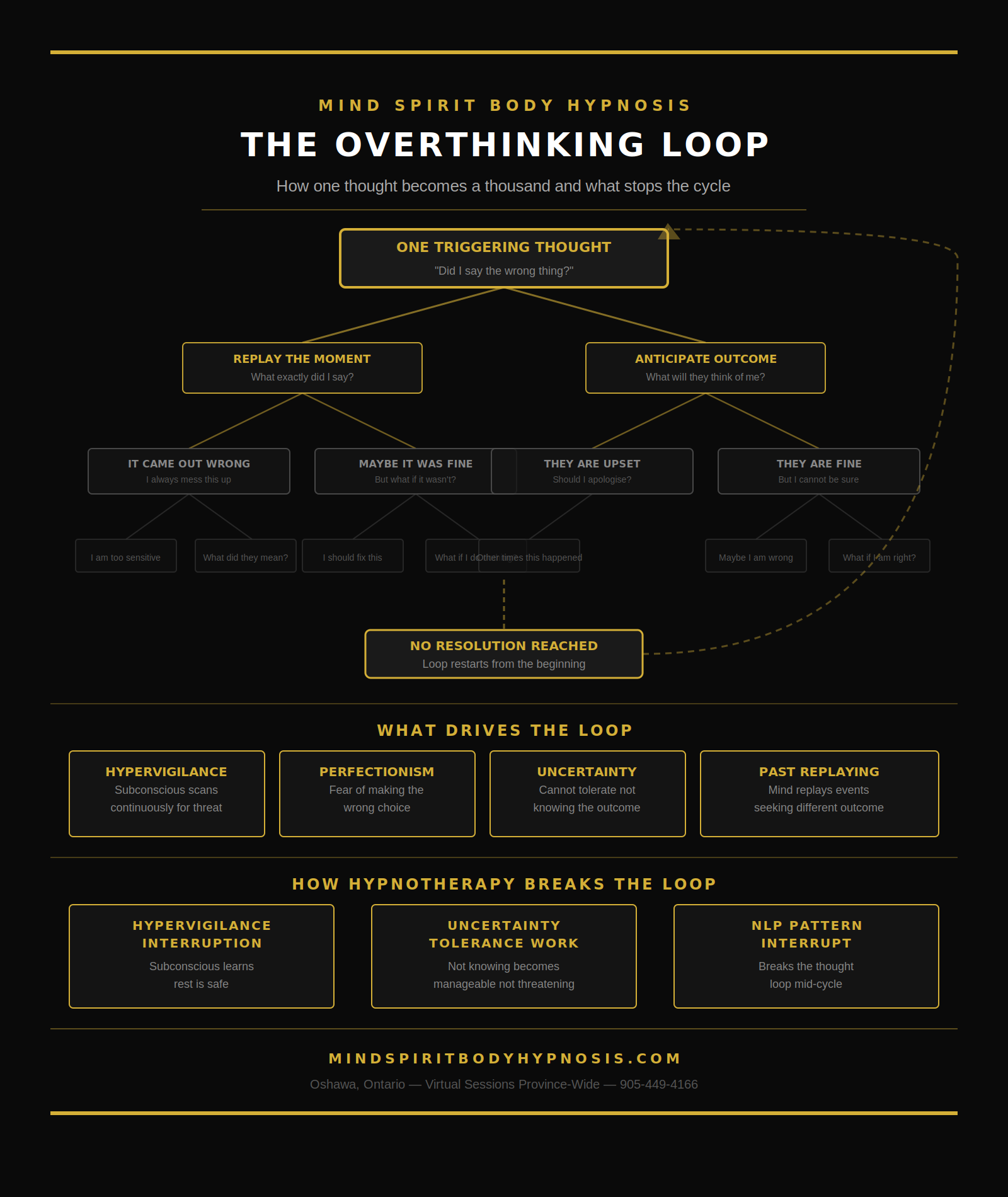
The subconscious plays a central role. Overthinking is almost always driven by a hypervigilance pattern, a nervous system that has learned to scan continuously for threat, to review past events for errors, and to anticipate future scenarios for danger. This pattern may have been adaptive at some point, perhaps during a period of genuine uncertainty or stress, perhaps during childhood in an unpredictable environment. But the subconscious has not received the update that the vigilance is no longer needed.
Common drivers include:
Anxiety and the need to feel prepared. The subconscious believes that thinking through every possibility protects from negative outcomes. It does not. But the belief is subconscious, so it runs regardless of the evidence.
Perfectionism and fear of making the wrong choice. When any decision carries the weight of potential failure, the mind circles endlessly rather than committing to an action that might be less than perfect.
Low tolerance for uncertainty. Research consistently identifies intolerance of uncertainty as a core driver of chronic worry and overthinking. The mind keeps cycling because it is trying to resolve something that cannot be resolved without more information, and more thinking is the only tool it has (Dugas et al., 2005).
Past trauma or regret. Replaying past events repeatedly is the mind's attempt to find a different outcome, to locate the point at which things could have gone differently. It never does. But the subconscious keeps trying.
How Is Overthinking Different From Anxiety?
These two experiences are closely related and frequently coexist, but they are not identical.
Anxiety is a state of nervous system arousal characterized by physiological symptoms including elevated heart rate, muscle tension, shallow breathing, and a general sense of dread or threat. It is an emotional and bodily experience as much as a cognitive one.
Overthinking is primarily a cognitive pattern. It is the repetitive, circular mental activity that both feeds anxiety and is fed by it. A person can be an overthinker without experiencing severe physiological anxiety. And a person can experience acute anxiety without the chronic rumination pattern that characterizes overthinking.
In practice, the two almost always interact. The anxious nervous system generates the threat signal. Overthinking is the cognitive response to that signal, the mind's attempt to think its way to safety. Hypnotherapy addresses both simultaneously: the nervous system dysregulation at the root and the subconscious thought pattern that runs on top of it.
For more on how anxiety and the nervous system interact and how hypnotherapy addresses both, the hypnotherapy for anxiety and stress pillar page covers the foundational mechanisms in detail.
Why Overthinking Gets Worse at Night
One of the most consistent features of chronic overthinking is that it intensifies at night. Clients describe lying in bed as the worst part of their day, when the thoughts arrive in force, and nothing seems to quiet them.
The reason is straightforward. During the day, external demands, tasks, conversations, screens, and movement provide competing inputs that absorb some of the mind's processing capacity. The overthinking is still running in the background, but it has to share bandwidth with everything else.
At night, all of those competing inputs disappear. The room is quiet. The distractions are gone. And the subconscious has the floor entirely. Whatever it has been processing at a low level all day now runs at full volume.
This is also why meditation and breathing exercises, while genuinely helpful for many people, often reach their limits with chronic overthinkers. The moment the technique ends, the mind picks up exactly where it left off. The pattern has not been addressed. Only temporarily interrupted.
Hypnotherapy for overthinking works with the subconscious directly, addressing the hypervigilance pattern rather than just providing a temporary override. Many clients notice improvements in their nighttime thought patterns from the first or second session. For those whose overthinking significantly disrupts sleep, the hypnotherapy for sleep and insomnia page covers the sleep-specific dimension of this work.
How Hypnotherapy Quiets the Overthinking Mind
As a certified hypnotherapist trained through the American Board of Hypnotherapy, I approach chronic overthinking as a subconscious pattern with identifiable drivers, not a fixed personality trait. The work is precise, targeted, and builds practical tools that the client can use independently between sessions.
Hypervigilance pattern interruption. In trance, the subconscious programme of continuous scanning and analysis is identified and directly addressed. New associations are installed: not thinking is safe, uncertainty can be tolerated, and the absence of analysis is not dangerous. Many clients describe experiencing genuine mental quiet in trance for the first time in years. This becomes a reference point that the subconscious can return to.
Intolerance of uncertainty work. For overthinkers driven by the need to anticipate every possible outcome before they can relax, a specific suggestion can target intolerance of uncertainty at the subconscious level. The mind is given a new internal relationship with the unknown, one in which not knowing is manageable rather than threatening.
Perfectionism and control belief change. Using NLP logical levels work, the subconscious beliefs about what thinking is supposed to achieve are examined and updated. The belief that more thinking produces greater safety is replaced by a more accurate and functional one: that some situations are best resolved by acting, waiting, or letting go rather than by further analysis.
Root cause work. When chronic overthinking is linked to a specific period of genuine threat, childhood unpredictability, or a traumatic event that created the initial hypervigilance, regression work revisits that origin, releases the emotional charge, and updates the subconscious so it is no longer running a survival strategy that outlasted its usefulness.
A meta-analysis published in the International Journal of Clinical and Experimental Hypnosis found that hypnotherapy produced significantly greater reductions in anxiety and associated cognitive symptoms, including rumination and worry, compared to control conditions, with effects maintained at follow-up (Schnur et al., 2008).
NLP Techniques That Break the Thought Loop
NLP offers precise, fast-acting tools for dismantling the internal architecture of chronic overthinking. Clients I work with in Ontario find these particularly useful as portable tools between sessions.
Submodality work on the thought loop. The internal experience of the overthinking loop has a specific structure: a location in the mind's space, a pace, a volume, a quality of momentum. Changing those qualities directly changes the experience. When the thought loop is made slower, more distant, quieter, and less urgent, it loses its compulsive quality. The mind can step out of it rather than being swept along.
The pattern interrupt. A specific NLP technique for breaking automatic thought sequences mid-cycle. Particularly effective for the habitual what-if chains that begin automatically in specific situations and, once started, seem impossible to stop.
Parts integration. Chronic overthinkers often have an internal conflict between the part that wants to stop thinking and the part that believes continued thinking is essential for safety. NLP parts integration aligns these, so the internal argument is resolved, and the mind can genuinely rest.
Anchoring a quiet mind state. A state of genuine mental stillness experienced during trance is anchored to a physical cue. The client can activate this anchor whenever the overthinking cycle begins, shifting the internal state before the loop gains momentum.
The full approach used at Mind Spirit Body Hypnosis, including how NLP and hypnotherapy are combined in practice, is outlined on the about page.

What to Expect in a Session
The first session is a conversation. What does the overthinking focus on? Past events, future scenarios, or both? Are there specific triggers, or is it relatively constant? Does it affect sleep, work, and relationships? What has already been tried?
This mapping shapes the subconscious work. The induction is gentle, and most clients reach a deeply relaxed trance state within minutes. For many chronic overthinkers, this is genuinely surprising. They arrive assuming their minds will not cooperate. Most find the opposite.
Most overthinking programmes at Mind Spirit Body Hypnosis run between three and six sessions. Early sessions focus on hypervigilance interruption and installing the NLP tools. Later sessions address the underlying drivers and deepen the subconscious shift.
All sessions are delivered virtually, available to clients aged 10 and older across Ontario from the comfort of their own home.
What My Clients Say
"I cannot say enough about how amazing Fanis is! He has truly changed my life. I was always an anxious person and always overthinking everything. After seeing Fanis I feel like a completely different person. The anxiety is gone and my mind is actually quiet for the first time in my life. I am forever grateful."
Amanda B. | Anxiety and Overthinking | Five Stars
FAQ
Can hypnotherapy stop overthinking? Yes. Hypnotherapy works directly with the subconscious hypervigilance and control-seeking patterns driving chronic overthinking, retraining the nervous system to associate mental rest with safety rather than danger. Research supports hypnotherapy for significant reductions in cognitive arousal and rumination.
Why do I overthink everything? Chronic overthinking is almost always driven by a subconscious hypervigilance pattern, an anxious nervous system scanning continuously for threat. The analytical mind is attempting to think its way to safety. The pattern was often adaptive at some point in life, but continues running beyond its usefulness.
What is the difference between overthinking and anxiety? Anxiety is primarily a physiological state of nervous system arousal. Overthinking is primarily a cognitive pattern of repetitive, circular thought. The two interact closely and often coexist, but they can be present independently. Hypnotherapy addresses both the nervous system root and the cognitive pattern simultaneously.
Why does overthinking get worse at night? During the day, external demands absorb some of the mind's processing capacity. At night, competing inputs disappear, and the subconscious has the floor entirely. Whatever it has been processing at a low level all day runs at full volume. Hypnotherapy addresses the subconscious pattern rather than just providing a temporary override.
What is the best treatment for chronic overthinking? Approaches that work at the subconscious level, including hypnotherapy and NLP, are particularly effective for chronic overthinking because they address the hypervigilance pattern and intolerance of uncertainty at the root, rather than managing the thoughts at the surface. Cognitive behavioural therapy also has an evidence base and complements hypnotherapy well.
How many sessions will I need? Most clients at Mind Spirit Body Hypnosis work on overthinking and complete three to six sessions. Many notice a meaningful shift in the quality and volume of their thought patterns after the first two. The timeline depends on the depth of the pattern and whether there are underlying anxiety or trauma components.
Is this suitable for younger clients? Yes. Mind Spirit Body Hypnosis works with clients aged 10 and older. Overthinking is common in adolescents, particularly during academic pressure periods, and responds well to hypnotherapy and NLP.
Can I do sessions virtually from anywhere in Ontario? Yes. All sessions are delivered virtually, province-wide, with no referral required.
What if I have tried meditation and mindfulness, and they did not help? Meditation and mindfulness ask the conscious mind to observe thoughts without engaging. Hypnotherapy works below the conscious mind, directly retraining the subconscious patterns that generate the overthinking in the first place. Many clients who found meditation insufficient report significant shifts with hypnotherapy.
How do I get started? Book a free 30-minute virtual strategy session at calendly.com/mindspiritbodyhypnosis. No referral needed.
Ready to Take the Next Step?
If your mind has not been genuinely quiet for longer than you can remember, that is not your personality. It is a subconscious pattern. And it can change.
I offer a free 30-minute virtual strategy session for new clients across Ontario. There is no pressure, just a conversation about what is happening and how hypnotherapy or NLP may help.
Book your free session:calendly.com/mindspiritbodyhypnosis
Call or text:905-449-4166
Email:mindspiritbodyhypnosis@gmail.com
Visit:mindspiritbodyhypnosis.com
Serving clients virtually across Ontario, including Durham Region, Toronto, Ottawa, and beyond.
Disclaimer: This article is for informational purposes only and does not constitute medical or psychological advice. Hypnotherapy, NLP, and EMDR are complementary approaches and are not a substitute for diagnosis or treatment by a qualified healthcare provider. Please consult a licensed professional if you have concerns about your mental or physical health.
Written by Fanis Makrigiannis | Certified Hypnotherapist & NLP Master Practitioner | Mind Spirit Body Hypnosis.