Can Hypnotherapy stop food cravings?
Can Hypnotherapy Stop Food Cravings?
TL;DR: Food cravings are not about hunger, and they are not about lack of discipline. They are subconscious habit loops wired into the brain's reward system, and they run automatically before the conscious mind has had a chance to make a different choice. At Mind Spirit Body Hypnosis in Oshawa, Ontario, Fanis Makrigiannis uses hypnotherapy and NLP to rewire the craving response at the subconscious level, helping clients of all ages across the province build a calmer, more conscious relationship with food without relying on willpower.
Quick Answer
Hypnotherapy for food cravings is a subconscious-focused approach that reduces both the frequency and intensity of cravings by identifying and addressing the emotional triggers, reward associations, and habit loops that generate them, rather than relying on conscious willpower to resist them. Research from the HYPNODIET Trial found that 67.7 percent of hypnotherapy patients normalized their eating patterns compared to just 11.1 percent of controls. Fanis Makrigiannis, a Certified Hypnotherapist and NLP Master Practitioner at Mind Spirit Body Hypnosis in Oshawa, Ontario, offers virtual sessions across the province for clients of all ages ready to change their relationship with food from the inside out.
Questions This Article Answers
Can hypnotherapy really stop food cravings?
What causes food cravings?
Why is willpower not enough to stop cravings?
How is a food craving different from hunger?
What is the best treatment for food cravings?
In This Article:
It is 3 pm. You have eaten well today. You are not hungry. And yet the thought of something specific, chocolate, crisps, something sweet, something salty, arrives with an urgency that feels almost physical. You try to ignore it. It grows louder. You bargain with it. It wins.
That is a food craving. And it has almost nothing to do with the food.
In my practice, clients who come for craving work often arrive having tried every dietary strategy available. Meal prep. Calorie tracking. Removing the food from the house entirely. And the cravings simply migrate, becoming more urgent, more specific, and more difficult to resist the harder the person tries to fight them.
That is because cravings live in the subconscious. And the subconscious does not respond to willpower.
What Is a Food Craving and How Is It Different From Hunger?
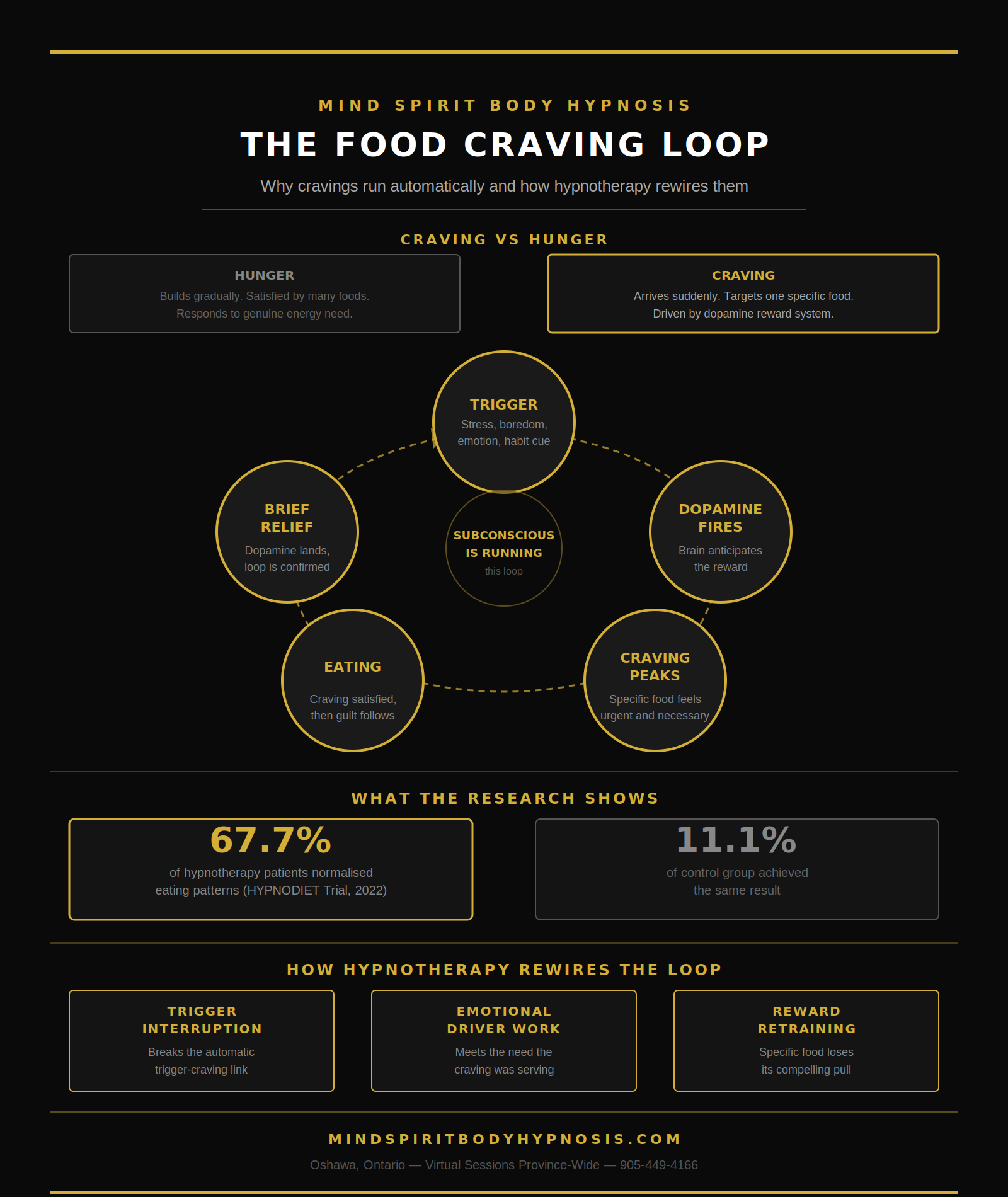
Hunger is a physiological signal. It builds gradually, can be satisfied by a range of different foods, and subsides when nutritional needs are met. It is produced by hormones, including ghrelin and leptin, in response to a genuine energy deficit.
A food craving is something else entirely. It arrives suddenly and at full intensity. It targets a specific food or category of food. It is not satisfied by eating something else. And it is driven not by the body's energy needs but by the brain's reward system, specifically by the dopamine pathways that associate certain foods with pleasure, relief, or emotional comfort.
Research published in the journal Frontiers in Psychiatry found that food cravings are neurologically distinct from hunger, involving the same dopamine-driven reward circuitry activated by addictive substances, with highly processed foods producing particularly strong and rapid reward responses in susceptible individuals (Schulte et al., 2015). The craving is not a sign of physical need. It is a signal from the subconscious that a familiar reward is available and the brain wants it.
Understanding this distinction matters because it changes the entire approach to managing cravings. Hunger responds to food. Cravings respond to the subconscious drivers behind them.
What Causes Food Cravings?
Food cravings are almost always driven by one or more of the following subconscious mechanisms:
Emotional association. At some point, a specific food became associated with a positive emotional state: comfort, reward, celebration, relief, or safety. The subconscious learned that food produces that state reliably, and it now reaches for the food automatically whenever that emotional state is needed.
Stress and cortisol. Chronic stress elevates cortisol, which directly increases appetite and cravings for high-fat, high-sugar foods. The brain's stress response and its craving response are neurologically connected. When stress rises, the craving follows without any conscious decision being made.
Habit loop reinforcement. The trigger-craving-eating-reward loop, once established, becomes progressively more automatic. The brain stops requiring any conscious input. The loop runs itself.
Nutritional patterns. Restrictive eating, skipping meals, or eliminating entire food categories can intensify cravings for the restricted foods through a combination of physiological and psychological reinforcement. The forbidden food becomes more compelling precisely because it is forbidden.
Boredom and emotional flatness. Food provides sensory stimulation, dopamine, and a sense of activity. For people experiencing boredom, emotional numbness, or a lack of pleasure in daily life, eating becomes one of the most reliable available sources of neurochemical reward.
For more on how cortisol and emotional states drive food-related patterns, the hypnotherapy for weight loss and emotional eating pillar page at Mind Spirit Body Hypnosis covers the foundational mechanisms. For more on how anxiety and stress directly fuel food cravings, the hypnotherapy for anxiety and stress page covers the cortisol-craving connection in detail.
Why Willpower Is Not Enough
Willpower is a conscious resource. Food cravings are a subconscious programme. The two do not operate at the same level, which is why willpower-based approaches so reliably fail over time.
Research consistently shows that willpower is a depleting resource. The more it is called upon throughout the day, the less available it becomes by evening, which is why cravings are typically strongest in the late afternoon and evening when decision-making capacity has been exhausted by the demands of the day. This is not a character flaw. It is a neurological reality.
A landmark meta-analysis published in the Journal of Consulting and Clinical Psychology found that adding hypnotherapy to behavioural weight loss programmes produced 97 percent more weight loss than behavioural programmes alone, with the advantage of hypnosis increasing at follow-up rather than fading, suggesting genuine and lasting behavioural change rather than temporary willpower-driven compliance (Kirsch, 1996).
More recently, the HYPNODIET Trial, a randomized controlled trial published in the American Journal of Clinical Nutrition, found that 67.7 percent of patients in the hypnotherapy group normalized their eating patterns, compared to just 11.1 percent of controls, with significant BMI reduction in the hypnotherapy group (Granger et al., 2022). The mechanism, as the researchers noted, was not willpower but subconscious reprogramming of the automatic eating response.
How Hypnotherapy Rewires the Craving Response
As a certified hypnotherapist trained through the American Board of Hypnotherapy, I approach food cravings as a subconscious habit with identifiable emotional drivers, not as a discipline problem. The work is precise, tailored to the specific triggers identified for each client, and builds tools the person can use independently between sessions.
Craving trigger identification and interruption. Before any trance work begins, sessions map the specific triggers that most reliably activate cravings: the time of day, the emotional state, the environment, the sequence of events. Once mapped, the automatic connection between trigger and craving is interrupted in trance, and a new response is installed. The trigger fires. The craving does not follow.
Emotional driver work. When cravings are linked to a specific emotional need, the session works with that need directly. If chocolate is being used to manage loneliness, the loneliness is addressed at the subconscious level, and a more effective way to meet the need is installed. The craving loses its function because the need is being met elsewhere.
Reward association retraining. Using guided suggestion in trance, the subconscious association between specific foods and positive emotional states is gently restructured. Rather than feeling deprived, clients often report that the specific food simply loses its compelling quality. The pull is no longer there.
Satiety signal enhancement. Through direct suggestion and imagery, the subconscious is trained to recognize and respond to the body's fullness signals more promptly and reliably. Many people with strong food cravings have learned to override satiety signals through years of habitual overeating. Hypnotherapy helps restore the connection.
Future pacing. The subconscious is walked through vivid scenes of the client moving through their typical craving situations with genuine ease, choosing foods that nourish rather than reaching automatically for familiar rewards. These scenes are filed as expected memory, making the new response feel natural rather than effortful.

NLP Techniques That Interrupt the Craving Cycle
NLP offers targeted tools for dismantling the internal architecture of food cravings quickly and practically. Clients I work with across Ontario find these particularly useful as portable tools between sessions.
Submodality works on the craving experience. A food craving has a specific internal structure: a mental image of the food with particular qualities of brightness, size, proximity, and appeal. Submodality work changes those qualities directly. When the internal image of the craved food is made smaller, more distant, and less vivid, the urgency of the craving reduces proportionally. This can be done in under two minutes and produces immediate, measurable changes in craving intensity.
The swish pattern. A rapid NLP technique that interrupts the automatic reach-for-food response and replaces it with a chosen alternative. Particularly effective for the habitual craving that fires at a specific time or in a specific context, for example, the afternoon sugar craving that reliably arrives at 3 pm or the post-dinner sweet craving that has been present for years.
Parts integration. Most people with persistent food cravings have an internal conflict between the part that wants to eat the craved food and the part that desperately wants to stop. NLP parts integration aligns these, so the internal tug of war is resolved, and the person is no longer exhausting themselves fighting themselves at every craving.
Anchoring a satisfied state. A genuinely satisfied, nourished, complete state experienced during trance is anchored to a physical cue. When a craving fires in daily life, activating the anchor provides an immediate alternative to the food response, a felt sense of enough that does not require eating to produce.
For more on how NLP and hypnotherapy are combined at Mind Spirit Body Hypnosis, the about page outlines the full clinical approach and qualifications.
What to Expect in a Session
The first session is a conversation. Which foods do you crave most? When do the cravings typically hit? What emotional state usually precedes them? What does the craving give you beyond the food itself? What would change if the cravings were manageable?
This mapping shapes the subconscious work. The induction is gentle, and most clients reach a deeply relaxed state within minutes. The core work then targets the specific triggers, emotional drivers, and habit loops identified in the conversation.
Most food craving programmes at Mind Spirit Body Hypnosis run between three and five sessions. Many clients notice a meaningful reduction in craving intensity after the first two. All sessions are delivered virtually and are available to clients aged 10 and older across Ontario from the comfort of their own homes.
What My Clients Say
"You will see results when you come see Fanis! He got me to stop eating cookies, especially Oreo cookies. Oreo cookies were like CRACK to me. I would easily buy 2 or 3 packs and finish them all on the same day! Thank goodness Fanis helped me. My weight went down and I'm still losing weight. Thanks Fanis for all your help!"
Lanre O. | Weight Loss and Food Cravings | Five Stars
FAQ
Can hypnotherapy really stop food cravings? Yes. Research, including the 2022 HYPNODIET Trial, found that 67.7 percent of hypnotherapy patients normalized their eating patterns, compared to just 11.1 percent of controls. Hypnotherapy reduces both the frequency and intensity of cravings by addressing the subconscious emotional triggers and reward associations driving them.
What causes food cravings? Food cravings are caused by subconscious associations between specific foods and positive emotional states, the brain's dopamine reward system, stress-driven cortisol spikes, established habit loops, and in some cases, the psychological effects of dietary restriction. They are not caused by hunger or a lack of willpower.
How is a food craving different from hunger? Hunger builds gradually, can be satisfied by a range of foods, and responds to genuine energy needs. A food craving arrives suddenly, targets a specific food, is not satisfied by eating something else, and is driven by the brain's reward system rather than physiological need.
Why is willpower not enough to stop cravings? Willpower is a conscious, depleting resource. Food cravings are a subconscious programme. They do not operate at the same level. Research shows willpower-based approaches produce temporary results that fade over time, while hypnotherapy produces lasting changes by working at the subconscious level where the craving actually lives.
What is the best treatment for food cravings? Research supports hypnotherapy as one of the most effective approaches for persistent food cravings because it addresses the subconscious emotional drivers and reward associations that generate them, rather than relying on willpower to resist them. At Mind Spirit Body Hypnosis, hypnotherapy and NLP are combined for a comprehensive result.
How many sessions will I need? Most clients at Mind Spirit Body Hypnosis working on food cravings complete three to five sessions. Many notice a meaningful reduction in craving intensity after the first two. The timeline depends on the depth of the emotional drivers and how long the craving patterns have been established.
Is this suitable for younger clients? Yes. Mind Spirit Body Hypnosis works with clients aged 10 and older. Food craving patterns in younger clients, including adolescents, respond well to hypnotherapy and NLP, which are gentle and medication-free.
Can I do sessions virtually from anywhere in Ontario? Yes. All sessions are delivered virtually, province-wide, with no referral required.
What if I have tried every diet and the cravings always come back? Diets target the conscious behaviour of what you eat. Hypnotherapy targets the subconscious drivers of why you eat. If every dietary approach has produced temporary results that fade, the root has not been addressed. Hypnotherapy works at the level where the craving actually lives.
How do I get started? Book a free 30-minute virtual strategy session at calendly.com/mindspiritbodyhypnosis. No referral needed.
Ready to Take the Next Step?
If food cravings have been running your relationship with food for months or years, and every approach has produced temporary results that eventually fade, that is not a willpower problem. The root has not been addressed.
I offer a free 30-minute virtual strategy session for new clients across Ontario. There is no pressure, just a conversation about what is happening and how hypnotherapy or NLP may help.
Book your free session: calendly.com/mindspiritbodyhypnosis
Call or text: 905-449-4166
Email: mindspiritbodyhypnosis@gmail.com
Visit: mindspiritbodyhypnosis.com
Serving clients virtually across Ontario, including Durham Region, Toronto, Ottawa, and beyond.
Disclaimer: This article is for informational purposes only and does not constitute medical or psychological advice. Hypnotherapy and NLP are complementary approaches and are not a substitute for diagnosis or treatment by a qualified healthcare provider. If you have a medical condition affected by eating patterns, please consult a qualified healthcare provider. Results vary by individual.
Written by Fanis Makrigiannis | Certified Hypnotherapist & NLP Master Practitioner | Mind Spirit Body Hypnosis.