Can hypnotherapy cure the fear of heights?
Can Hypnotherapy Cure a Fear of Heights?
TL;DR: Fear of heights, clinically known as acrophobia, is one of the most common specific phobias in the world and one of the most disruptive in daily Canadian life, affecting everything from workplace safety to travel to simple tasks like climbing a ladder. At Mind Spirit Body Hypnosis in Oshawa, Ontario, Fanis Makrigiannis uses hypnotherapy and NLP to work directly with the subconscious root of height phobia, helping clients of all ages across the province move through the world without dread.
Quick Answer
Hypnotherapy for fear of heights is a subconscious-focused approach that addresses acrophobia by accessing the original experiences and threat-based learning that established the fear response, releasing their emotional charge, and retraining the nervous system to associate heights with manageable discomfort rather than catastrophic danger. Research supports hypnotherapy as an effective complementary approach for specific phobias. Fanis Makrigiannis, a Certified Hypnotherapist and NLP Master Practitioner at Mind Spirit Body Hypnosis in Oshawa, Ontario, offers virtual sessions across the province for clients of all ages ready to stop letting height fear control their choices.
Questions This Article Answers
What is acrophobia, and how common is it?
Can hypnotherapy cure a fear of heights?
What causes fear of heights?
How is acrophobia different from vertigo?
What is the best treatment for fear of heights?
In This Article:
Most people feel some degree of unease when they look down from a significant height. That is entirely normal. What is not normal is the complete body shutdown that happens to people with acrophobia.
The frozen legs on a ladder. The white-knuckle grip on a glass railing five stories up. The refusal to take the elevator above the third floor. The panic that begins before the height is even reached, just from anticipating it.
In my practice, clients with height phobia often arrive having reorganized significant parts of their lives around the fear without fully realizing it. They choose accommodation on lower floors. They decline jobs that require working at height. They avoid hiking trails, observation decks, bridges, and balconies. The fear quietly shrinks the world, and often nobody around them knows how much.
What Is Acrophobia and How Common Is It?
Acrophobia is the clinical term for an intense, persistent fear of heights that is disproportionate to the actual level of danger and significantly interferes with daily functioning. It is classified as a specific phobia under the DSM-5, in the natural environment subtype alongside fears of storms and water.
Acrophobia affects approximately 3 to 6 percent of the global population, making it one of the most prevalent specific phobias worldwide. It affects twice as many women as men, with onset typically occurring in early adulthood. Beyond clinical acrophobia, a related condition called visual height intolerance (VHI) affects a significantly larger proportion of the population. Approximately one-third of people worldwide experience some form of visual height intolerance, the uncomfortable sensation when looking down from an elevated place that does not quite rise to the level of a clinical phobia but still disrupts activities and choices.
In Ontario, where urban environments feature tall office buildings, elevated transit infrastructure, construction work at height, and popular outdoor activities including hiking the Niagara Escarpment and the Bruce Trail, acrophobia carries real practical consequences. Clients I work with across Durham Region and the GTA frequently describe the fear affecting their career options, their social participation, and their ability to enjoy Ontario's natural landscapes fully.
What Causes Fear of Heights?
The human nervous system is born with two innate fears: loud noises and falling. A wariness around heights is therefore entirely built in, a survival mechanism developed over hundreds of thousands of years when falling from a tree or a cliff genuinely was fatal. In this sense, some degree of height sensitivity is not a disorder; it is good design.
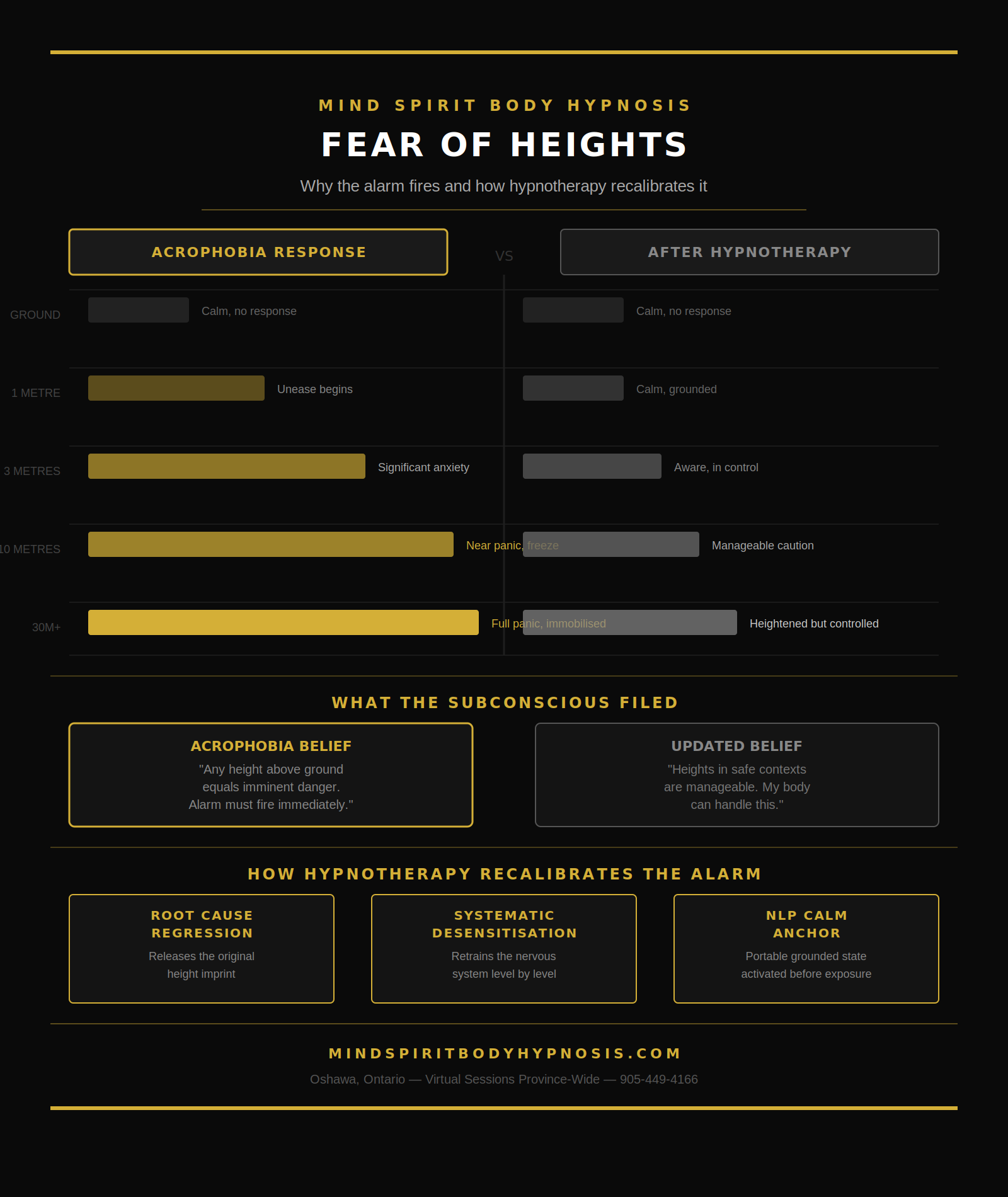
Acrophobia develops when this innate wariness becomes a disproportionate, automatic threat response that fires in situations where the actual danger is minimal or zero. Several pathways lead to this:
A traumatic height experience. A fall, a near-miss, being frozen on a ladder as a child, witnessing someone else's fall, or any experience in which height was associated with genuine terror can create a powerful subconscious imprint. The subconscious files height as life-threatening and enforces the conclusion with the full force of the fear response ever after.
Gradual sensitization. For some people, no single event is identifiable. The fear developed slowly, through repeated uncomfortable experiences at height that compounded over time. Each avoidance reinforced the belief that heights are dangerous, making the fear easier to trigger and harder to override.
Learned fear. Learned behavioural responses from parents can be a contributing factor. Growing up watching a caregiver react to heights with visible fear or avoidance is often enough for the subconscious to internalize the same response.
Anxiety sensitization. Anxiety and depression can heighten sensitivity to fears, making acrophobia feel more intense or harder to manage. For clients with a broader anxiety presentation, height phobia is often one of several specific fears that have developed on top of a chronically dysregulated nervous system.
Research published in the Journal of Anxiety Disorders found that acrophobia is strongly associated with a broader trait of anxiety sensitivity and that the most effective treatments address both the specific phobic response and the underlying anxiety architecture (Coelho & Wallis, 2010).
For more on how anxiety and phobias are held in the nervous system and how hypnotherapy addresses both, the hypnotherapy for fears and phobias pillar page at Mind Spirit Body Hypnosis covers the foundational mechanisms.
How Is Acrophobia Different From Vertigo?
This is one of the most common points of confusion around height fear, and getting it right matters for treatment.
Vertigo is a medical condition involving a sensation of spinning or movement when the body is still. It is caused by problems in the inner ear or brain, and it can be triggered by heights, but also by many other situations. Vertigo is a physical condition with medical causes and requires medical assessment.
Acrophobia is a psychological phobia. The dizziness and disorientation that people with acrophobia experience at heights is produced by the anxiety response -- the surge of adrenaline and cortisol changes blood pressure and affects vestibular function, producing genuine physical sensations that feel like vertigo but are anxiety-driven rather than medically caused.
Here is how the two experiences differ in practice:
Acrophobia: Fear begins at the anticipation of heights, before any actual exposure. The primary experience is psychological dread and panic. Dizziness, if present, is secondary to the fear response.
Vertigo: Dizziness is the primary experience and may occur without any psychological fear component. It is not specific to heights and requires medical investigation.
Many people with acrophobia have been told they have vertigo and have pursued medical investigations that found nothing wrong. If your dizziness at heights is preceded by dread, if the anticipation of the height produces the symptoms, the root is likely psychological rather than medical. Hypnotherapy is well placed to address the psychological root.
How Hypnotherapy Treats Fear of Heights at the Root
Hypnotherapy for acrophobia works at the subconscious level, where the phobic response was established and where it continues to fire automatically. As a certified hypnotherapist trained through the American Board of Hypnotherapy, I approach height phobia as a learned threat response with identifiable origins, not a fixed feature of the person's nervous system.
Root cause regression. The session identifies and revisits the original experience or pattern of experiences that established the fear of heights. In trance, the emotional charge attached to those memories is released, and the subconscious receives an updated interpretation: heights in safe, controlled contexts are manageable. The automatic threat response loses its trigger.
Systematic desensitization in trance. Working within the deeply relaxed hypnotic state, the client is gradually and gently walked through a hierarchy of height-related situations, beginning with the least anxiety-provoking and moving progressively toward more challenging scenarios. At each level, the nervous system is trained to respond with calm rather than threat. This is the same mechanism as exposure therapy, but conducted in a safe, controlled internal environment without requiring actual exposure before the client is ready.
Height-calm association installation. Using guided imagery and direct suggestion, vivid and fully sensory experiences of the client at height calm, grounded, genuinely okay are installed in the subconscious. These scenes are filed as expected memory, making calm at height feel familiar and achievable rather than impossible.
Anchoring a grounded state. A deeply settled, physically grounded state experienced during trance is anchored to a specific physical cue such as a breath pattern or hand position. The client can activate this anchor independently before and during any height-related situation, shifting the nervous system toward calm before the fear response can gain momentum.
A meta-analysis published in the Journal of Consulting and Clinical Psychology found that hypnotherapy produced effect sizes equivalent to or exceeding those of exposure-based therapies for specific phobias, with the added advantage of being experienced as significantly less distressing by participants (Kirsch et al., 1995).
NLP Techniques That Dissolve the Height Fear Response
NLP offers powerful, fast-acting tools for dismantling the internal structure of height phobia. Clients I work with in Ontario find these particularly practical as portable tools between sessions.
The fast phobia cure. One of the most well-researched NLP techniques for specific phobias, the fast phobia cure uses a structured dissociation process to allow the person to reprocess the fear-triggering memory from a safe, detached perspective. Many clients experience significant reductions in fear intensity after a single application.
Submodality work on the height image. The internal representation of a feared height has a specific structure: a mental image with particular qualities of proximity, scale, angle, and emotional intensity. Changing those qualities directly changes the fear response. When the internal image of the feared height is made smaller, flatter, more distant, and less vivid, the alarm it generates reduces proportionally.
Perceptual positions. Acrophobia involves being completely trapped inside a first-person, physiologically activated experience of the fear. NLP perceptual positions work moves the person to a detached observer perspective, allowing the subconscious to process the height scenario without the full physical charge of the phobic response.
Timeline work. When height fear traces to a specific past event, timeline work revisits that event in trance, releases the emotional charge at the point of origin, and installs new resources and perspectives at that moment. Every subsequent experience of height is then approached without the weight of the original imprint.
More about how these techniques are applied at Mind Spirit Body Hypnosis is available on the about page.
What to Expect in a Session
The first session is a conversation. When did the fear of heights start? Is there an identifiable triggering event, or did it develop gradually? What specific situations trigger the response ladders, elevators, balconies, bridges, and open staircases? What would change in your life if heights were manageable?
This mapping shapes the subconscious work. The induction is gentle, and most clients reach a deeply relaxed state within minutes. The phobia work then proceeds at a pace determined entirely by the client's comfort and readiness.
Height phobia typically responds well and relatively quickly to hypnotherapy. Many clients notice a meaningful reduction in the intensity of the fear response after two to three sessions. For more details on the approach used at Mind Spirit Body Hypnosis for height phobia, the fear of heights page covers the clinical details.
All sessions are delivered virtually, available to clients aged 10 and older across Ontario from the privacy of their own home.
What My Clients Say
"I came to Fanis with pretty severe anxiety surrounding a fear of heights and flying. I felt my anxiety was holding me back from fully living my life and experiencing the world. After 3 sessions with Fanis my anxiety is next to nothing and I have been able to experience things I never thought possible. I would highly recommend Fanis to anyone suffering from anxiety or phobias!"
Chris H. | Anxiety and Phobias | Five Stars
FAQ
Can hypnotherapy cure a fear of heights? Hypnotherapy produces significant and often rapid reductions in height phobia by addressing the subconscious root of the fear response. Many clients reach a point where previously impossible situations become manageable after two to four sessions. Results vary by individual and the depth of the original pattern.
What is acrophobia? Acrophobia is the clinical term for an intense, persistent, and disproportionate fear of heights that significantly interferes with daily functioning. It is classified as a specific phobia under the DSM-5 and affects approximately 3 to 6 percent of the population.
What causes fear of heights? Acrophobia typically develops from a traumatic height experience, gradual sensitization through repeated uncomfortable exposures, learned fear from a caregiver, or a broader anxiety pattern that makes all threat-related situations feel more dangerous. The subconscious has concluded that heights are life-threatening and enforces that conclusion automatically.
How is acrophobia different from vertigo? Vertigo is a medical condition involving a spinning sensation caused by inner ear or neurological issues. Acrophobia is a psychological phobia in which the dizziness experienced at heights is produced by the anxiety response rather than a medical cause. If your dizziness is preceded by anticipatory dread, the root is likely psychological.
What is the best treatment for fear of heights? Research supports hypnotherapy, NLP, and cognitive behavioural therapy as effective approaches for specific phobias, including acrophobia. Hypnotherapy is particularly effective because it addresses the subconscious threat-based learning that drives the fear, rather than relying on repeated real-world exposure to gradually reduce the response.
How many sessions will I need? Most clients at Mind Spirit Body Hypnosis, working on fear of heights, complete two to four sessions. Many notice a significant shift after the first or second session. More complex presentations with underlying anxiety or trauma components may take longer.
Is this suitable for younger clients? Yes. Mind Spirit Body Hypnosis works with clients aged 10 and older. Height phobia in children and adolescents responds well to hypnotherapy and NLP, which are gentle, non-invasive, and medication-free.
Can I do sessions virtually from anywhere in Ontario? Yes. All sessions are delivered virtually, province-wide, with no referral required. The virtual format is particularly well-suited to phobia work because clients can engage fully from the safety of their own environment.
What if I have had this fear my whole life? Lifelong phobias can absolutely shift. The subconscious does not have an expiry date on change. Many clients with decades-long height phobias find that addressing the subconscious root produces changes they did not believe were possible.
How do I get started? Book a free 30-minute virtual strategy session at calendly.com/mindspiritbodyhypnosis. No referral needed.
Ready to Take the Next Step?
If height fear has been quietly limiting your career, your travel, your outdoor activities, or your ability to simply move through Ontario's built and natural environments without dread, you do not have to keep working around it.
I offer a free 30-minute virtual strategy session for new clients across Ontario. There is no pressure, just a conversation about what is happening and how hypnotherapy or NLP may help.
Book your free session: calendly.com/mindspiritbodyhypnosis
Call or text: 905-449-4166
Email: mindspiritbodyhypnosis@gmail.com
Visit: mindspiritbodyhypnosis.com
Serving clients virtually across Ontario, including Durham Region, Toronto, Ottawa, and beyond.
Disclaimer: This article is for informational purposes only and does not constitute medical or psychological advice. If you experience dizziness at heights, please consult a healthcare provider to rule out vestibular or neurological causes before pursuing psychological treatment. Hypnotherapy and NLP are complementary approaches and are not a substitute for medical care. Results vary by individual.
Written by Fanis Makrigiannis | Certified Hypnotherapist & NLP Master Practitioner | Mind Spirit Body Hypnosis.