Hypnotherapy for fear of public speaking Ontario
Hypnotherapy for Fear of Public Speaking in Ontario: Your Questions Answered
TL;DR: Fear of public speaking is not a weakness, shyness, or a lack of confidence. It is one of the most common specific fears in the adult population; it has a clear subconscious mechanism, and it responds very well to hypnotherapy. At Mind Spirit Body Hypnosis in Oshawa, Ontario, Fanis Makrigiannis answers the five questions people ask most before their first session for glossophobia directly and without the motivational framing that rarely helps anyone actually take the stage.
Quick Answer
Fear of public speaking, known clinically as glossophobia, is a conditioned subconscious threat response to the specific combination of scrutiny, judgment, and performance that speaking in front of others produces. It is not a personality trait, and it is not permanent. Hypnotherapy addresses the subconscious threat association at its root: the experience of being watched and evaluated fires as safe rather than dangerous, and builds the internal resources for genuine, grounded presence in front of any audience. At Mind Spirit Body Hypnosis in Oshawa, Ontario, Fanis Makrigiannis, a Certified Hypnotherapist and NLP Master Practitioner, offers virtual sessions province-wide for clients of all ages who are ready to stop letting this fear limit their professional and personal lives.
Questions This Article Answers
Is fear of public speaking a real phobia?
Where does fear of public speaking come from?
Why does my mind go blank when I have to speak?
Can hypnotherapy help with public speaking anxiety?
How is fear of public speaking different from shyness or introversion?
In This Article:
You have been asked to speak. At the meeting, at the wedding, at the conference, at the interview. And immediately something happens. The chest tightens. The thinking slows. There is a particular quality of dread that is qualitatively different from ordinary nervousness: a sense that something genuinely dangerous is about to happen, that you will lose control of yourself in front of other people, that the exposure will be catastrophic in a way that is difficult to articulate but impossible to dismiss.
And then, typically, one of two things happens. You say yes and spend the intervening days in a state of low-grade dread, rehearsing and catastrophizing in equal measure. Or you find a way to avoid it, and carry the relief of avoidance alongside the quiet disappointment of another thing you could not do.
In my practice, clients who come for public speaking work are frequently among the most capable people in their field. The fear is rarely about actual incompetence. It is about the specific and intensely activating combination of being watched, being evaluated, and being in a position where losing composure is both possible and witnessed. That combination fires a threat response in the nervous system that has nothing to do with whether the person actually knows their material.
Understanding that distinction is the beginning of resolving it.
Is Fear of Public Speaking a Real Phobia?
Yes, and the distinction between a phobia and ordinary nervousness matters significantly for how the fear is understood and addressed.
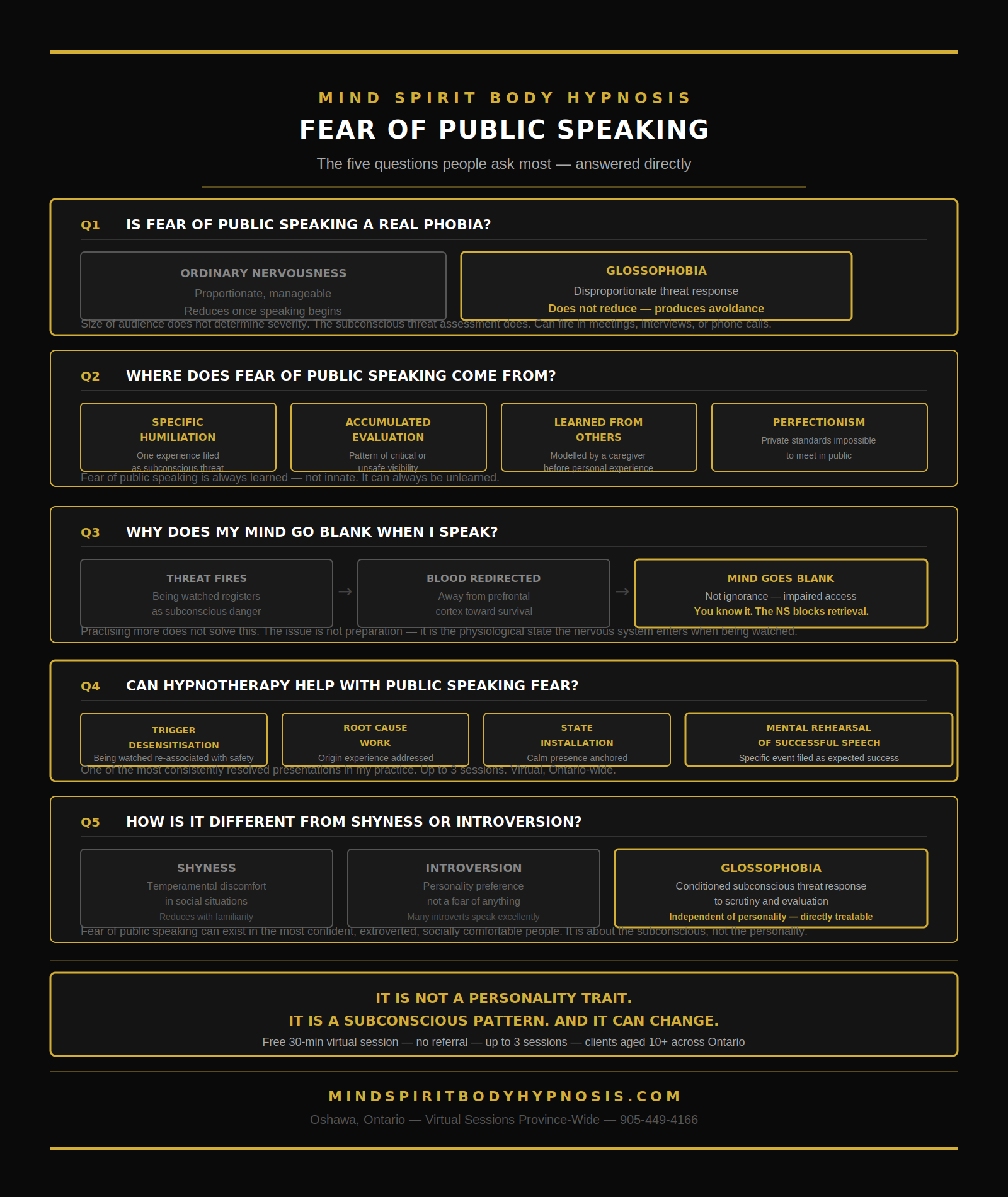
Ordinary nervousness before public speaking is the mild to moderate discomfort that most people experience before speaking in front of others. It is proportionate, manageable, and typically reduces once the speech begins. The nervous system registers a degree of heightened alertness and then settles as the situation becomes familiar.
Glossophobia is qualitatively different. It produces a full or near-full fear response that is disproportionate to the actual threat. Being watched, being evaluated, speaking in front of others carries no genuine physical danger, but the subconscious registers it as if it does. The fear does not reduce significantly once speaking begins. It may escalate. And it produces significant avoidance that limits the person's professional and personal life over extended periods.
The clinical distinction matters because it determines the approach. Ordinary nervousness responds to preparation, practice, and confidence-building. Glossophobia, as a conditioned subconscious threat response, requires direct work at the subconscious level to change what the nervous system does when the public speaking context is encountered.
It is also worth noting that fear of public speaking does not require an audience of hundreds to qualify as a genuine phobia. Many clients experience the full phobic response in team meetings, one-to-one performance conversations, university seminars, or even phone calls they know are being listened to. The size of the audience is not what determines the severity of the response. The subconscious threat assessment does.
⭐ Pro Tip: A reliable way to distinguish ordinary nervousness from a genuine glossophobic response is to notice when the fear begins. Ordinary nervousness typically arrives close to the speaking event and reduces once it is underway. Glossophobia often produces significant anticipatory anxiety days or weeks before the event, and the anxiety does not reliably reduce once speaking begins. If you are still experiencing significant fear once you are in the room and speaking, that is a signal that the pattern requires subconscious work rather than more preparation.
Where Does Fear of Public Speaking Come From?
Fear of public speaking is never innate. It is a learned response, the result of specific experiences, interpretations, or modelled behaviour that established the public speaking context as a site of subconscious threat.
The most common origins in clinical practice are:
A specific humiliating or overwhelming experience. A presentation that went badly, a moment of freezing or losing composure in front of others, a teacher or authority figure who responded to a public mistake with criticism or ridicule. The subconscious files the public speaking context as genuinely dangerous and activates a protective threat response whenever the cues are present again. The experience may have occurred decades ago. The subconscious response fires as if it just happened.
The accumulated experience of being evaluated. For some clients, there is no single defining moment. The fear has developed gradually from a pattern of experiences in which being watched and evaluated felt unsafe: critical family environments, competitive school settings, workplaces with a culture of public correction. The nervous system has learned, across many experiences, that being visible carries risk.
Learned fear from significant others. Children are highly attuned to the emotional states of the people around them. A parent or caregiver who expressed significant anxiety about public situations, who communicated that speaking in front of others was frightening or shameful, can establish a fear in a child who has no negative personal experience of their own. The fear is learned before it is experienced.
The specific threat of evaluation and judgment. Unlike most specific phobias, which are triggered by an external object or situation, fear of public speaking is rooted in the threat of social evaluation: being watched, being assessed, and being found wanting. This makes it closely related to social anxiety, though it can exist without generalized social anxiety, limited specifically to the performance and scrutiny context of speaking in front of others.
Identity and perfectionism. For some clients, the fear is less about humiliation and more about the impossibility of meeting their own standards in a public context where imperfection is visible. The perfectionism that functions effectively in private becomes a significant liability in front of an audience.
Research on the origins of public speaking anxiety consistently finds that evaluative threat the perceived danger of negative evaluation by others is the primary cognitive driver, with the subconscious having established watching, evaluating others as genuinely threatening rather than simply uncomfortable (Hofmann et al., 2004).
For more on how conditioned fear responses develop and how hypnotherapy addresses them at the root, the hypnotherapy for fears and phobias pillar page covers the subconscious mechanics of specific phobias in detail.
Why Does My Mind Go Blank When I Have to Speak?
This is the most practically urgent question about public speaking fear, and the answer reveals exactly why the conventional advice know your material, practise more, just breathe consistently fails to solve the problem.
The mind goes blank because the nervous system's threat response and effective cognitive performance are physiologically incompatible. When the subconscious registers a threat, and for someone with glossophobia, the moment of being watched and expected to perform registers as exactly that, the sympathetic nervous system activates the fight-or-flight response. Blood is redirected from the prefrontal cortex, the part of the brain responsible for organized thinking, language retrieval, and structured communication, toward the muscles and survival systems.
The result is that the very cognitive capacities required for effective public speaking clear thinking, word retrieval, structured narrative, smooth delivery are physiologically impaired at exactly the moment they are needed. The mind is not going blank because the person does not know what to say. It is going blank because the survival response has temporarily impaired access to what they know perfectly well.
This is why practising more and knowing the material better rarely solves the problem beyond a certain threshold. The issue is not preparation. It is the physiological state the nervous system enters when the speaking context is encountered. You can know the material flawlessly in private and lose access to it completely the moment the threat response fires.
Hypnotherapy changes what the nervous system does when the public speaking context is encountered. When the subconscious no longer registers the watching, evaluating audience as a threat, the fight-or-flight response does not activate, and the prefrontal cortex remains fully available. The person can think, retrieve, structure, and deliver because the physiological state that makes those things possible has not been hijacked.
⭐ Pro Tip: If you notice that your mind goes blank specifically in the moment of beginning to speak -- not during preparation, not during rehearsal, but at the precise moment of starting in front of others -- this is the threat response activating at the cue of being watched rather than at the cue of beginning. The subconscious has learned that being watched is the signal for danger, not the content of what you are saying. This is highly specific and highly targetable in hypnotherapy. The work identifies exactly when and why the threat fires, and addresses that specific moment directly.
Can Hypnotherapy Help With Public Speaking Anxiety?
Yes, and it is one of the presentations where the combination of hypnotherapy and NLP produces the most consistently clear results in my practice.
The reason is the specificity of the pattern. Unlike generalized anxiety, which can have many triggers and many expressions, public speaking fear typically has a clear, identifiable trigger sequence: being watched, being expected to perform, being in a position where composure could be lost publicly. That specificity makes the subconscious work very targetable.
Trigger desensitization. The specific cues of the public speaking context being at the front of a room, the moment of beginning, the feeling of all eyes focusing are identified and, in trance, systematically re-associated with safety and presence rather than threat. Each cue is approached in guided imagery, experienced without the threat response following, and the association updated.
Root cause work. The original experience or pattern of experience that established public speaking as a subconscious threat is identified and addressed directly. Where there is a specific humiliating event in the history, that event is revisited with adult resources, the adult perspective, the understanding of what actually happened and what it means about speaking now and the subconscious assessment is updated.
State installation. A specific internal state of calm, grounded presence, the physiological opposite of the fight-or-flight response, is built in trance and anchored to a physical cue. When this anchor is activated in the speaking context, it provides immediate access to the physiological state required for effective performance. Many clients activate this anchor in the seconds before they begin speaking.
Mental rehearsal of a successful performance. The subconscious is walked through a specific upcoming speaking situation in complete sensory detail, from walking into the room through to finishing and receiving the response of the audience, experiencing the entire sequence with genuine presence, clarity, and the satisfaction of having communicated effectively. This scene is filed as expected experience, making the actual event feel familiar rather than threatening.
NLP submodality work. The internal representation of the feared speaking situation the qualities of the image, the internal voice, the felt sense is identified and changed directly. When the internal representation of standing up to speak is transformed from threatening to manageable to genuinely comfortable, the behaviour that follows changes with it.
How Is Fear of Public Speaking Different From Shyness or Introversion?
This distinction is one of the most commonly confused in the public conversation about public speaking fear, and it matters for understanding what is actually happening and what will help.
Shyness is a temperamental tendency to feel uncomfortable, self-conscious, or inhibited in social situations, particularly with unfamiliar people. Shy people may feel nervous in many social contexts and find that discomfort reduces with familiarity. Shyness is not a phobia. It does not require the same level of clinical intervention, and it often reduces naturally as social experience accumulates.
Introversion is a personality trait characterized by a preference for less stimulating environments and a tendency to find extended social interaction draining rather than energizing. Introversion is not a fear. Introverts are not afraid of people or social situations. They simply recharge differently. Many introverts are excellent, compelling public speakers. Introversion and public speaking fear are completely independent dimensions.
Fear of public speaking is a conditioned subconscious threat response specifically to the performance and scrutiny context of speaking in front of others. It is not about social comfort or personality. It is about what the nervous system has learned to do when being watched and evaluated. It can exist in the most socially confident, extroverted, and outgoing people. And it can be resolved without changing personality, temperament, or social preference.
The clinical significance of this distinction is that shyness and introversion do not require hypnotherapy. Fear of public speaking does not because it is a character flaw but because it is a subconscious conditioned pattern, and conditioned patterns are what hypnotherapy specifically addresses.
For more on how NLP and hypnotherapy are used together at Mind Spirit Body Hypnosis to address the anxiety and confidence dimensions that frequently accompany public speaking fear, the hypnotherapy for anxiety and stress pillar page covers the foundational nervous system mechanisms.

What to Expect at Mind Spirit Body Hypnosis
The first session is a conversation. When did the fear start or become significant? Is there a specific event that appears to have originated or sharply worsened it? What is the specific trigger sequence? What does it feel like, and when exactly does it fire? What speaking situations are currently being avoided? And what would change, professionally and personally, if you could speak in front of others without the threat response running the experience?
The mapping shapes the trance work precisely. Public speaking fear typically resolves in up to three sessions at Mind Spirit Body Hypnosis. The first session addresses the primary trigger desensitization and state installation. Subsequent sessions consolidate the root cause work, address any remaining trigger points, and install the full mental rehearsal of specific upcoming speaking situations.
All sessions are delivered virtually, available to clients aged 10 and older across Ontario from the comfort of their own home. More about how the full approach is structured at Mind Spirit Body Hypnosis is available on the about page.
What My Clients Say
"I came to Fanis with pretty severe anxiety surrounding a fear of heights and flying. I felt my anxiety was holding me back from fully living my life and experiencing the world. After 3 sessions with Fanis my anxiety is next to nothing and I have been able to experience things I never thought possible. I would highly recommend Fanis to anyone suffering from anxiety or phobias!"
Chris H. | Anxiety and Phobias | Five Stars
"Working with Fanis has changed my life. After years of therapy for anxiety and confidence issues, I wanted to try something different. This experience has transformed me from the inside out and continues to have an effect even after our sessions. I am now able to be myself, face my fears, surround myself with those who care about me and live a fulfilling and happy life. So grateful."
Kristen W. | Anxiety and Confidence | Five Stars
FAQ
Is fear of public speaking a real phobia? Yes. Glossophobia is a conditioned subconscious threat response to the scrutiny, evaluation, and performance context of speaking in front of others. It is qualitatively different from ordinary nervousness -- it is disproportionate to the actual threat, does not reliably reduce once speaking begins, and produces significant avoidance over time.
Where does fear of public speaking come from? From specific experiences, accumulated patterns, or modelled behaviour that established the public speaking context as a site of subconscious threat. A humiliating experience, a pattern of critical evaluation, a family environment where visibility felt unsafe, or a significant other who expressed fear of public situations. The fear is always learned, which means it can be unlearned.
Why does my mind go blank when I speak in public? Because the fight-or-flight response redirects blood away from the prefrontal cortex, the part of the brain responsible for clear thinking, word retrieval, and structured communication at the moment of threat activation. The mind goes blank not because you do not know what to say but because the nervous system has temporarily impaired access to it. Hypnotherapy changes what the nervous system does when the speaking context is encountered.
Can hypnotherapy help with fear of public speaking? Yes. It is one of the most consistently resolved presentations in my practice. The specificity of the trigger sequence being watched, being expected to perform, makes the subconscious work very targetable. Up to three sessions for most clients.
How is fear of public speaking different from shyness? Shyness is a temperamental tendency to feel uncomfortable in social situations. Fear of public speaking is a conditioned subconscious threat response to being watched and evaluated; it can exist in the most socially confident and extroverted people. They are independent dimensions.
How is fear of public speaking different from introversion? Completely different. Introversion is a personality trait about energy and preference, not fear. Many introverts are excellent public speakers. Public speaking fear has nothing to do with whether a person is introverted or extroverted.
How many sessions will I need? Up to three sessions for most public speaking fear presentations at Mind Spirit Body Hypnosis. The first session addresses the primary trigger desensitization and state installation. Subsequent sessions address root cause work and specific upcoming situation rehearsal.
Can this help if I need to speak at a specific upcoming event? Yes. The mental rehearsal component of the hypnotherapy work is tailored to specific upcoming situations: a presentation, a wedding speech, an interview, a meeting. The subconscious is walked through that specific event as a successful, grounded experience, which makes it feel familiar and manageable when the moment arrives.
Can I do sessions virtually from anywhere in Ontario? Yes. All sessions are delivered virtually, province-wide, with no referral required.
How do I get started? Book a free 30-minute virtual strategy session at calendly.com/mindspiritbodyhypnosis. No referral needed.
Ready to Take the Next Step?
If fear of public speaking has been limiting your professional opportunities, your personal presence, or your ability to contribute what you actually have to offer, this is a subconscious pattern. Not a personality trait. Not a permanent feature of who you are.
I offer a free 30-minute virtual strategy session for new clients across Ontario. No pressure. Just an honest conversation about what the fear is costing you and what hypnotherapy and NLP can do about it.
Book your free session: calendly.com/mindspiritbodyhypnosis
Call or text: 905-449-4166
Email: info@mindspiritbodyhypnosis.com
Visit: mindspiritbodyhypnosis.com
Serving clients virtually across Ontario, including Durham Region, Toronto, Ontario, and beyond.
Disclaimer: This article is for informational purposes only and does not constitute medical or psychological advice. Hypnotherapy and NLP are complementary approaches and are not a substitute for diagnosis or treatment by a qualified healthcare provider. Results vary by individual.
Written by Fanis Makrigiannis | Certified Hypnotherapist & NLP Master Practitioner | Mind Spirit Body Hypnosis.