Can hypnotherapy help me stop gambling?
Can Hypnotherapy Help With Gambling Addiction?
TL;DR: Gambling addiction is not about money, and it is not about greed. It is a subconscious pattern built around dopamine, escapism, and deeply held beliefs about control, worth, and excitement, and it responds well to hypnotherapy because that is exactly where those patterns live. Fanis Makrigiannis, Certified Hypnotherapist and NLP Master Practitioner at Mind Spirit Body Hypnosis in Oshawa, Ontario, uses hypnotherapy and NLP to help clients of all ages across the province address gambling addiction at the subconscious root, not just the surface behaviour.
Quick Answer
Hypnotherapy for gambling addiction is a subconscious-focused approach that identifies and addresses the underlying emotional triggers, dopamine-seeking patterns, and limiting beliefs that sustain compulsive gambling by accessing the deeper layers of the mind that drive automatic behaviour. Research suggests combining hypnotherapy with other approaches produces significantly better outcomes than conventional treatment alone. Fanis Makrigiannis, a Certified Hypnotherapist and NLP Master Practitioner at Mind Spirit Body Hypnosis in Oshawa, Ontario, offers virtual sessions across the province for clients of all ages ready to break free from the gambling cycle.
Questions This Article Answers
Can hypnotherapy help with gambling addiction?
What causes gambling addiction?
Why is gambling so hard to stop?
How does the brain become addicted to gambling?
What is the best treatment for gambling addiction?
In This Article:
Most people who come to me about gambling do not arrive describing themselves as addicts. They arrive describing a pattern they cannot explain. They won a meaningful amount early on, or gambling became the place where the stress of the day disappeared, or it became the one thing that made them feel genuinely alive and in control when everything else felt flat.
And then, over months or years, it stopped being a choice.
In my practice, clients with gambling addiction often carry enormous shame alongside the financial and relational damage. The shame tends to keep the pattern hidden longer than it should be, which is exactly why addressing it at the subconscious level without judgment and without needing to justify every decision is so important.
What Is Gambling Addiction and How Does It Start?
Gambling disorder is a recognized clinical condition listed in the DSM-5, defined as a persistent and recurrent problematic gambling behaviour that causes significant distress or impairment. According to the Centre for Addiction and Mental Health (CAMH), approximately 3 percent of Canadians experience problem gambling, with Ontario having one of the highest rates of gambling participation in the country due to the density of casinos, racetracks, and online platforms (CAMH, 2023).
Gambling addiction rarely starts as an addiction. It typically begins in one of three ways.
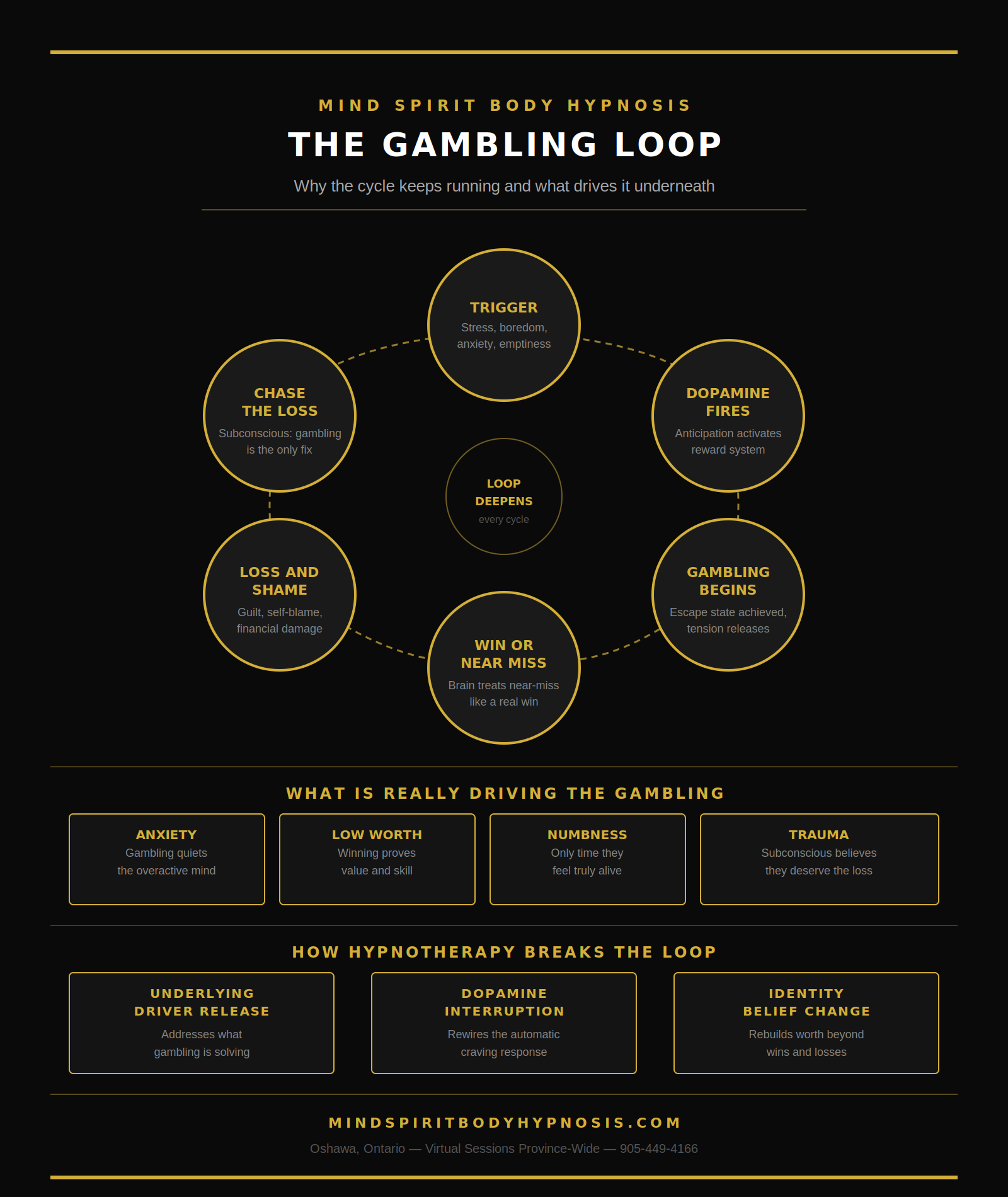
The first is the early win. A significant win early in the gambling experience creates a powerful neurochemical imprint. The brain associates gambling with a large dopamine release, and the subconscious begins to chase that feeling even as the mathematical reality of gambling makes its repetition increasingly unlikely.
The second is escapism. For many people, gambling is initially a way to escape stress, anxiety, boredom, or emotional pain. The total absorption of the gambling state, the way it quiets every other thought, is itself deeply appealing to someone whose mind is otherwise very loud. The escape works. And the subconscious remembers.
The third is identity and control. For some people, gambling provides a sense of mastery, strategy, and excitement that is missing elsewhere in life. The gambler becomes someone with skill, someone who reads situations, someone whose choices matter. The identity piece can be as compelling as the chemical reward.
Why Is Gambling So Hard to Stop?
Gambling addiction is particularly difficult to break for reasons that go beyond simple habit.
The gambling reward system operates on what psychologists call a variable ratio reinforcement schedule -- the same mechanism that makes slot machines so compulsive. Unlike a fixed reward (where you know what you will get for a specific action), variable ratio rewards are unpredictable. The brain responds to unpredictable rewards with significantly higher dopamine release than to predictable ones, because the uncertainty itself activates the anticipation system.
Research published in Nature Neuroscience found that near-miss outcomes in gambling, the almost-win, activate the same neural reward circuits as actual wins, effectively maintaining motivation even in the face of consistent losses (Clark et al., 2009). The brain is being rewarded by the process of gambling itself, independent of the financial outcome. This is why cutting losses rationally is so difficult; the subconscious is not tracking money, it is tracking the dopamine pattern.
Added to this is the role of chasing losses. The subconscious enters a loop in which the gambling becomes the solution to the pain the gambling has caused. The only way to fix the financial damage is to win. The only way to win is to keep gambling. The logic is internally consistent to the subconscious even as it is demonstrably destructive from the outside.
For more on how compulsive patterns are maintained by the subconscious and how they are addressed through hypnotherapy, the hypnotherapy for habits and addictions page at Mind Spirit Body Hypnosis covers the foundational mechanisms.

What Is Really Driving the Gambling?
In my experience working with clients across Ontario, the gambling behaviour is rarely the core issue. It is the solution to a core issue that has never been addressed directly.
Common underlying drivers include:
Anxiety and the need to escape. The total focus of gambling provides temporary relief from an overactive, anxious mind. The gambling state is one of the few places where the chronic background noise goes quiet. Hypnotherapy works with the anxiety at the root, so the escape is no longer needed.
Low self-worth and the need to prove something. For some clients, winning represents validation, proof of intelligence, skill, or luck that feels otherwise unavailable. The subconscious keeps returning to gambling as the place where worth can be demonstrated.
Emotional numbness and the search for aliveness. Gambling produces intense sensation in people who otherwise feel flat, disconnected, or emotionally unavailable to themselves. The highs and lows of gambling are the only times they feel genuinely present.
Unprocessed trauma or loss. The financial self-destruction pattern of advanced gambling addiction sometimes reflects a deeper subconscious belief that the person does not deserve security, stability, or good things. This is particularly common in clients with histories of trauma, shame, or significant early loss.
A study combining hypnotherapy with cognitive behavioural therapy for gambling addiction found significant reductions in gambling-related behaviours in both treatment groups at six-month follow-up, with the hypnotherapy group showing enhanced outcomes on measures of self-regulation and emotional control (Grant et al., 2009).
How Hypnotherapy Addresses Gambling Addiction at the Root
As a certified hypnotherapist trained through the American Board of Hypnotherapy, I approach gambling addiction as a subconscious pattern with identifiable roots, not a moral failure or a willpower problem. The work is structured, precise, and paced to what emerges in the initial conversation.
Underlying driver identification and release. The first stage of gambling-specific hypnotherapy is identifying what the gambling is actually doing for the person. What state does it produce? What does it solve? What would the person lose if the gambling stopped? Once the underlying need is clear, the subconscious work addresses that need directly, providing better internal resources so the gambling is no longer required.
Dopamine pattern interruption. Using guided suggestion and NLP, the automatic reach toward gambling when the trigger fires is interrupted and redirected. The craving loses its compelling quality not because it is suppressed, but because the subconscious has been given a different way to meet the same need.
Loss chasing loop interruption. The specific cognitive distortion of loss chasing, the belief that continued gambling is the only route to financial recovery, is addressed directly in trance. The subconscious is given an updated framework: the most effective way to reduce gambling-related financial harm is to stop, not to continue.
Identity-level belief change. Where gambling has become wrapped up in identity, the work addresses the underlying identity need directly. Using NLP logical levels work, sessions build a new sense of identity that does not depend on gambling for its vitality, validation, or sense of aliveness.
Future pacing. The subconscious is walked through vivid, sensory scenes of the client in their typical gambling trigger situations, responding with genuine calm, disinterest, and clarity. These scenes are filed as expected memory, making the new response feel natural rather than forced.
NLP Techniques That Break the Gambling Pattern
NLP offers targeted tools for dismantling the internal architecture of compulsive gambling. Clients I work with in Ontario find these particularly useful as portable tools between sessions.
Submodality work on the gambling urge. The internal experience of the urge to gamble has a specific structure: a location in the body, a quality, a pull toward something. Submodality work changes that structure directly, making the urge smaller, more distant, and less compelling. When the internal representation of the gambling experience loses its brightness and its pull, the behaviour loses its automaticity.
The swish pattern. A rapid NLP technique that interrupts the automatic move-toward-gambling response and replaces it with a chosen alternative. Particularly effective for the habitual patterns that fire at specific times or in specific environments -- the sports app at 9 pm, the online casino after a difficult day.
Parts integration. Most people with gambling addiction have an internal conflict between the part that wants to gamble and the part that desperately wants to stop. NLP parts integration aligns these, so the person is no longer fighting themselves every time the urge fires.
Timeline work. When gambling traces to a specific early experience or period, timeline work revisits that origin, releases the emotional charge, and updates the subconscious so it is no longer running a pattern formed under conditions that no longer exist.
More about the NLP and hypnotherapy approach at Mind Spirit Body Hypnosis is available on the about page.
What to Expect in a Session
The first session is a conversation without judgment. When did the gambling start? What does it give you? What has it cost you? What have you already tried? What would your life look like if gambling were no longer part of it?
The answers to these questions shape the subconscious work. The induction is gentle, and most clients reach a deeply relaxed state within minutes. The core work then targets the specific drivers identified in the conversation.
Most gambling addiction programs at Mind Spirit Body Hypnosis run between five and eight sessions, reflecting the layered nature of the pattern. Early sessions focus on underlying driver work and dopamine pattern interruption. Later sessions address identity, future pacing, and the NLP tools the client will use independently between sessions and after the program is complete.
All sessions are delivered virtually and are available to clients aged 10 and older across Ontario from the privacy of their own homes. For clients who carry shame around their gambling, the virtual format is particularly valuable; no one sees you arriving, no waiting room, no exposure before you are ready.
What My Clients Say
"Fanis is excellent at what he does. He knows the right words and what you need to heal and move forward freely in life. I initially experienced major ups and downs throughout my journey but Fanis was always just an email away. He is very caring and truly puts so much of his time and effort just to see the best in you. At times I gave up on my journey but Fanis never did. I felt comfortable and open to sharing even my deepest secrets. He makes you feel comfortable enough to completely be yourself without any judgments. I am so grateful for this experience."
Bella K. | General | Five Stars
FAQ
Can hypnotherapy help with gambling addiction? Yes. Hypnotherapy works directly with the subconscious patterns, dopamine-seeking behaviours, and underlying emotional drivers that sustain compulsive gambling. Research supports combining hypnotherapy with other approaches for significantly better outcomes than conventional treatment alone.
What causes gambling addiction? Gambling addiction typically develops from a combination of the brain's response to variable ratio reinforcement, early wins that create powerful neurochemical imprints, and underlying emotional drivers, including anxiety, low self-worth, emotional numbness, or unprocessed trauma. Gambling is rarely the core issue; it is the subconscious solution to something deeper.
Why is gambling so hard to stop? The brain responds to near-miss gambling outcomes almost identically to actual wins, maintaining the dopamine reward cycle even in the face of consistent losses. The subconscious is being rewarded by the process itself, not the financial outcome. Loss chasing compounds this by creating a loop in which gambling feels like the only solution to the damage gambling has caused.
How does the brain become addicted to gambling? Gambling activates the brain's reward system through unpredictable dopamine releases. The variable ratio reinforcement schedule, the same mechanism behind slot machines, produces higher dopamine responses than predictable rewards because the uncertainty itself activates the anticipation system. Over time, the brain prioritizes gambling over other sources of reward.
What is the best treatment for gambling addiction? Research supports a combination of approaches, including cognitive behavioural therapy, support groups, and hypnotherapy for gambling addiction. Hypnotherapy is particularly effective because it addresses the subconscious emotional drivers and dopamine patterns that cognitive approaches alone often cannot fully reach. At Mind Spirit Body Hypnosis, hypnotherapy and NLP are combined for a comprehensive result.
How many sessions will I need? Most clients at Mind Spirit Body Hypnosis working on gambling addiction complete five to eight sessions. The timeline depends on the depth of the pattern, the underlying emotional drivers involved, and whether there are compounding anxiety or trauma components.
Is hypnotherapy suitable for younger clients? Yes. Mind Spirit Body Hypnosis works with clients aged 10 and older. Problem gambling is increasingly common in younger adults, particularly with the rise of online gambling platforms, and responds well to hypnotherapy and NLP.
Can I do sessions virtually from anywhere in Ontario? Yes. All sessions are delivered virtually, province-wide, with no referral required. The virtual format is particularly valuable for gambling addiction clients who carry shame and prefer the privacy of their own home.
What if I have tried to stop before and failed? Previous attempts that did not work typically targeted conscious willpower rather than the subconscious patterns driving the behaviour. Hypnotherapy works at the level where the gambling actually lives, which is why it produces results that willpower-based approaches often cannot sustain.
How do I get started? Book a free 30-minute virtual strategy session at calendly.com/mindspiritbodyhypnosis. No referral needed.
Ready to Take the Next Step?
If gambling has taken more than money, if it has taken your sleep, your relationships, your sense of self, you do not have to keep fighting it alone with willpower.
I offer a free 30-minute virtual strategy session for new clients across Ontario. There is no pressure and no judgment, just a conversation about what is happening and how hypnotherapy or NLP may help.
Book your free session: calendly.com/mindspiritbodyhypnosis
Call or text: 905-449-4166
Email: mindspiritbodyhypnosis@gmail.com
Visit: mindspiritbodyhypnosis.com
Serving clients virtually across Ontario, including Durham Region, Toronto, Ottawa, and beyond.
Disclaimer: This article is for informational purposes only and does not constitute medical or psychological advice. Hypnotherapy and NLP are complementary approaches and are not a substitute for diagnosis or treatment by a qualified healthcare provider. If gambling is causing significant financial, legal, or relationship harm, please also contact the Ontario Problem Gambling Helpline at 1-888-230-3505. Results vary by individual.
Written by Fanis Makrigiannis | Certified Hypnotherapist & NLP Master Practitioner | Mind Spirit Body Hypnosis.