Can Hypnosis help with my fear of rejection?
Can Hypnotherapy Overcome Fear of Rejection?
TL;DR: Fear of rejection is not oversensitivity, and it is not a personality flaw. It is a subconscious threat response that the brain learned early in life, and it runs automatically every time there is a chance of being turned down, disapproved of, or left out. Fanis Makrigiannis, Certified Hypnotherapist and NLP Master Practitioner at Mind Spirit Body Hypnosis in Oshawa, Ontario, uses hypnotherapy and NLP to address fear of rejection at the subconscious root, helping clients of all ages across the province stop letting this fear make their decisions for them.
Quick Answer
Hypnotherapy for fear of rejection is a subconscious-focused approach that addresses the deep-seated beliefs and survival responses driving the avoidance of rejection by accessing the original experiences where the fear was formed and updating the subconscious conclusion that rejection equals danger or worthlessness. Research suggests hypnotherapy may significantly reduce anxiety-driven avoidance behaviours and limiting beliefs. Fanis Makrigiannis, a Certified Hypnotherapist and NLP Master Practitioner at Mind Spirit Body Hypnosis in Oshawa, Ontario, offers virtual sessions across the province for clients of all ages ready to stop organizing their lives around the fear of a no.
Questions This Article Answers
What causes fear of rejection?
Can hypnotherapy help with fear of rejection?
Why does rejection feel so painful?
How does fear of rejection affect relationships and career?
What is the best therapy for fear of rejection?
In This Article:
You do not apply for the job because you are already certain you will not get it. You do not ask the person out because the potential embarrassment feels unbearable. You water down your ideas in meetings before anyone else gets the chance to dismiss them. You say yes when you mean no, because saying no might make someone like you less.
If any of this sounds familiar, fear of rejection is likely running a significant portion of your decision-making. Not loudly. Not dramatically. Just quietly, in the background, steering you away from anything that carries the risk of a no.
In my practice, clients often arrive having achieved a great deal on the outside while quietly managing an internal experience of constant low-grade dread around other people's opinions of them. The fear of rejection is not always obvious. But its footprint is everywhere.
Why Does Rejection Feel So Painful?
Rejection hurts at a level that surprises most people, given how ordinary an experience it is. The reason is neurological.
Research published in the Proceedings of the National Academy of Sciences demonstrated that social rejection activates the same brain regions as physical pain, specifically the secondary somatosensory cortex and the dorsal posterior insula, the areas that process the intensity of physical pain experience (Kross et al., 2011). The brain does not distinguish clearly between a broken bone and being excluded from a group. Both are registered as threats. Both activate the same alarm.
This makes evolutionary sense. For most of human history, being rejected by the group meant loss of protection, resources, and survival. The brain that treated social rejection as a physical threat survived longer than the brain that shrugged it off. So the alarm system was kept sensitive.
The problem in the modern world is that the same alarm fires for a mildly critical email, a lukewarm response to an idea, a text message left on read, or the anticipation of any of these. The threat level is zero. The alarm response is identical to danger.
For people with a fear of rejection, this alarm is set particularly low. It fires at the mere possibility of rejection, before any actual rejection has occurred. And the subconscious solution is simple: avoid any situation where rejection is possible.
What Causes Fear of Rejection?
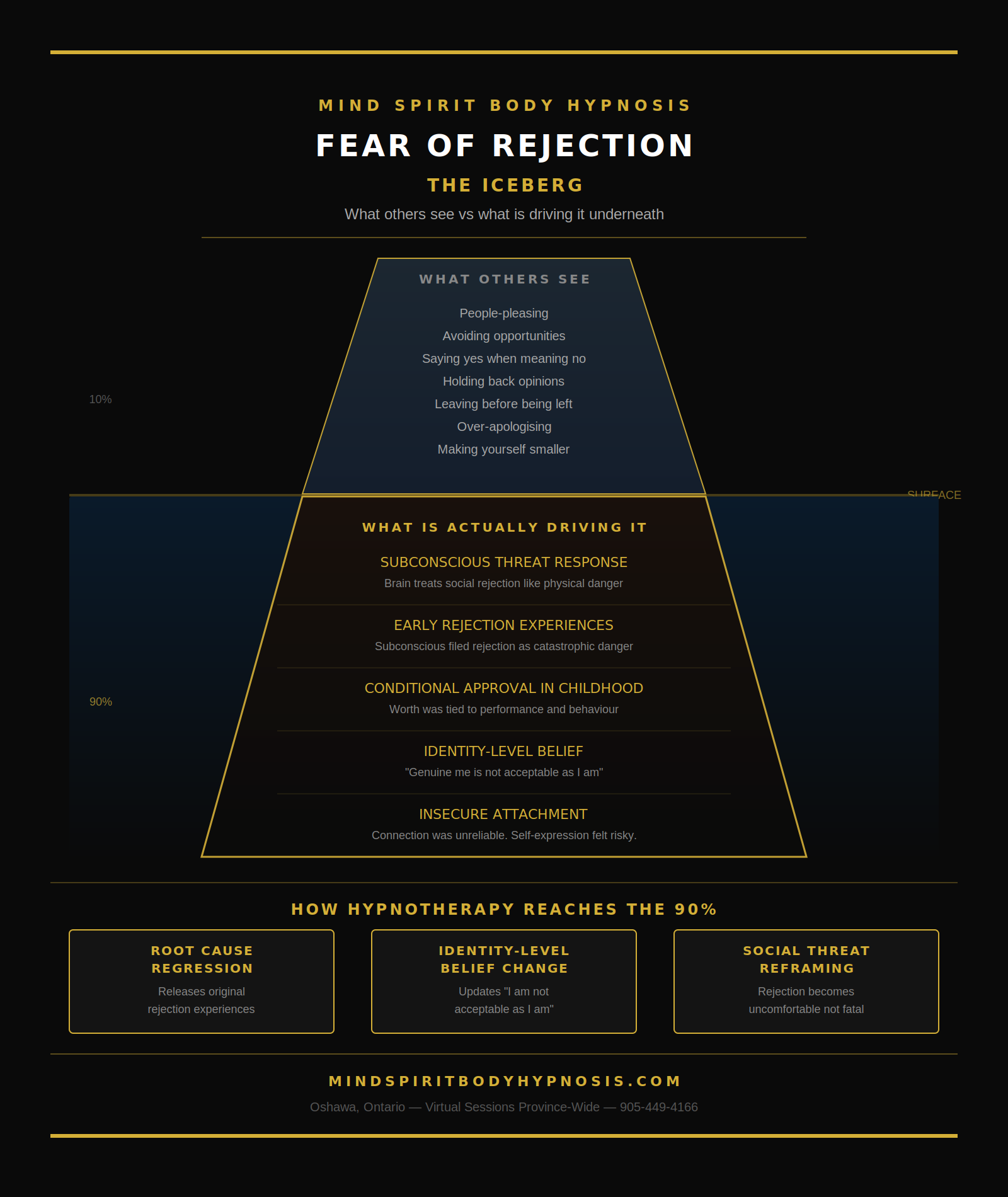
Fear of rejection is almost always rooted in early experience. The subconscious mind of a child is highly attuned to the social environment in which it grows up, and it draws powerful conclusions from repeated experiences of dismissal, criticism, conditional acceptance, or emotional unavailability.
Common origins include:
Conditional approval in childhood. When love, praise, or acceptance from caregivers was consistently tied to performance, behaviour, or meeting specific expectations, the subconscious concluded that approval must be earned and that failure to earn it leads to loss of connection. This pattern, once established, generalizes to all relationships and contexts.
Significant early rejection experiences. Bullying, social exclusion, public humiliation, or a formative experience of being turned down in a way that felt catastrophic can create a lasting subconscious template. The original event is filed as evidence that rejection is dangerous, and the subconscious applies that template to new situations automatically.
Attachment disruption. Research by John Bowlby and Mary Ainsworth on attachment theory consistently demonstrates that insecure attachment in early childhood, particularly anxious attachment formed when caregivers were inconsistently available, produces heightened sensitivity to social rejection in adult life (Bowlby, 1988).
Trauma or emotional neglect. When early emotional experiences involved neglect, abandonment, or chronic misattunement, the subconscious concludes that connection is unreliable and that expressing genuine needs or desires risks loss of the relationship entirely.
In every case, the mechanism is the same: an early experience generated a subconscious conclusion about what rejection means and how dangerous it is, and the subconscious has been applying that conclusion ever since.
How Fear of Rejection Shows Up in Daily Life
Fear of rejection rarely announces itself directly. It shows up as patterns that look like personality traits or sensible caution from the outside:
In relationships: Difficulty expressing needs, chronic people-pleasing, staying in relationships that are not working to avoid the pain of ending them, or conversely ending relationships first before the other person can leave. Jealousy, reassurance-seeking, and hypervigilance to signs of disapproval or distance.
In career and creative life: Not applying for roles or opportunities because the possibility of rejection feels worse than the certainty of staying put. Withholding ideas, opinions, or creative work to avoid criticism. Over-preparing as a way of reducing the chance of rejection while never quite feeling ready enough to begin.
In social situations: Avoiding new social environments, over-rehearsing conversations, interpreting neutral responses as negative, and withdrawing after any perceived slight or coolness from others.
In communication: Saying yes when meaning no. Softening requests until they become unclear. Apologizing excessively. Framing needs as questions to give the other person maximum room to decline without it counting as rejection.
For more on how fear of rejection overlaps with self-sabotage patterns, the hypnotherapy for self-sabotage pillar page at Mind Spirit Body Hypnosis covers the broader mechanisms in detail.
How Hypnotherapy Addresses Fear of Rejection at the Root
As a certified hypnotherapist and NLP Master Practitioner, I work with fear of rejection at the level where it was formed, not at the level of conscious behaviour management.
Root cause regression. The session traces the fear of rejection back to its source. In trance, those early experiences are revisited with adult perspective and resources, the emotional charge attached to them is released, and the subconscious receives an updated conclusion: that rejection is uncomfortable but not dangerous, and that worth is not conditional on being accepted by any particular person in any particular moment.
Identity-level belief change. Fear of rejection is fundamentally an identity issue. The subconscious holds a belief that who you are is not enough, that genuine self-expression risks loss of connection, and that the safest version of yourself is a smaller, more accommodating one. NLP logical levels work addresses this at the identity level, installing a new core belief that the self is inherently acceptable regardless of any single person's response.
Social threat reframing. Using submodality work and direct suggestion in trance, the internal experience of potential rejection is changed. Rather than representing catastrophic danger, it becomes uncomfortable but manageable, a normal feature of a life lived with genuine self-expression rather than a signal to retreat.
Future pacing. The subconscious is walked through vivid, fully sensory scenes of the client expressing their genuine self, making requests, putting forward ideas, and handling rejection with ease and equanimity when it occurs. These scenes are filed as expected memory, making this new way of operating feel familiar rather than terrifying.
A meta-analysis published in the International Journal of Clinical and Experimental Hypnosis found that hypnotherapy produced significantly greater reductions in anxiety and avoidance behaviour compared to control conditions, with the largest effect sizes seen in presentations rooted in subconscious threat-based learning (Kirsch et al., 1995).
For more on how low self-esteem and the fear of rejection reinforce each other, the hypnotherapy for self-esteem page covers the overlapping subconscious patterns.
NLP Techniques That Dissolve the Rejection Response
NLP offers precise tools for dismantling the internal architecture of rejection fear quickly and practically. Clients I work with in Ontario find these particularly useful because they can be applied independently between sessions.
Submodality work on the rejection image. The internal representation of being rejected has a specific structure: a mental image with particular qualities of size, distance, colour, and emotional tone. Changing those qualities directly reduces the fear response. When the anticipated rejection scene is made smaller, more distant, less vivid, and drained of its emotional charge, the avoidance drive it generates weakens proportionally.
The meta mirror. A powerful NLP technique for shifting the internal relationship the person has with the possibility of rejection. Used to move from a trapped first-person experience of shame and danger to a broader, more resourceful perspective from which rejection is simply information rather than catastrophe.
Logical levels of belief change. Fear of rejection almost always involves beliefs at the identity level. "I am not someone people choose." "Genuine me is not acceptable." Logical levels work addresses these beliefs directly at the structural level rather than arguing with their content, which produces lasting change rather than temporary reassurance.
Anchoring social confidence. A genuinely confident, grounded, self-accepting state experienced during trance is anchored to a physical cue. The client activates this anchor before any situation where rejection fear typically fires, shifting the internal state from threatened to grounded before the interaction begins.
The full approach used at Mind Spirit Body Hypnosis, including how NLP and hypnotherapy are combined in practice, is outlined on the about page.

What to Expect in a Session
The first session is a conversation. Where does the fear of rejection show up most in your life? What does it cost you? What would you do differently if the fear were gone? Is there a specific early experience that comes to mind when you think about rejection?
This mapping shapes the subconscious work. The induction is gentle, and most clients reach a deeply relaxed state within minutes. The core work then targets the specific origins and subconscious beliefs identified in the conversation.
Most fear of rejection programs at Mind Spirit Body Hypnosis run between four and six sessions. Many clients notice a meaningful shift in how potential rejection feels after the first two sessions: less urgent, less threatening, easier to hold with perspective. Later sessions deepen the identity-level work and install the NLP tools for independent use.
All sessions are delivered virtually, available to clients aged 10 and older across Ontario.
What My Clients Say
"Working with Fanis has changed my life. After years of therapy for anxiety and confidence issues, I wanted to try something different. This experience has transformed me from the inside out and continues to have an effect even after our sessions. I am now able to be myself, face my fears, surround myself with those who care about me and live a fulfilling and happy life. So grateful."
Kristen W. | Anxiety and Confidence | Five Stars
FAQ
Can hypnotherapy help with fear of rejection? Yes. Hypnotherapy works directly with the subconscious roots of rejection fear, accessing the original experiences and beliefs that established the threat response and updating them at the level where they are held. Research supports hypnotherapy as an effective approach for anxiety-driven avoidance behaviours.
What causes fear of rejection? Fear of rejection typically originates in early experiences of conditional approval, significant rejection events, insecure attachment, or emotional neglect. The subconscious drew a conclusion from these experiences that rejection is dangerous, and it has been applying that conclusion automatically ever since.
Why does rejection feel so painful? The brain processes social rejection in the same regions that process physical pain. This is an evolutionary survival mechanism: for most of human history, social rejection threatened survival. The alarm system is therefore highly sensitive, and it fires in response to anticipated rejection as readily as actual rejection.
How does fear of rejection affect relationships? Fear of rejection drives people-pleasing, chronic reassurance-seeking, difficulty expressing needs, staying in unsuitable relationships to avoid the pain of ending them, and hypervigilance to any signs of disapproval or distance. It often produces the very disconnection it is trying to prevent.
What is the best therapy for fear of rejection? Approaches that work at the subconscious level, including hypnotherapy and NLP, are particularly effective because they address the threat-based learning that drives the fear rather than managing the conscious thoughts and behaviours it produces. At Mind Spirit Body Hypnosis, hypnotherapy and NLP are combined for a comprehensive result.
How many sessions will I need? Most clients at Mind Spirit Body Hypnosis are working on fear of rejection, and complete four to six sessions. Many notice a meaningful reduction in the intensity of the fear response after the first two. The timeline depends on the depth of the original pattern and whether there are compounding anxiety or trauma components.
Is this suitable for younger clients? Yes. Mind Spirit Body Hypnosis works with clients aged 10 and older. Fear of rejection is particularly common in adolescents navigating peer relationships and social identity, and responds well to hypnotherapy and NLP.
Can I do sessions virtually from anywhere in Ontario? Yes. All sessions are delivered virtually, province-wide, with no referral required.
What if I have always been like this? Lifelong patterns can absolutely shift. The subconscious does not have an expiry date on change. Many clients who have organized their entire lives around avoiding rejection find that addressing the root produces changes they did not believe were possible.
How do I get started? Book a free 30-minute virtual strategy session at calendly.com/mindspiritbodyhypnosis. No referral needed.
Ready to Take the Next Step?
If fear of rejection has been quietly making your decisions for you, shrinking your world, softening your voice, and steering you away from the things you most want, you do not have to keep living inside those limits.
I offer a free 30-minute virtual strategy session for new clients across Ontario. There is no pressure, just a conversation about what has been getting in the way and how hypnotherapy or NLP may help.
Book your free session: calendly.com/mindspiritbodyhypnosis
Call or text:905-449-4166
Email:mindspiritbodyhypnosis@gmail.com
Visit:mindspiritbodyhypnosis.com
Serving clients virtually across Ontario, including Durham Region, Toronto, Ottawa, and beyond.
Disclaimer: This article is for informational purposes only and does not constitute medical or psychological advice. Hypnotherapy, NLP, and EMDR are complementary approaches and are not a substitute for diagnosis or treatment by a qualified healthcare provider. Please consult a licensed professional if you have concerns about your mental or physical health.
Written by Fanis Makrigiannis | Certified Hypnotherapist & NLP Master Practitioner | Mind Spirit Body Hypnosis.