Does hypnosis actually work for chronic fatigue?
Can Hypnotherapy Help With Chronic Fatigue?
TL;DR: Chronic fatigue is not laziness, and it is not simply tiredness. It is a nervous system and subconscious pattern in which the body's energy regulation system has become dysregulated, often following prolonged stress, illness, trauma, or burnout, and rest alone cannot restore it. At Mind Spirit Body Hypnosis in Oshawa, Ontario, Fanis Makrigiannis uses hypnotherapy and NLP to work directly with the nervous system patterns, subconscious beliefs, and emotional drivers maintaining chronic fatigue, helping clients of all ages across the province begin to recover genuine energy rather than just manage exhaustion.
Quick Answer
Hypnotherapy for chronic fatigue is a subconscious-focused approach that addresses the nervous system dysregulation, psychological patterns, and unresolved emotional material that maintain persistent exhaustion even when sleep and rest are adequate, by retraining the autonomic nervous system and accessing the deeper subconscious patterns driving the condition. Research published in the Journal of Chronic Fatigue Syndrome found hypnotherapy effective in managing fatigue, pain, cognitive function, and mood in people with CFS. Fanis Makrigiannis, a Certified Hypnotherapist and NLP Master Practitioner at Mind Spirit Body Hypnosis in Oshawa, Ontario, offers virtual sessions across the province for clients of all ages who are exhausted in ways that sleep does not fix.
Questions This Article Answers
Can hypnotherapy help with chronic fatigue syndrome?
What causes chronic fatigue that sleep does not fix?
How is chronic fatigue different from being tired?
What is the role of the nervous system in chronic fatigue?
What is the best treatment for chronic fatigue syndrome?
In This Article:
You sleep eight hours and wake up exhausted. You rest on weekends and return on Monday, no more recovered than when you left. You push through each day on a baseline of depletion that caffeine manages but never fixes. And you have been doing this for so long that you have forgotten what it felt like to have energy.
This is not tiredness. Tiredness resolves with rest. What you are describing is chronic fatigue, and rest alone is not reaching the root.
In my practice, clients presenting with chronic fatigue often arrive having seen multiple practitioners and received either a diagnosis they do not know what to do with, or no diagnosis at all. Many have been told their blood is normal, that there is nothing physically wrong, and to manage their energy carefully. Very few have been told that the nervous system itself may be stuck in a pattern that is actively preventing genuine recovery.
What Is Chronic Fatigue and How Is It Different From Tiredness?
Tiredness is a normal physiological response to exertion, inadequate sleep, or high demand. It is temporary, proportionate to the cause, and resolved reliably by rest.
Chronic fatigue is something different. It is persistent, often severe exhaustion that is not proportionate to activity levels, is not relieved by rest, and significantly impairs daily functioning. In its clinical presentation as Myalgic Encephalomyelitis and Chronic Fatigue Syndrome (ME/CFS), it is formally recognized by Health Canada and characterized by post-exertional malaise, unrefreshing sleep, cognitive difficulties (commonly called brain fog), and a range of other symptoms that fluctuate unpredictably.
Beyond the clinical presentation of ME/CFS, many people experience chronic fatigue as a functional pattern without meeting full diagnostic criteria: persistent depletion, a sense of running on empty regardless of sleep, and a body that no longer responds to rest the way it used to. This presentation is increasingly recognized as a nervous system and subconscious phenomenon, not simply a physical one.
According to the Public Health Agency of Canada, approximately 580,000 Canadians meet criteria for ME/CFS, with many more experiencing subclinical chronic fatigue states associated with prolonged stress, burnout, or post-viral illness. Ontario's rate of diagnosed fatigue-related conditions is among the highest in Canada, reflecting the chronic stress demands of urban and suburban life in the GTA and surrounding regions.
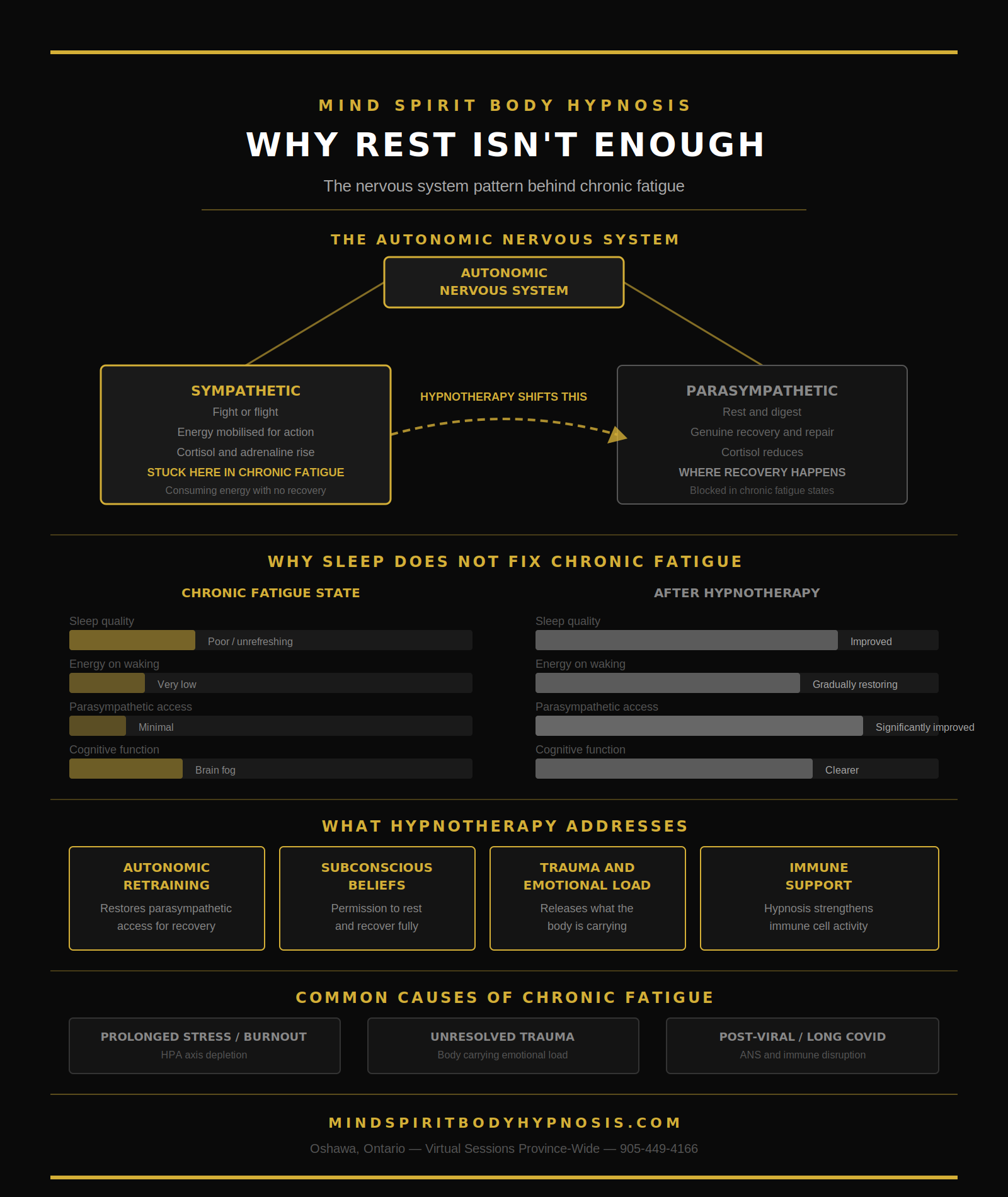
What Causes Chronic Fatigue That Sleep Does Not Fix?
The fact that sleep does not fix chronic fatigue is the clearest indicator that the root is not simply insufficient rest. Sleep deprivation produces tiredness. Chronic fatigue has different drivers.
Nervous system dysregulation. The autonomic nervous system governs the body's energy management. When it becomes stuck in a sustained sympathetic state, the fight-or-flight response that was designed for short-term threat management, it consumes energy continuously without allowing genuine recovery. The body cannot fully enter the parasympathetic rest-and-digest state even during sleep. Rest occurs on the surface. Physiological recovery does not.
Prolonged stress and burnout. Extended periods of high demand, whether from work, caregiving, grief, or chronic anxiety, can exhaust the HPA axis, the hormonal system governing the cortisol stress response. When cortisol regulation becomes impaired, the body loses its normal rhythm of energy and recovery. Fatigue becomes chronic rather than situational.
Trauma and unresolved emotional material. Research increasingly links unresolved trauma and chronic emotional suppression to physical fatigue states. The body carries what the mind has not been allowed to process. The energy cost of holding unresolved material in the nervous system is high and ongoing.
Post-viral presentations. Viral illness, particularly in the context of conditions like long COVID, can trigger persistent fatigue states that appear to involve immune dysregulation, neurological inflammation, and autonomic nervous system disruption. Hypnotherapy's capacity to directly influence the autonomic nervous system and support immune function makes it particularly relevant in this context.
Subconscious beliefs about energy and self. Some clients with chronic fatigue carry deep subconscious beliefs that rest is not permitted, that productivity defines worth, or that stopping is dangerous. These beliefs maintain a hypervigilant internal state that prevents genuine physiological recovery regardless of outward rest.
Research published in the Journal of Chronic Fatigue Syndrome found that hypnotherapy produced significant improvements across multiple CFS symptom domains, including fatigue control, mood, pain, and cognitive function, with researchers noting that hypnotherapy's direct access to subconscious and autonomic processes made it uniquely positioned to address the multifactorial nature of the condition (Bongartz et al., 2002).
How Is the Nervous System Involved in Chronic Fatigue?
Understanding the autonomic nervous system's role in chronic fatigue is central to understanding why hypnotherapy works for it when rest alone does not.
The autonomic nervous system has two primary branches. The sympathetic branch activates for threat and exertion, mobilizing energy for action. The parasympathetic branch governs recovery, repair, digestion, and genuine rest. Healthy energy management requires the two to cycle appropriately: sympathetic activation when needed, parasympathetic recovery when the demand has passed.
In chronic fatigue, this cycling is disrupted. The sympathetic branch has become chronically dominant. Research using heart rate variability measurement, one of the most reliable indicators of autonomic function, consistently shows significantly reduced parasympathetic activity in people with ME/CFS and chronic fatigue states, indicating a nervous system stuck in a low-grade survival mode rather than cycling into genuine recovery (Fonseca et al., 2020).
The hypnotic trance state produces a measurable and significant shift toward parasympathetic dominance. This is not relaxation in the ordinary sense. It is a genuine physiological shift in autonomic balance that creates the conditions for genuine recovery rather than surface-level rest. For clients with chronic fatigue, this shift is often experienced as profoundly different from anything achieved by conventional rest, meditation, or sleep.
For more on how the nervous system and sleep interact and how hypnotherapy addresses both, the hypnotherapy for sleep and insomnia page at Mind Spirit Body Hypnosis covers the overlapping mechanisms.
How Hypnotherapy Addresses Chronic Fatigue at the Root
As a certified hypnotherapist trained through the American Board of Hypnotherapy, I approach chronic fatigue as a multifactorial pattern with nervous system, subconscious, and emotional components. The work is paced carefully to the client's current energy capacity.
Autonomic nervous system retraining. The primary focus of early sessions is restoring parasympathetic access. Using deep trance induction, the nervous system is guided into a genuinely parasympathetic state, demonstrating to the subconscious that this level of recovery is available. Over sessions, the nervous system begins to carry this pattern beyond the trance state itself. Many clients report sleeping more deeply, feeling more recovered after rest, and noticing a gradual lifting of the baseline depletion.
Subconscious belief work. Where chronic fatigue is maintained by beliefs about productivity, worth, or the danger of stopping, these are addressed directly in trance. The subconscious permission to rest, to recover, and to receive rather than only give is often one of the most significant shifts in the entire programme.
Trauma and unresolved emotional material. When chronic fatigue is linked to unresolved stress, grief, or trauma, the emotional material that the body is carrying is addressed in trance using regression work and guided imagery. As the emotional load reduces, clients frequently notice a corresponding improvement in their physical energy.
Immune system support. Research at Washington State University found that hypnotic suggestion significantly strengthened immune cell activity, including natural killer cell function and lymphocyte response, suggesting that hypnotherapy's influence on the nervous system extends to immune regulation (Ruzyla-Smith et al., 1995). For clients whose fatigue has a post-viral or immune component, this dimension of the work may be particularly relevant.
Future pacing and energy identity. Sessions include vivid, sensory-rich scenes of the client moving through daily life with genuine energy, engaging fully, resting without guilt, and functioning at a level they may not have experienced in years. These scenes update the subconscious expectation of what is possible.
For more on how anxiety and chronic stress deplete the nervous system and how hypnotherapy addresses the root, the hypnotherapy for anxiety and stress page covers the cortisol and HPA axis mechanisms in detail.
NLP Techniques That Support Energy Recovery
NLP offers practical tools that complement the deeper hypnotherapy work and can be used independently between sessions.
Submodality works on the fatigue experience. The internal experience of chronic fatigue has a specific structure: a weight, a location, a colour, a quality. Submodality work changes those qualities directly. When the fatigue is made lighter, less heavy, more distant, and less all-consuming in the internal representation, the physiological experience of it shifts proportionally.
Anchoring a vitality state. Any available moment of genuine energy or aliveness, however brief, is used to create a neurological anchor. Activating this anchor during low-energy periods does not replace genuine recovery, but it does provide access to a different internal state than the fatigue-identified baseline most clients are running from.
Parts integration. Many clients with chronic fatigue have an internal conflict between the part that desperately wants to push through and keep going, and the part that is exhausted and needs to stop. NLP parts integration resolves this conflict, allowing the person to rest without internal argument and to act without the guilt and hypervigilance that often accompany any reduction in productivity.
Timeline work. When chronic fatigue traces to a specific precipitating event or period, timeline work revisits that origin, releases the emotional charge, and allows the nervous system to begin its recovery from a different internal starting point.
More about the clinical approach at Mind Spirit Body Hypnosis is available on the about page.

What to Expect in a Session
The first session is paced carefully. How long have you been experiencing chronic fatigue? Was there a clear onset or did it develop gradually? What does a typical day look and feel like? What have you already tried? And importantly, what does your body feel like right now, today, in this moment?
The induction for chronic fatigue clients is slower and gentler than for other presentations. The goal in early sessions is not to push through material but to restore the parasympathetic access that genuine recovery requires. Most clients find the trance experience itself significantly different from any form of rest they have previously accessed.
Most chronic fatigue programmes at Mind Spirit Body Hypnosis run between five and eight sessions, reflecting the layered nature of the pattern. Early sessions focus on nervous system regulation. Later sessions address subconscious beliefs, emotional material, and identity-level work around energy, rest, and worth. All sessions are delivered virtually and are available to clients aged 10 and older across Ontario.
What My Clients Say
“I was desperately seeking help for insomnia and was tired of relying on a substance or a pill to help me sleep. I've suffered from insomnia for 9 years and was nearly hospitalized from being awake for over 72 hours. I'm now sleeping with zero substance and zero pills. Fanis is absolutely amazing and I felt comfortable right from the beginning. He's helped change my life in such a short period of time.”
Holly G. | Burnout and Insomnia | Five Stars
FAQ
Can hypnotherapy help with chronic fatigue syndrome? Yes. Research published in the Journal of Chronic Fatigue Syndrome found that hypnotherapy produced significant improvements across multiple CFS symptom domains. Hypnotherapy's direct access to autonomic nervous system function and subconscious patterns makes it particularly well suited to a condition with both physiological and psychological components.
What causes chronic fatigue that sleep does not fix? The most common causes are autonomic nervous system dysregulation, prolonged stress or burnout depleting the HPA axis, unresolved trauma or emotional material carried in the nervous system, post-viral presentations, and subconscious beliefs that prevent genuine physiological recovery. Rest addresses surface tiredness but does not reach these underlying patterns.
How is chronic fatigue different from being tired? Tiredness is proportionate to exertion and resolves reliably with rest. Chronic fatigue is persistent, disproportionate to activity, and not relieved by rest. It significantly impairs daily functioning and is increasingly understood as a nervous system and subconscious pattern rather than simply a physical one.
What is the role of the nervous system in chronic fatigue? In chronic fatigue, the autonomic nervous system becomes stuck in sympathetic dominance, consuming energy continuously without allowing genuine parasympathetic recovery. Research using heart rate variability measurement consistently shows significantly reduced parasympathetic activity in people with CFS and chronic fatigue states. Hypnotherapy produces a measurable shift toward parasympathetic dominance, creating the conditions for genuine recovery.
What is the best treatment for chronic fatigue syndrome? Current evidence supports a multimodal approach including graded activity, psychological support, and complementary therapies. Hypnotherapy is particularly effective because it directly addresses autonomic nervous system dysregulation, subconscious beliefs about rest and worth, and unresolved emotional material that conventional approaches often cannot reach.
How many sessions will I need? Most clients at Mind Spirit Body Hypnosis working on chronic fatigue complete five to eight sessions. Early sessions focus on nervous system regulation and restoring parasympathetic access. Later sessions address deeper subconscious and emotional patterns.
Is this suitable for younger clients? Yes. Mind Spirit Body Hypnosis works with clients aged 10 and older. Chronic fatigue patterns in younger people, including adolescents, often respond well to hypnotherapy and NLP, which are gentle and medication-free.
Can I do sessions virtually from anywhere in Ontario? Yes. All sessions are delivered virtually, province-wide, with no referral required. The virtual format is particularly valuable for clients with chronic fatigue as it removes the energy cost of travel.
What if I have had this for years? Long-standing chronic fatigue can absolutely improve. The nervous system retains the capacity for change regardless of how long the pattern has been established. Many clients who have been exhausted for years notice meaningful shifts within the first few sessions.
How do I get started? Book a free 30-minute virtual strategy session at calendly.com/mindspiritbodyhypnosis. No referral needed.
Ready to Take the Next Step?
If you have been running on empty for months or years and nothing has fully restored your energy, that is not simply your body failing you. It is a nervous system pattern. And it can change.
I offer a free 30-minute virtual strategy session for new clients across Ontario. There is no pressure, just a conversation about what is happening and how hypnotherapy or NLP may support your recovery.
Book your free session: calendly.com/mindspiritbodyhypnosis
Call or text: 905-449-4166
Email: mindspiritbodyhypnosis@gmail.com
Visit: mindspiritbodyhypnosis.com
Serving clients virtually across Ontario, including Durham Region, Toronto, Ottawa, and beyond.
Disclaimer: This article is for informational purposes only and does not constitute medical or psychological advice. Chronic fatigue syndrome is a recognized medical condition that requires assessment and management by a qualified healthcare provider. Hypnotherapy and NLP are complementary approaches and are not a substitute for medical care. If you are experiencing persistent fatigue, please consult your doctor before pursuing complementary treatment. Results vary by individual.
Written by Fanis Makrigiannis | Certified Hypnotherapist & NLP Master Practitioner | Mind Spirit Body Hypnosis.