Advanced Hypnotherapy for burnout
Hypnotherapy for Burnout Recovery in Ontario: Your Questions Answered
TL;DR: Burnout is not a character flaw, a productivity failure, or simply needing more sleep. It is a specific state of nervous system depletion that develops after prolonged stress without adequate recovery, and it has a clear subconscious dimension that rest alone cannot address. This article answers the five questions Ontarians are asking most about burnout and hypnotherapy, directly and without the hustle-culture framing that makes burnout so hard to talk about honestly.
Quick Answer
Burnout is a state of chronic nervous system exhaustion produced by sustained stress without adequate recovery, characterized by emotional depletion, reduced motivation, cognitive fog, and a paradoxical inability to rest even when rest is available. Research confirms that approximately 78 percent of Canadians have experienced burnout at some point in their career, with 35 percent reporting current burnout. Hypnotherapy addresses burnout at the subconscious level, where chronic threat activation, identity beliefs around productivity, and an inability to disengage operate, producing a nervous system reset that time off alone rarely achieves. At Mind Spirit Body Hypnosis in Oshawa, Ontario, Fanis Makrigiannis, a Certified Hypnotherapist and NLP Master Practitioner, offers virtual sessions province-wide for clients of all ages who are ready to recover at the root rather than waiting for burnout to lift on its own.
Questions This Article Answers
What is burnout and how is it different from being tired?
Why do I feel exhausted even after rest?
Can burnout cause physical symptoms?
How long does burnout recovery take?
Can hypnotherapy help with burnout recovery?
In This Article:
The most common thing I hear from clients presenting with burnout is that they took time off and came back feeling the same.
Sometimes worse.
This is one of the most demoralizing features of burnout and one of the most diagnostically important. If rest were the problem, rest would be the solution. The fact that it is not tells you something essential about what burnout actually is. It is not tiredness that a good weekend or a week of annual leave will resolve. It is a specific state of nervous system dysregulation that has become the body's new default, and changing a default requires a different kind of intervention than the one that produced it.
In my practice, the clients who arrive for burnout work are often the most capable, conscientious, and high-functioning people I see. They have not burned out because they are weak or undisciplined. They have burned out. They are the kind of person who carries more than their share for longer than is sustainable, because they do not recognize the early signals, and because the identity beliefs they hold about productivity and rest make it extraordinarily difficult to stop before depletion becomes collapse.
Understanding burnout clearly is the first step to recovering from it.
What Is Burnout and How Is It Different From Being Tired?
This is the most important distinction to establish, because the answer determines whether rest will help or whether something more fundamental needs to change.
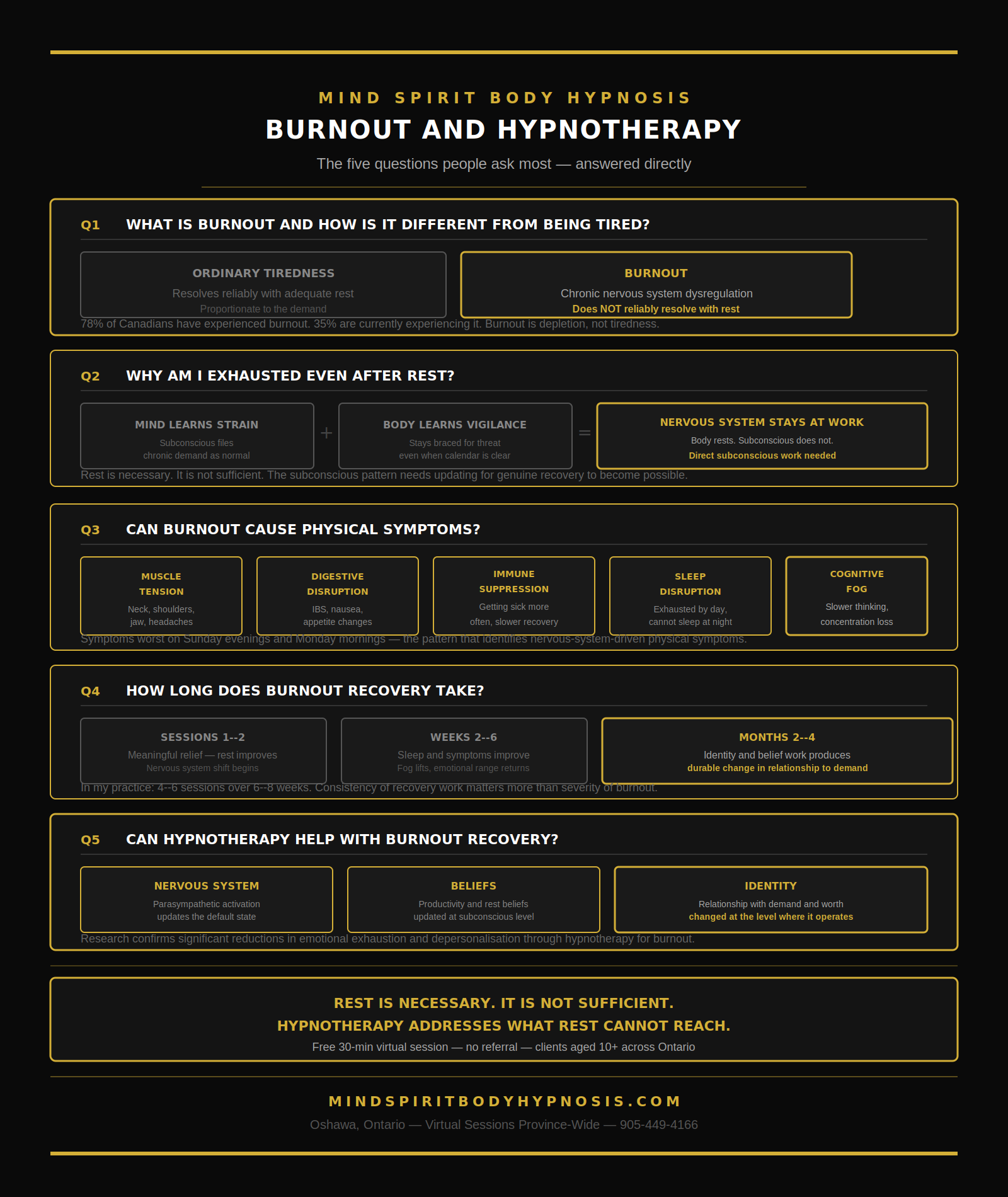
Ordinary tiredness is the body's signal that it needs recovery from a specific physical or mental demand. It is proportionate to the activity that produced it, it resolves reliably with adequate rest, and it does not persist beyond the recovery period. You work hard, you rest, you recover. The cycle is intact.
Burnout is a qualitatively different state. It is the result of the stress-recovery cycle breaking down entirely from sustained demand without adequate recovery for long enough that the nervous system has stopped returning to baseline. Burnout is not simply a bad week or a passing loss of motivation. It tends to build gradually, often in capable, conscientious people who have carried too much for too long. By the time it is recognized, the person is not simply tired. They are depleted in a way that rest does not reliably address.
The clinical picture of burnout includes three characteristic dimensions, first identified by researcher Christina Maslach and now the standard framework for burnout assessment:
Emotional exhaustion. The feeling of being emotionally drained, of having nothing left to give, of running on fumes even at the beginning of the day. Emotional exhaustion is the core of burnout and the dimension that people most readily identify in themselves.
Depersonalization or cynicism. A distancing response to the exhaustion, becoming detached, cynical, or emotionally numb toward work, relationships, or responsibilities that previously felt meaningful. This is a protective subconscious mechanism: when the nervous system is overwhelmed, emotional engagement is reduced to preserve resources.
Reduced sense of efficacy. The sense that nothing one does makes a difference, that effort is no longer producing results, that competence and capability have deserted the person. This dimension is particularly distressing for high-achievers, whose identity is often deeply tied to their effectiveness.
The practical distinction between tiredness and burnout is this: tiredness improves with rest. Burnout does not reliably improve with rest alone and may not improve at all until the subconscious patterns driving it are directly addressed.
⭐ Pro Tip: The most reliable self-test for burnout versus ordinary tiredness is the Monday morning test. If the prospect of another week produces a quality of dread, flatness, or resistance that is not proportionate to anything specifically difficult about the upcoming week, that is a burnout signal rather than a tiredness signal. Ordinary tiredness produces the wish for more rest. Burnout produces a more pervasive sense of depletion that the prospect of rest does not meaningfully address.
Why Do I Feel Exhausted Even After Rest?
This question describes one of the most characteristic and most confusing features of burnout, and the answer reveals why rest alone is rarely sufficient to resolve it.
Burnout has both a psychological and physiological pattern. The mind learns strain. The body learns vigilance. Repeated pressure conditions the system to stay braced, and after a while that response can become automatic.
This is the key mechanism. When the nervous system has been in sustained threat activation for an extended period, it undergoes a form of learning. The chronic sympathetic activation, the constant low-level alertness, the inability to fully disengage, and the hypervigilance about demands become the default operating state. The nervous system has learned that this is what normal feels like.
When the person takes time off, the conscious mind registers the absence of the demand. But the subconscious nervous system does not automatically update. It continues running the learned threat-activation pattern because that is now what it expects to do. The person is on leave, but their nervous system is still at work.
This is why people return from holidays or periods of rest still feeling depleted. The body was present for the rest. The nervous system was not. It was continuing to run the chronic activation pattern that burnout has trained it to maintain.
Added to this is the identity dimension. Many people in burnout hold deeply subconscious beliefs about the relationship between rest and worth. Rest without productivity feels dangerous, indulgent, or wrong. The holiday that was supposed to be recovery is spent feeling guilty about not working, monitoring the inbox, and planning how to manage the backlog upon return. The conscious mind rests. The subconscious does not get the message.
Clinical hypnosis for burnout is less about switching off and more about creating conditions in which recovery becomes possible again. The trance state produces genuine parasympathetic activation, the physiological opposite of the chronic sympathetic threat response. In trance, the nervous system is not told to relax. It is provided with the conditions in which relaxation naturally occurs. Over repeated sessions, the nervous system begins to update its default, learning that safety and disengagement are available states rather than threats to be managed.
For more on how anxiety and the nervous system dysregulation that sustains burnout are addressed together, the hypnotherapy for anxiety and stress pillar page covers the foundational mechanisms.
Can Burnout Cause Physical Symptoms?
Yes, and this is one of the most under-recognized dimensions of burnout, particularly for people who have been told their physical symptoms have no identifiable medical cause.
The nervous system does not draw a clear line between psychological and physical experience. When the sympathetic nervous system is in chronic activation, the effects are body-wide. The chronic elevation of stress hormones, including cortisol and adrenaline, produces measurable physical consequences across multiple systems.
Musculoskeletal. Chronic muscle tension, particularly in the neck, shoulders, jaw, and lower back. Tension headaches that arrive consistently and resist standard treatment. The body is braced for a threat that never fully resolves, and the musculature reflects that bracing continuously.
Cardiovascular. Elevated resting heart rate, palpitations, the sensation of the heart working harder than the situation warrants. Chronic stress hormone elevation produces genuine cardiovascular strain.
Digestive. Irritable bowel symptoms, nausea, changes in appetite in either direction, digestive disruption that correlates with stress periods. The gut-brain axis is highly responsive to nervous system state, and chronic activation reliably produces digestive dysregulation.
Immune. Increased susceptibility to illness, slower recovery from minor infections, the experience of getting sick repeatedly or of every workplace illness finding its way in. Chronic cortisol elevation suppresses immune function significantly.
Sleep. The paradoxical burnout sleep pattern: exhausted during the day, unable to sleep properly at night. The nervous system that cannot disengage during waking hours cannot fully disengage during sleep either. The person wakes tired from sleep that did not produce genuine rest.
Cognitive. Brain fog, difficulty concentrating, the sense that thinking has become slower or less reliable. The prefrontal cortex, the seat of executive function, planning, and clear thinking, is significantly impaired by chronic stress hormone elevation.
If you are experiencing persistent physical symptoms that have not responded to standard medical treatment, and those symptoms began or worsened during a period of sustained stress and high demand, burnout is a clinically appropriate consideration. This does not replace medical assessment; physical causes should always be investigated, but it adds the nervous system dimension that medical assessment alone may not address.
⭐ Pro Tip: The physical symptoms of burnout almost always follow a specific pattern: they are worst in the morning and on Sunday evenings, they reduce somewhat during holidays and then return when work resumes, and they are consistently worse during periods of high demand. This temporal pattern is the clearest indicator that the symptoms are nervous-system-driven rather than purely structural. It is also one of the most reliable indicators that hypnotherapy and nervous system regulation work will produce meaningful physical relief alongside the psychological recovery.
How Long Does Burnout Recovery Take?
This is the question people ask most urgently, and it deserves an honest answer rather than a reassuring one.
Burnout recovery is not linear, and it is not fast. The idea that burnout can be resolved in a two-week holiday, a wellness retreat, or a short course of any therapy is inconsistent with what burnout actually is. The nervous system that has been in sustained dysregulation for months or years does not return to baseline in weeks.
That said, meaningful change is possible relatively quickly through direct subconscious work, even if full recovery takes longer.
Here is a more realistic picture:
Immediate relief (sessions 1-2): Most clients notice a meaningful shift in nervous system state within the first two sessions. The quality of rest improves. The constant background tension reduces somewhat. The sense of not being able to switch off becomes less absolute. These early shifts are significant even if the full recovery is not yet present, because they demonstrate to the nervous system that a different state is available, which begins the updating process.
Early recovery (weeks 2--6): With consistent session work and the self-hypnosis practices installed in early sessions, the nervous system begins to spend more time in parasympathetic states. Sleep quality improves. The physical symptoms reduce. Cognitive fog lifts. The emotional flatness of burnout begins to give way to a wider range of emotional experience.
Deeper recovery (month 2): The identity-level work on the beliefs about rest, productivity, worth, and boundaries begins to produce durable change in how the person relates to demand. The chronic bracing reduces. The person begins to experience genuine rest rather than performing rest while the subconscious monitors the next demand.
Full recovery: Variable and individual. Burnout that has developed over years typically requires months of recovery work, not weeks. Burnout that is caught relatively early may resolve more quickly. The most reliable predictor of full recovery is not the severity of the burnout but the consistency of the recovery work and the willingness to address the identity and belief dimensions that produced the burnout in the first place.
In my practice, burnout presentations typically require between four and six sessions, with the nervous system regulation work beginning in session one and the deeper identity and belief work building across the programme. Most clients notice significant improvement within the first two sessions and complete the programme within six to eight weeks.
Can Hypnotherapy Help With Burnout Recovery?
Yes, and specifically because it addresses the dimensions of burnout that rest and time alone cannot reach.
Burnout has three dimensions that require direct intervention:
The nervous system dimension. The chronic sympathetic activation that produces the inability to rest, the persistent exhaustion, and the physical symptoms. Hypnotherapy produces genuine parasympathetic activation, the physiological state that is the opposite of the chronic threat response, and repeats that experience across sessions until it becomes more accessible between sessions. Research published in the European Journal of Integrative Medicine found that hypnotherapy led to a significant reduction in burnout symptoms including emotional exhaustion and depersonalization in healthcare professionals.
The subconscious belief dimension. The deeply held beliefs about productivity and worth the sense that rest must be earned, that stopping is dangerous, that value is conditional on performance prevent genuine disengagement even when the person is not working. These beliefs are subconscious and are not changed by conscious intention or rational understanding. Hypnotherapy addresses them directly in trance, updating the operating assumptions that have been producing the chronic overextension.
The identity dimension. For many people in burnout, the condition is connected to a deep identification with capability, productivity, and being the person others rely on. Recovery requires not just nervous system regulation but an identity-level update: a genuinely different relationship with rest, with limits, and with what gives the person value and meaning. This work, done in trance, produces changes that feel genuine rather than effortful.
The combination of these three dimensions nervous system regulation, belief updating, and identity work is what distinguishes hypnotherapy from rest alone, and from approaches that address only one layer of the burnout at a time.
For more on how sleep disruption, which is almost always a significant feature of burnout, is addressed alongside the recovery work, the hypnotherapy for sleep and insomnia pillar page covers the mechanisms in detail.
What to Expect at Mind Spirit Body Hypnosis
The first session is a conversation. When did the burnout begin? Was there a specific period, or was it a gradual accumulation? What does it feel like specifically? Which of the three burnout dimensions is most prominent? What has already been tried? What has the person sacrificed or stopped doing that they want to recover? And what does genuinely sustainable feel like to them, if they can still remember.
This conversation matters because burnout recovery is not generic. The specific beliefs, identity patterns, and nervous system history that produced the burnout in this particular person determine the most effective pathway through it.
The trance work begins with nervous system regulation, which provides immediate relief and demonstrates to the person that a different physiological state is available. The belief and identity work follows across subsequent sessions, addressed at the subconscious level where it needs to change rather than the conscious level where it is already understood.
All sessions are delivered virtually, available to clients aged 10 and older across Ontario. The virtual format is particularly valuable for burnout; a person in depletion often has significant practical difficulty adding a commitment that requires travel. More about the full programme is available on the about page.
What My Clients Say
"I began seeing Fanis after a long battle with trauma and grief. I suffered from severe anxiety, panic attacks, insomnia and self harm. After 3 months of weekly hypnotherapy sessions done online, I no longer suffer from panic attacks, insomnia, or self harm and have learned how to better regulate my emotions and find peace. Fanis helped me process many childhood traumas and confront my overwhelming grief. I am eternally grateful to Fanis and his wonderful work."
Sara V. | Trauma and Grief | Five Stars
"I cannot say enough about how amazing Fanis is! He has truly changed my life. I was always an anxious person and always overthinking everything. After seeing Fanis I feel like a completely different person. The anxiety is gone and my mind is actually quiet for the first time in my life. I am forever grateful."
Amanda B. | Anxiety and Overthinking | Five Stars
FAQ
What is burnout? Burnout is a state of chronic nervous system exhaustion produced by sustained stress without adequate recovery. It is characterized by emotional depletion, depersonalization or cynicism, reduced efficacy, and an inability to rest that persists even when the external demand is temporarily removed. Approximately 78 percent of Canadians have experienced burnout at some point in their career.
How is burnout different from being tired? Ordinary tiredness resolves reliably with rest. Burnout does not, because burnout is not a tiredness problem but a nervous system dysregulation problem. The chronic sympathetic activation of burnout has become the nervous system's default state, and rest without direct subconscious intervention does not reliably change that default.
Why am I exhausted even after rest? Because the nervous system learned to stay in chronic activation and does not automatically update when the external demand is removed. The body rests. The subconscious nervous system continues running the learned threat-activation pattern. Direct subconscious work is needed to update the default.
Can burnout cause physical symptoms? Yes. Chronic stress hormone elevation produces body-wide effects: muscle tension, headaches, cardiovascular strain, digestive disruption, immune suppression, sleep dysregulation, and cognitive fog. These symptoms follow a characteristic pattern worse on Sunday evenings and Monday mornings, improving somewhat during genuine holidays that distinguishes them as nervous-system-driven.
How long does burnout recovery take? Meaningful relief typically arrives within the first two sessions. More complete recovery takes months rather than weeks for established burnout. In my practice, burnout programmes run four to six sessions over six to eight weeks, with ongoing improvement continuing after the programme ends.
Can hypnotherapy help with burnout? Yes. Hypnotherapy addresses all three dimensions of burnout: the nervous system activation pattern, the subconscious beliefs about productivity and rest, and the identity-level relationship with demand and worth. Research confirms significant reductions in burnout symptoms, including emotional exhaustion and depersonalization, through hypnotherapy.
Why does taking time off not fix burnout? Because burnout is not a time-off problem. The subconscious nervous system continues running the chronic activation pattern during leave. The identity beliefs that prevent genuine disengagement remain unchanged. Rest is necessary but not sufficient. Hypnotherapy changes what rest cannot.
Is hypnotherapy safe for burnout? Yes. It is gentle, non-invasive, and medication-free. The trance state is physiologically consistent with the parasympathetic activation that burnout recovery requires. For burnout alongside significant depression or complex psychiatric presentations, suitability is assessed in the initial session.
Can I do sessions virtually from anywhere in Ontario? Yes. All sessions are delivered virtually, province-wide, with no referral required. The virtual format is particularly suited to burnout presentations.
How do I get started? Book a free 30-minute virtual strategy session at calendly.com/mindspiritbodyhypnosis. No referral needed.
Ready to Take the Next Step?
If you have taken time off and come back feeling the same, or if the prospect of another week produces dread rather than motivation, this is not a character problem. It is a nervous system pattern. And nervous system patterns can change.
I offer a free 30-minute virtual strategy session for new clients across Ontario. No pressure, no judgment. Just an honest conversation about what has depleted you and what recovery might actually look like.
Book your free session: calendly.com/mindspiritbodyhypnosis
Call or text: 905-449-4166
Email: info@mindspiritbodyhypnosis.com
Visit: mindspiritbodyhypnosis.com
Serving clients virtually across Ontario, including Durham Region, Toronto, Ontario and beyond.
Disclaimer: This article is for informational purposes only and does not constitute medical or psychological advice. Physical symptoms associated with burnout should be medically assessed. Hypnotherapy and NLP are complementary approaches and are not a substitute for medical care or mental health treatment. If you are experiencing a mental health crisis, please contact the 988 Suicide Crisis Helpline or go to your nearest emergency room. Results vary by individual.
Written by Fanis Makrigiannis | Certified Hypnotherapist & NLP Master Practitioner | Mind Spirit Body Hypnosis.