Hypnotherapy for anxiety relief Ontario
Hypnotherapy for Anxiety in Ontario: Your Questions Answered
TL;DR: Anxiety is not a thinking problem, a weakness, or something to simply manage for life. It is a subconscious threat response that can be directly addressed, and the questions people ask before their first session reveal exactly what has been missing from every approach they have already tried. This article answers the five most-searched anxiety questions in Ontario directly, honestly, and without the reassuring vagueness that tends to leave people no clearer than before they started reading.
Quick Answer
Anxiety is the nervous system's automatic threat response firing in situations where no genuine physical danger is present, triggered by subconscious patterns, learned associations, and belief structures that developed from specific past experiences and have been operating below conscious awareness ever since. Hypnotherapy addresses those subconscious patterns directly, producing change at the level where anxiety is generated rather than at the level where it is experienced. At Mind Spirit Body Hypnosis in Oshawa, Ontario, Fanis Makrigiannis, a Certified Hypnotherapist and NLP Master Practitioner, offers virtual sessions province-wide for clients of all ages who are ready to address the root rather than manage the symptoms.
Questions This Article Answers
What is the difference between stress and anxiety?
Why does anxiety come out of nowhere?
Is anxiety curable or is it something I just have to manage?
What does hypnotherapy for anxiety actually feel like?
Can anxiety and burnout be treated at the same time?
In This Article:
The most common thing I hear in the first few minutes of a free strategy session is some version of: I know logically that there is nothing to be afraid of. And it does not help. The anxiety is there anyway.
That observation contains everything important about what anxiety is and why conventional approaches so often fall short of resolving it. Anxiety is not a thinking problem. Knowing that something is not genuinely dangerous does not switch off a nervous system that has learned to respond to it as if it were. The knowledge lives in the conscious mind. The anxiety lives in the subconscious. They are operating at different levels, which is why conscious reassurance, rational reframing, and breathing through it produce limited and temporary relief but rarely lasting change.
Hypnotherapy works at the level where the anxiety lives.
What Is the Difference Between Stress and Anxiety?
This is one of the most practically important distinctions in mental health, and it is one that is routinely blurred in popular conversation. Understanding the difference changes how the person understands their own experience and what approach is most likely to help.
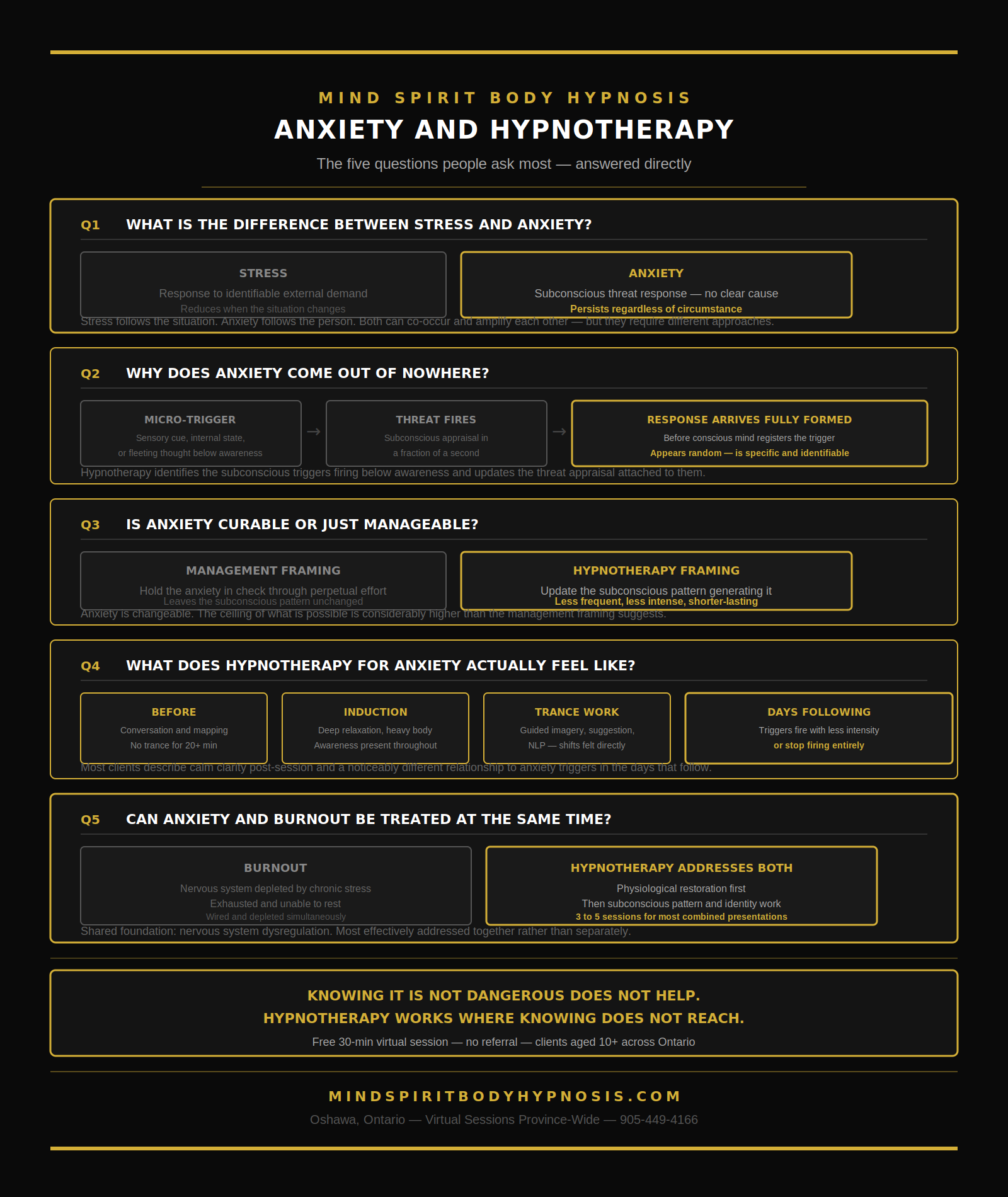
Stress is a response to an identifiable external demand. A deadline, a difficult relationship, financial pressure, a health concern, an accumulation of responsibilities that exceeds available resources. Stress is the nervous system's appropriate activation in response to a genuine situational challenge. When the situation changes, the deadline passes, the conflict resolves, the pressure lifts, stress typically reduces. Stress has a source, and removing or changing the source addresses it.
Anxiety is a threat response that occurs in the absence of, or disproportionate to, an identifiable external cause. The nervous system is activated not by a genuine current threat but by a subconscious pattern, an association, a belief, or a learned evaluation of certain situations as dangerous that fires automatically and produces the full physiological threat response regardless of what is actually happening externally. Anxiety persists when the situation has not changed or even when the external circumstances are genuinely fine. It does not reliably resolve when the apparent cause is removed because the actual cause is internal and subconscious.
The clinical significance of this distinction is substantial. Stress responds well to practical change: workload management, boundary-setting, situational problem-solving, relaxation techniques that reduce activation while the situation is addressed. Anxiety requires direct subconscious work because the driver is internal, automatic, and below the level of conscious reasoning.
Many people experience both. Genuine external pressures produce stress while the subconscious patterns produce anxiety, and the two amplify each other; stress depletes the nervous system's resources, making the anxiety patterns more easily triggered. At Mind Spirit Body Hypnosis, both dimensions are addressed: the nervous system regulation work that reduces the baseline activation, and the subconscious pattern work that changes what the nervous system evaluates as a threat.
⭐ Pro Tip: A reliable practical test: if the anxious feeling follows you into situations where there is nothing externally demanding or threatening happening, into rest, into enjoyment, into objectively safe moments, that is anxiety rather than stress. Stress follows the situation. Anxiety follows the person.
Why Does Anxiety Come Out of Nowhere?
This is the most distressing question about anxiety, and it describes one of its most characteristic and disorienting features: the way it can arrive with apparent randomness, in moments of relative calm, with no obvious trigger.
The experience of anxiety arriving out of nowhere is real. The cause, however, is not random. What appears to be unprompted anxiety is almost always a subconscious pattern firing in response to a trigger that is below the threshold of conscious awareness.
The trigger does not have to be obvious. It does not have to be a dramatic external event. It can be a sensory cue a smell, a sound, a quality of light that the subconscious has associated with a past threatening experience. It can be an internal state, a level of tiredness, a particular emotional texture, a slight change in physical sensation that the subconscious has learned to evaluate as the precursor to something dangerous. It can be a thought that passed through awareness so briefly that the conscious mind did not register it, but the subconscious responded to it fully.
The fight-or-flight response can be activated by these micro-triggers in a fraction of a second. The physiological response the racing heart, the chest tightening, the surge of alarm arrives fully formed before the conscious mind has had time to register what triggered it. The conscious mind, observing the anxiety response already underway, searches for a cause and finds nothing obvious. The anxiety appears to have come from nowhere.
This is one of the reasons that anxiety is so difficult to address through conscious reasoning alone. The trigger is subconscious. The response is subconscious. The conscious mind is an observer of an event that has already happened at a different level of the system.
Research published in the Journal of Anxiety Disorders consistently confirms that anxiety is primarily driven by automatic subconscious appraisal processes rather than conscious deliberative thought, and that interventions targeting these automatic processes produce significantly more durable outcomes than those targeting conscious cognition alone (Teachman et al., 2012).
Hypnotherapy identifies these subconscious triggers, often surfacing the specific sensory cues, internal states, or thought patterns that are firing below conscious awareness and directly updates the threat appraisal attached to them. When the subconscious no longer evaluates the trigger as dangerous, the anxiety response does not follow.
For more on how the subconscious patterns driving anxiety develop and how hypnotherapy addresses them specifically, the hypnotherapy for anxiety and stress pillar page covers the foundational mechanisms in detail.
⭐ Pro Tip: If your anxiety frequently arrives without an apparent trigger, start keeping a brief record of exactly what you were doing, feeling, and sensing in the five minutes before the anxiety arrived. Not an analysis -- just a description. Over several instances, patterns typically emerge: a consistent emotional state, a particular environment, a recurring internal sensation. Those patterns are the subconscious triggers. This record is also valuable to bring to the first hypnotherapy session, where it significantly accelerates the mapping process.
Is Anxiety Curable or Is It Something I Just Have to Manage?
This is the question that people ask most carefully, because it has often been answered in a way that quietly lowered their expectations before they had a fair chance at genuine change.
The direct answer is: anxiety is changeable. Not always to zero, and not without work. But the idea that anxiety is a fixed condition that can only be managed, held in check through perpetual effort is not an accurate picture of what is possible.
Here is a more precise way to think about it. Anxiety has two components. One is the baseline activation level of the nervous system, how hair-trigger reactive the threat system is in general. The other is the specific subconscious patterns, triggers, and beliefs that produce the anxiety response in particular situations.
Both are changeable. The baseline activation level changes as the nervous system is consistently brought into parasympathetic regulation through the relaxation work in hypnotherapy sessions, through the self-hypnosis tools practised between sessions, and as the specific anxiety patterns reduce and the nervous system spends less time in chronic activation. The specific patterns change as the subconscious threat associations are identified and updated through the direct subconscious work of hypnotherapy.
What this looks like in practice: clients who complete a full programme at Mind Spirit Body Hypnosis typically report not that they never feel any anxiety but that the anxiety is qualitatively different. It arrives less frequently, with less intensity, in fewer situations. When it does arrive, it passes more quickly and feels more manageable. The specific triggers that previously produced the most distressing anxiety often stop firing entirely. The background hum of chronic anxiety the constant low-level activation that makes everything slightly harder reduces significantly.
This is not management. It is change. Not every person achieves the same degree of change, and some anxiety presentations with significant biological components or deep developmental roots require more work and produce more modest gains. But the ceiling of what is possible with hypnotherapy is considerably higher than the management framing suggests.
What Does Hypnotherapy for Anxiety Actually Feel Like?
This is the transparency question the one that would genuinely help people decide whether to try hypnotherapy and that almost no promotional content answers specifically enough to be useful.
Here is an honest, session-by-session description of what most clients experience.
Before the trance. The first session begins with a conversation. There is no trance work in the first twenty minutes at minimum. The mapping conversation what the anxiety feels like, when it fires, what has already been tried, what the specific triggers and feared outcomes are comes first. This conversation itself is often valuable. Many clients report that being asked very specific questions about the structure of their anxiety, rather than just its emotional content, produces a quality of clarity and curiosity about their own experience that is different from how they usually relate to it.
The induction. The hypnotic induction is gentle and unhurried. Most clients describe it as the beginning of the deepest relaxation they have felt in a long time. There is no dramatic moment of going under. The awareness does not disappear. The body becomes heavy and comfortable. The quality of attention shifts more inward, more absorbed, with less monitoring of the external environment. Most clients notice a point at which they realize they have been quite still for some time without any effort.
The trance work. This varies by session and by what is being addressed. It might involve guided imagery, visiting a specific memory or imagining a future scenario, or direct suggestion delivered into the relaxed state. It might involve NLP techniques applied with the heightened receptivity of trance. Most clients describe being aware of what is being said throughout, sometimes vividly and sometimes more distantly, and noticing emotional or physical responses to the content: a releasing sensation, a change in how a memory feels, a quiet internal shift that is difficult to articulate but clearly felt.
After the session. Most clients describe waking from trance with a quality of calm and clarity that is different from ordinary rest. Some feel mildly tired, as if they have done something that required genuine attention. Many notice a change in how they feel about the specific material that was worked on; a memory that previously produced anxiety may feel less charged, a scenario that previously felt threatening may feel more navigable.
In the days following. Changes often continue after the session ends. Clients frequently report noticing, in the days following a session, that a situation that would previously have activated the anxiety either did not trigger it or triggered it with significantly less intensity. This between-session change is one of the most reliable indicators that the subconscious work is producing genuine updating rather than temporary symptom relief.
More about the full session experience at Mind Spirit Body Hypnosis is available on the about page.
Can Anxiety and Burnout Be Treated at the Same Time?
Yes, and in 2026, this is one of the most clinically relevant questions in the practice, as the intersection of anxiety and burnout has become increasingly prevalent among Ontario adults across every profession and life stage.
Anxiety and burnout are not the same condition, but they are deeply interconnected and frequently co-occur in a way that makes treating them separately less effective than addressing them together.
Burnout is the result of prolonged depletion and chronic stress that has exhausted the nervous system's adaptive resources to the point where the normal stress response is no longer functioning. The person is simultaneously exhausted and unable to rest, emotionally flat yet reactive, unmotivated and unable to disengage from responsibility. The nervous system has moved from chronic activation into a kind of collapsed dysregulation.
Anxiety, in the burnout context, is typically the nervous system's attempt to maintain alertness and responsiveness despite depletion. The threat response is still firing, generating the anxious activation, but the resources to respond to that activation are gone. The result is the characteristic burnt-out-and-anxious experience: wired and exhausted simultaneously, dreading the next demand while being unable to rest from the current one genuinely.
Hypnotherapy addresses both dimensions of this presentation. The nervous system regulation work, the parasympathetic activation produced in trance, and the consistent reduction of the chronic sympathetic activation that sustains both the burnout and the anxiety produce the physiological restoration that is the necessary foundation for any bigger change. The subconscious pattern work addresses the beliefs, identity conclusions, and boundary patterns that produced the burnout in the first place: the belief that rest requires justification, the sense of responsibility for others' states, the inability to disengage, the subconscious equation of productivity with worth.
At Mind Spirit Body Hypnosis, the combined anxiety and burnout presentation typically requires between three and five sessions, with the nervous system regulation work beginning in session one and the deeper pattern and identity work built across subsequent sessions. The virtual format is particularly valuable for this presentation; a person in burnout often has significant practical difficulty adding another commitment that requires travel.
For more on how sleep, which is almost always disrupted in the burnout-anxiety presentation, is addressed alongside the anxiety work, the hypnotherapy for sleep and insomnia pillar page covers the nervous system mechanisms in detail.

What to Expect at Mind Spirit Body Hypnosis
The first session is always a conversation before it is anything else. What does the anxiety feel like, specifically? When does it fire what situations, what times of day, what internal states? What has already been tried and what helped temporarily? What would change, practically and in daily life, if the anxiety were no longer running the experience?
This conversation is the mapping. It shapes the trance work precisely. The more specific the map, the more targeted the work.
All sessions are delivered virtually, available to clients aged 10 and older across Ontario from the comfort of their own home. No referral required.
What My Clients Say
"I cannot say enough about how amazing Fanis is! He has truly changed my life. I was always an anxious person and always overthinking everything. After seeing Fanis I feel like a completely different person. The anxiety is gone and my mind is actually quiet for the first time in my life. I am forever grateful."
Amanda B. | Anxiety and Overthinking | Five Stars
"Working with Fanis has changed my life. After years of therapy for anxiety and confidence issues, I wanted to try something different. This experience has transformed me from the inside out and continues to have an effect even after our sessions. I am now able to be myself, face my fears, surround myself with those who care about me and live a fulfilling and happy life. So grateful."
Kristen W. | Anxiety and Confidence | Five Stars
FAQ
What is the difference between stress and anxiety? Stress is a response to an identifiable external demand that reduces when the situation changes. Anxiety is a subconscious threat response that fires in the absence of or disproportionate to an external cause, driven by internal patterns that persist regardless of circumstance. Both can co-occur and amplify each other.
Why does anxiety come out of nowhere? Because the trigger is subconscious. A sensory cue, an internal state, or a micro-thought below conscious awareness fires the threat appraisal system in a fraction of a second. The physiological response arrives before the conscious mind has registered the trigger. The anxiety appears random, but the pattern is specific and identifiable through the right mapping process.
Is anxiety curable? Anxiety is changeable, significantly and durably. The specific subconscious triggers and patterns that produce anxiety can be updated directly through hypnotherapy. The nervous system baseline activation reduces as those patterns change. Most clients report not the complete elimination of all anxiety but a qualitative change: less frequent, less intense, shorter-lasting, and no longer controlling their choices.
What does hypnotherapy for anxiety actually feel like? A conversation first, then a gentle induction into deep relaxation. Awareness is present throughout. The body becomes heavy and comfortable. The trance work involves guided imagery, direct suggestion, and NLP techniques applied in the receptive trance state. Post-session, most clients describe a calm clarity. In the days following, situations that previously triggered the anxiety often do so with significantly reduced intensity or not at all.
Can anxiety and burnout be treated at the same time? Yes. They share a common nervous system dysregulation foundation and are most effectively addressed together. The hypnotherapy work begins with physiological restoration, parasympathetic activation and nervous system regulation and builds through the subconscious pattern and identity work that produced the burnout alongside the anxiety. Three to five sessions for most combined presentations.
How many sessions will I need for anxiety? Most anxiety presentations at Mind Spirit Body Hypnosis resolve within three to five sessions. Specific phobias and circumscribed anxiety patterns respond fastest. Generalized anxiety with multiple triggers and significant history may require more sessions. An honest estimate is always given in the free strategy session.
How is hypnotherapy different from CBT for anxiety? CBT works at the conscious level, identifying and challenging unhelpful thoughts and behaviours. It is valuable and evidence-based. Hypnotherapy works at the subconscious level where anxiety is generated. The two approaches are complementary. Many clients who have done significant CBT work find that hypnotherapy addresses the layer beneath the thinking that the CBT did not fully reach.
Is hypnotherapy safe for anxiety? Yes. It is gentle, non-invasive, and medication-free. For anxiety alongside significant trauma or complex psychiatric presentations, suitability is assessed in the initial session, and the approach is adapted accordingly.
Can I do sessions virtually from anywhere in Ontario? Yes. All sessions are delivered virtually, province-wide, with no referral required.
How do I get started? Book a free 30-minute virtual strategy session at calendly.com/mindspiritbodyhypnosis. No referral needed.
Ready to Take the Next Step?
If you have been managing anxiety rather than resolving it, the part that has not yet been addressed is the subconscious pattern generating it. That is what hypnotherapy changes.
I offer a free 30-minute virtual strategy session for new clients across Ontario. No pressure. Just an honest conversation about what the anxiety is costing you and what a subconscious approach could do differently.
Book your free session: calendly.com/mindspiritbodyhypnosis
Call or text: 905-449-4166
Email: info@mindspiritbodyhypnosis.com
Visit: mindspiritbodyhypnosis.com
Serving clients virtually across Ontario, including Durham Region, Toronto, Ontario, and beyond.
Disclaimer: This article is for informational purposes only and does not constitute medical or psychological advice. Hypnotherapy and NLP are complementary approaches and are not a substitute for diagnosis or treatment by a qualified healthcare provider. If you are experiencing a mental health crisis, please contact the 988 Suicide Crisis Helpline or go to your nearest emergency room. Results vary by individual.
Written by Fanis Makrigiannis | Certified Hypnotherapist & NLP Master Practitioner | Mind Spirit Body Hypnosis.