Can hypnotherapy help with grief and loss?
Can Hypnotherapy Help With Grief and Loss?
TL;DR: Grief is not something to push through or get over on a timeline. It is a subconscious and nervous system experience that can become stuck, particularly when loss is sudden, traumatic, or layered with unresolved emotion. Fanis Makrigiannis, Certified Hypnotherapist and NLP Master Practitioner at Mind Spirit Body Hypnosis in Oshawa, Ontario, uses hypnotherapy and EMDR to help clients of all ages across the province process grief at the level where it is held, gently and without forcing.
Quick Answer
Hypnotherapy for grief and loss is a subconscious-focused approach that helps the nervous system process the emotional impact of loss by accessing the deeper layers of feeling, memory, and belief that talk-based approaches often cannot reach alone. Research suggests it may significantly reduce grief-related anxiety, emotional numbness, and complicated grief responses. Fanis Makrigiannis, a Certified Hypnotherapist and NLP Master Practitioner at Mind Spirit Body Hypnosis in Oshawa, Ontario, offers virtual sessions across Ontario for clients of all ages navigating the loss of a loved one, a relationship, a role, or any significant part of life.
Questions This Article Answers
Can hypnotherapy help with grief?
What does grief do to the nervous system?
How is hypnotherapy different from grief counselling?
What types of loss can hypnotherapy address?
How many sessions does it take to process grief with hypnotherapy?
In This Article:
Grief does not follow a schedule. It does not care that you have work on Monday, that your family needs you to hold it together, or that it has been six months and people around you seem to think you should be moving on.
And sometimes it does not move at all. It just sits there, heavy and unchanged, no matter how much time passes or how much you talk about it.
In my practice, clients who come for grief work often arrive not because they are crying too much, but because they have stopped feeling altogether. The numbness. Going through the motions. The sense of being sealed off from their own life. That is grief that has become stuck in the subconscious. And that is precisely where hypnotherapy works.
What Happens to the Nervous System During Grief?
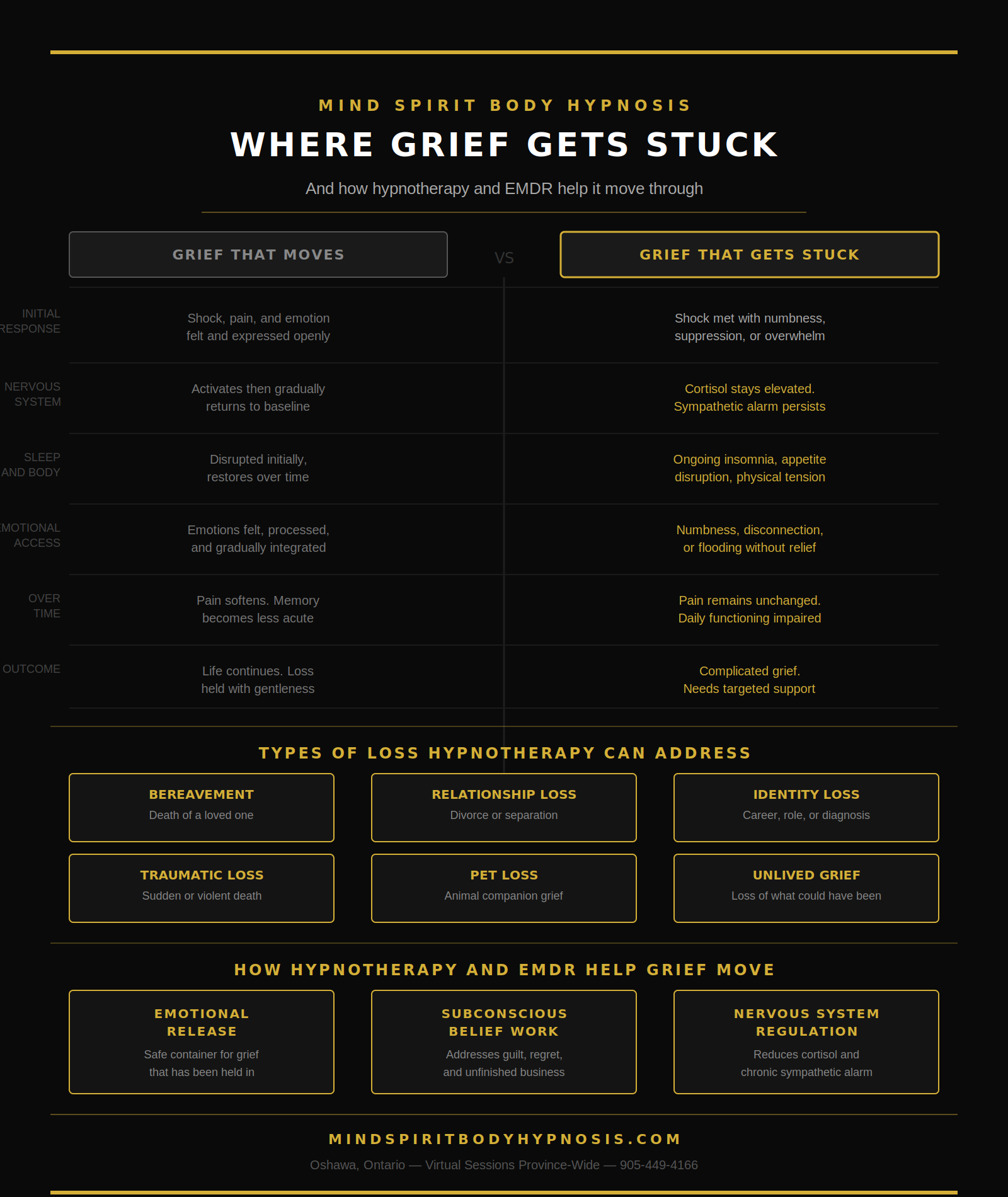
Grief is not only an emotional experience. It is a full nervous system response. When we lose someone or something of profound importance, the brain processes it as a genuine threat to survival. The attachment system, which is wired to keep us connected to the people and things we depend on, activates in a state of alarm.
Research published in Psychosomatic Medicine found that bereavement significantly elevates cortisol levels and activates the sympathetic nervous system, producing physiological effects similar to chronic stress, including disrupted sleep, appetite changes, impaired immunity, and heightened anxiety (Buckley et al., 2012). Nearly 30 to 40 percent of bereaved individuals experience clinically significant depressive symptoms within the first year of a major loss.
When grief becomes complicated, meaning it persists at high intensity beyond what is typical or begins to significantly impair daily functioning, the nervous system is often stuck in a loop it cannot resolve on its own. The loss is processed by the conscious mind as past, but the subconscious and nervous system continue responding as if the threat is ongoing.
A clinical case study published in the Indian Journal of Psychiatry demonstrated that hypnotherapy was effective in resolving complicated grief that had been resistant to multiple courses of conventional talk therapy, producing lasting improvements in functioning and adaptive coping mechanisms (Gupta & Avasthi, 2020). The authors noted that hypnotherapy's ability to communicate directly with the subconscious made it particularly suited to cases where conscious processing had stalled.
What Types of Loss Can Hypnotherapy Address?
Grief is not limited to bereavement. In my work with clients across Ontario, I have supported people through many different kinds of loss, each of which carries its own emotional weight and its own subconscious impact.
Loss of a loved one. The death of a parent, partner, child, sibling, or close friend. Grief following sudden or traumatic death is particularly likely to become complicated, as the nervous system has no preparation time and the loss may be layered with shock, guilt, or trauma alongside the grief itself.
Loss of a relationship. The end of a significant partnership through divorce, separation, or estrangement. This grief is often minimized by others but can be as profound as bereavement, particularly when identity, home, plans, and daily life are all disrupted simultaneously.
Loss of a role or identity. Retirement, job loss, the end of a career, or a diagnosis that changes what a person is capable of. When who you are has been bound up with what you do, losing that role can produce genuine grief that goes unacknowledged.
Grief for a life unlived. The grief of what did not happen: the relationship that never came, the children who were not born, the health that declined, the opportunities that passed. This is one of the least visible forms of grief and one of the most burdensome to carry.
Pet loss. The death of an animal companion can be a profound loss, particularly for people who live alone or for whom the pet was their primary source of daily comfort and connection.
For more on how trauma and loss intersect and how EMDR addresses both, the EMDR trauma therapy page at Mind Spirit Body Hypnosis covers the neurological foundations in detail.
How Is Hypnotherapy Different From Grief Counselling?
Grief counselling and hypnotherapy are complementary rather than competing approaches. Many clients benefit from both. The key difference is the level at which each works.
Grief counselling works primarily at the conscious level. It provides a safe space to talk, to be heard, and to process the narrative of what happened. It helps the person make meaning of their loss and develop coping strategies. For many people, this is enormously valuable.
Hypnotherapy works at the subconscious level. It accesses the emotional memory, the nervous system encoding, and the deeper belief structures that maintain grief in place even when the conscious mind has understood and accepted the loss. It can reach the parts of the experience that words alone cannot.
Here is how the two approaches differ in practice:
Grief counselling: Narrative-focused, conscious processing, verbal, meaning-making, weekly structure.
Hypnotherapy: Subconscious-focused, emotional and somatic processing, works with feeling rather than story, accesses material that verbal processing cannot reach.
Combined approach: Many clients at Mind Spirit Body Hypnosis come having already done grief counselling and found that something is still stuck. Hypnotherapy addresses what talk has not been able to shift.

How Hypnotherapy Helps With Grief at the Subconscious Level
As a certified EMDR practitioner and hypnotherapist, I work with grief at multiple levels simultaneously. The approach is gentle, paced to the client, and never forces material to surface before the person is ready.
Emotional release in a contained setting. Many grieving people have learned to suppress their grief to function. The trance state creates a safe container in which the emotional charge of the loss can surface and move through without the person being overwhelmed. Clients often describe feeling as though something heavy has been lifted during a session.
Subconscious belief work. Grief frequently generates painful beliefs: that the loss was somehow deserved, that the person could have done something differently, that life cannot be good again, or that loving someone means risking devastation. These beliefs are not resolved by reassurance. They are held in the subconscious and need subconscious-level intervention to shift.
Unfinished business. For clients who lost someone without the chance to say what needed to be said, hypnotherapy can provide a therapeutic space for that completion. Using guided imagery within trance, clients can access a felt sense of communication with the person they have lost. This is not a supernatural claim -- it is a subconscious process that has significant clinical precedent in grief resolution work and frequently produces profound relief.
Nervous system regulation. Deep trance activates the parasympathetic nervous system, reducing the chronic cortisol elevation and sympathetic activation that prolonged grief produces. Many clients notice improvements in sleep, appetite, and baseline anxiety from early sessions as a direct result of the physiological impact of the trance state itself.
Future orientation. Once the acute grief work is progressing, sessions begin to orient the subconscious toward the future: a life that continues to honour the loss while also having room for new meaning, connection, and experience. This is not about forgetting. It is about making space.
For more on how the anxiety dimension of grief is addressed at Mind Spirit Body Hypnosis, the hypnotherapy for anxiety and stress page covers the nervous system mechanisms that underpin both conditions.
The Role of EMDR in Grief Processing
When grief follows a traumatic loss, EMDR (Eye Movement Desensitization and Reprocessing) is often the most effective starting point before deeper hypnotherapy work begins.
Traumatic grief, the kind that follows sudden death, accident, suicide, or violent loss, is held differently in the nervous system from anticipated loss. The memory is encoded as a traumatic fragment rather than a coherent narrative. EMDR's bilateral stimulation works directly with that encoding, allowing the brain to reprocess the traumatic memory and file it as past rather than ongoing.
At Mind Spirit Body Hypnosis, EMDR and hypnotherapy are frequently used in combination for grief presentations. EMDR reduces the traumatic charge. Hypnotherapy then works with the deeper subconscious beliefs, emotional patterns, and unfinished business that remain. The two approaches together create a more complete pathway through grief than either alone.
What to Expect in a Session
The first session is a gentle conversation. What have you lost? How long ago? What does the grief feel like right now, and where do you carry it in your body? Is there anything that feels unresolved, unsaid, or unprocessed? What would healing look and feel like for you?
There is no pressure to detail the loss in full in the first session. The work proceeds at whatever pace feels right.
From there, the induction is slow and careful. Grief sessions typically begin with extended nervous system regulation before moving into deeper subconscious work. Clients are always in control of how far any given session goes.
Most grief programs at Mind Spirit Body Hypnosis run between four and eight sessions, depending on the complexity of the loss, whether trauma is involved, and whether there are compounding factors such as long-standing depression or anxiety. All sessions are delivered virtually, available to clients aged 10 and older across Ontario.
More about Fanis's clinical approach, qualifications, and training in EMDR and NLP is available on the about page.
What My Clients Say:
"I began seeing Fanis after a long battle with trauma and grief. I suffered from severe anxiety, panic attacks, insomnia and self harm. After 3 months of weekly hypnotherapy sessions done online, I no longer suffer from panic attacks, insomnia, or self harm and have learned how to better regulate my emotions and find peace. Fanis helped me process many childhood traumas and confront my overwhelming grief. I am eternally grateful to Fanis and his wonderful work."
Sara V. | Trauma and Grief | Five Stars
FAQ
Can hypnotherapy really help with grief? Yes. Hypnotherapy works at the subconscious and nervous system level where grief is held, reaching emotional material that talk-based approaches often cannot access alone. Research supports its effectiveness for complicated grief and grief-related anxiety, with case studies demonstrating resolution of grief presentations that had been resistant to conventional therapy.
What does grief do to the nervous system? Grief activates the nervous system in a way that is similar to chronic stress. Cortisol levels rise, the sympathetic nervous system remains elevated, sleep and appetite are disrupted, and the immune system is suppressed. When grief becomes complicated, the nervous system can remain in this state of chronic activation long after the loss itself.
How is hypnotherapy different from grief counselling? Grief counselling works at the conscious, narrative level. Hypnotherapy works at the subconscious level, accessing emotional memory and nervous system encoding that verbal processing alone cannot reach. The two approaches are complementary, and many clients benefit from both.
What types of loss can hypnotherapy address? Hypnotherapy can support grief following the death of a loved one, the end of a relationship, job or role loss, pet loss, grief for a life unlived, and traumatic or sudden loss. Each type of grief has its own subconscious impact and can be addressed through a tailored approach.
Is hypnotherapy suitable for traumatic grief? Yes, particularly when combined with EMDR. Traumatic grief is held differently in the nervous system from anticipated loss. EMDR reduces the traumatic encoding, while hypnotherapy addresses the deeper subconscious beliefs and unfinished business that remain.
What is the best therapy for complicated grief? Research supports a combination of approaches for complicated grief, including EMDR, trauma-focused therapy, and hypnotherapy. At Mind Spirit Body Hypnosis, EMDR and hypnotherapy are used together for grief presentations that involve trauma, providing a more complete pathway than either approach alone.
How many sessions will I need? Most grief programs at Mind Spirit Body Hypnosis run between four and eight sessions. The timeline depends on the complexity of the loss, whether trauma is involved, and whether there are compounding factors. Some clients feel significant relief after two or three sessions.
Is this suitable for younger clients? Yes. Mind Spirit Body Hypnosis works with clients aged 10 and older. Children and adolescents can experience profound grief and benefit significantly from hypnotherapy, which is gentle, non-invasive, and does not require extensive verbal processing.
Can I do sessions virtually from anywhere in Ontario? Yes. All sessions are delivered virtually, province-wide, with no referral required. Many clients find the privacy of their own home supportive during grief work.
How do I get started? Book a free 30-minute virtual strategy session at calendly.com/mindspiritbodyhypnosis. No referral needed. The first conversation is simply a chance to talk about what you are carrying and whether hypnotherapy may help.
Ready to Take the Next Step?
Grief deserves proper support. Not a timeline. No advice to move on. A space where what you are carrying can finally be set down.
I offer a free 30-minute virtual strategy session for new clients across Ontario. There is no pressure, just a conversation about what you are going through and how hypnotherapy, EMDR, or NLP may support you.
Book your free session: calendly.com/mindspiritbodyhypnosis
Call or text: 905-449-4166
Email:mindspiritbodyhypnosis@gmail.com
Visit: mindspiritbodyhypnosis.com
Serving clients virtually across Ontario, including Durham Region, Toronto, Ottawa, and beyond.
Disclaimer: This article is for informational purposes only and does not constitute medical or psychological advice. Hypnotherapy, NLP, and EMDR are complementary approaches and are not a substitute for diagnosis or treatment by a qualified healthcare provider. If you are experiencing suicidal thoughts or a mental health crisis, please contact a qualified healthcare provider or call 988. Results vary by individual.
Written by Fanis Makrigiannis | Certified Hypnotherapist & NLP Master Practitioner | Mind Spirit Body Hypnosis.