Hypnotherapy for emotional eating
Hypnotherapy for Emotional Eating in Ontario: Your Questions Answered
TL;DR: Emotional eating is not a willpower problem, and it is not about food. It is a subconscious coping mechanism that developed because eating reliably produces a specific emotional effect, and that effect is genuinely needed. At Mind Spirit Body Hypnosis in Oshawa, Ontario, the five questions people ask most before addressing emotional eating through hypnotherapy are answered here directly, without the shame-framing that makes this topic so difficult to discuss honestly.
Quick Answer
Emotional eating is the use of food to manage emotional states rather than to satisfy physical hunger, driven by subconscious associations, conditioned responses, and the genuine emotional regulation function that eating has come to serve. It is not a character weakness, and it is not about loving food too much. Hypnotherapy addresses the subconscious root of emotional eating by identifying what emotional function food is serving, installing alternative subconscious resources to meet that need, and dismantling the automatic trigger-response associations that produce the reach for food before any conscious decision is made. At Mind Spirit Body Hypnosis in Oshawa, Ontario, Fanis Makrigiannis, a Certified Hypnotherapist and NLP Master Practitioner, offers virtual sessions province-wide for clients of all ages ready to address why they eat rather than just what.
Questions This Article Answers
Am I an emotional eater and how do I know?
Why do I eat when I am not hungry?
What is the difference between hunger and a craving?
Can hypnotherapy change my relationship with food permanently?
What happens in the brain during emotional eating?
In This Article:
Most clients who come for emotional eating work describe the same bewildering gap. They know, clearly and consciously, that they are not hungry. They know the eating is not going to help with whatever is happening emotionally. They know they will feel worse afterwards. And they eat anyway.
This gap between knowing and doing is not a mystery, and it is not a weakness. It is the precise signature of a subconscious pattern operating below the level of conscious intention. The emotional eating is not a failure of awareness. The awareness is fully present. The pattern is simply running at a different level, one that conscious awareness and intention cannot directly reach.
The question is not how to be more aware of the emotional eating. The question is how to change the subconscious architecture that is driving it. That is where hypnotherapy works.
Am I an Emotional Eater and How Do I Know?
Emotional eating exists on a spectrum, and almost all people eat emotionally to some degree at some times. The question of clinical significance is whether the emotional eating is the primary driver of eating behaviour rather than physical hunger, and whether it is producing consequences in health, in weight, in the relationship with food that the person wants to change.
Here are the most reliable indicators that emotional eating is a significant pattern rather than an occasional occurrence:
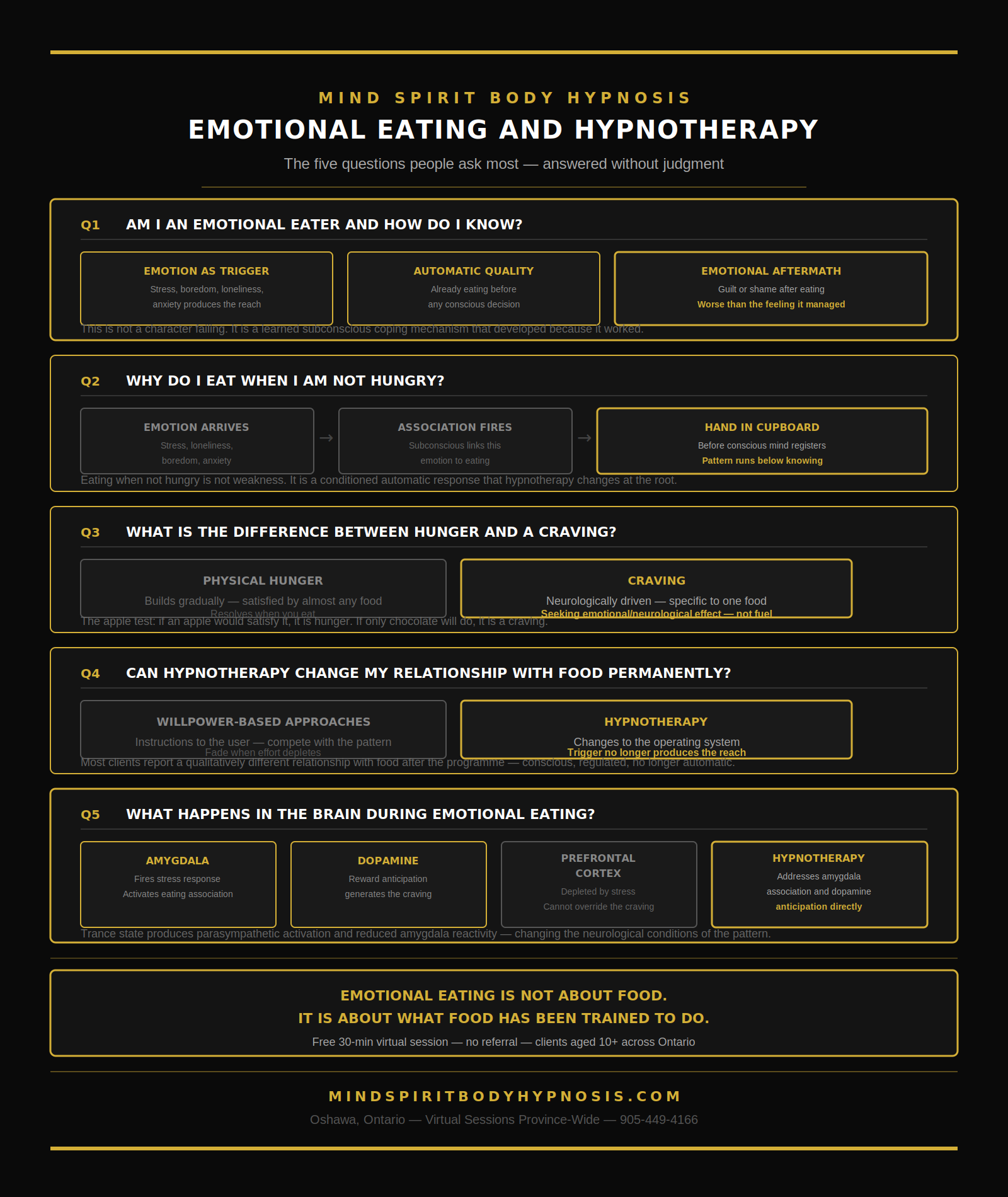
You eat in response to specific emotional states rather than physical hunger. The reach for food is reliably triggered by boredom, loneliness, stress, anxiety, frustration, or the end of a difficult day, not by genuine physical hunger sensations. The emotion is the cue, not the body.
The eating produces a predictable emotional effect. Food does something reliable for you emotionally: it reduces the intensity of the feeling, provides a moment of comfort or pleasure, creates a brief period of not-feeling, or punctuates the emotional state in a way that feels regulating. This is not irrational. Food genuinely works as an emotional regulator. The problem is not that it does not work. It is the consequences of the pattern over time.
The eating happens quickly and automatically. You find yourself eating before you have consciously decided to. The food is simply there, and you are already eating it. This automatic quality is the most reliable indicator that the pattern is subconscious rather than a deliberate choice being made in a moment of weakness.
You eat past fullness and feel worse afterwards. The eating continues beyond any physical satisfaction, and the emotional aftermath, typically some combination of guilt, shame, and a temporary sense of having failed again, is worse than the emotional state the eating was trying to address.
You use food to reward, to punish, to comfort, or to celebrate consistently. The relationship with food is highly emotionally charged in multiple directions, not just in one.
If three or more of these describe your experience of eating, emotional eating is likely a significant driver of your pattern with food. The most important thing to understand at this point is that this is not a character failing. It is a learned subconscious coping mechanism that developed because it worked and because nothing else was available that worked as reliably or as quickly.
⭐ Pro Tip: Keep a brief, non-judgmental eating record for one week. Not calories, just note the time, what you ate, and the emotional state immediately before eating. Most emotional eaters find that this exercise produces an immediate shift in awareness: the same two or three emotional states appear repeatedly as the trigger for the eating. Those specific states are the targets for the subconscious work. And the act of observing the pattern from curiosity rather than shame changes the quality of the relationship with it before any other change is made.
Why Do I Eat When I Am Not Hungry?
This is the most practically urgent question about emotional eating, and the honest answer is both simple and counterintuitive: you eat when you are not hungry because eating works.
Not for nutrition. For emotion. Eating, particularly eating foods with high sugar, fat, or salt content, produces a reliable, rapid neurological effect. Dopamine is released. The stress response briefly softens. The difficult emotional state is interrupted, not by resolving it but by occupying the sensory attention and neurological reward system with something else. The eating provides genuine, if temporary, relief from whatever emotional state was present.
The subconscious learns this reliably and quickly. If eating consistently produces relief from a specific emotional state, the subconscious establishes a direct trigger-response association: this emotional state produces a reach for food. This association is not a decision. It is a trained automatic response, as reflexive as pulling your hand back from heat.
Once this association is established, the reach for food happens before any conscious deliberation occurs. The emotional state arrives, the association fires, and the hand is already in the cupboard before the conscious mind has had time to register what is happening. This is why resolving not to do it, remembering the consequences, and applying willpower all tend to work temporarily and then fail because they are operating at the conscious level of a pattern that is entirely subconscious.
What eating when not hungry is rarely about: lack of discipline, poor motivation, not caring about health, or not trying hard enough. These are the shame narratives that sustain the pattern by adding an emotional charge of shame and self-criticism that requires its own regulation, which the subconscious already knows how to provide.
Research published in Appetite found that emotional eating is significantly predicted by alexithymia, difficulty identifying and describing emotional states and that people with higher emotional awareness show significantly lower rates of emotional eating even under equivalent levels of stress (Evers et al., 2010). This finding has direct clinical implications: one of the most effective first steps in emotional eating work is building the capacity to identify the specific emotional state that is triggering the eating, which is precisely what the mapping work in hypnotherapy does.
For more on how the emotional patterns driving eating behaviour interact with anxiety and stress responses, the hypnotherapy for anxiety and stress pillar page covers the foundational nervous system mechanisms.
What Is the Difference Between Hunger and a Craving?
This is one of the most practically useful distinctions for anyone working on their relationship with food, and it is one that most people have never been taught clearly.
Physical hunger is the body's physiological signal that it needs nutritional input. It builds gradually over time, typically three to five hours after the last meal. It is accompanied by specific physical sensations: a hollow feeling in the stomach, mild light-headedness as blood sugar drops, reduced energy, and sometimes physical noise from the digestive system. Physical hunger can be satisfied by almost any food. It is not specifically demanding a particular food; it simply wants fuel. And physical hunger resolves when food is eaten.
A craving is a neurologically driven desire for a specific food or category of food that arises independently of physical hunger. Cravings can occur immediately after eating, can arise in specific emotional states regardless of when the last meal was, and are specifically focused on a particular food rather than food generally. A chocolate craving is very different from hunger. Hunger would also be satisfied by an apple. The craving is not interested in an apple.
Cravings are primarily driven by the same dopamine-reward system that underlies all habitual behaviour. The brain has learned that a specific food produces a specific neurological effect, and it generates a desire for that effect in emotional states where the effect is needed. Cravings are not irrational. They are highly rational; the brain is pursuing a neurological outcome it has learned a specific food reliably produces.
The clinical significance of this distinction is substantial. Physical hunger requires food. Cravings require the emotional regulation they are seeking. If the craving is driven by stress, it is stress regulation that is needed, not chocolate. If the craving is driven by loneliness, it is connection that is needed, not chips. Hypnotherapy identifies the emotional need driving the craving and installs alternative subconscious resources to meet that need directly, removing the craving's mandate rather than trying to resist it through willpower.
⭐ Pro Tip: The clearest practical test is the apple test. When the urge to eat arrives, ask yourself whether you would be satisfied by an apple. If yes, that is hunger. If the apple sounds deeply unappealing and the urge is specifically for something sweet, salty, or highly palatable, that is a craving. The craving is not about fuel. It is about a specific emotional or neurological effect that a specific food reliably produces. This is exactly what the subconscious work in hypnotherapy targets.
Can Hypnotherapy Change My Relationship With Food Permanently?
This question always arrives carrying the weight of previous attempts. The person asking it has usually tried many things. Some of them worked for a while. None of them stuck. And they want to know whether hypnotherapy is genuinely different or just another temporary improvement.
The honest answer requires a distinction between what hypnotherapy changes and what remains the responsibility of the person.
What hypnotherapy changes durably: the subconscious trigger-response associations that produce the automatic reach for food in specific emotional states. The emotional function that food has been serving and that now has an alternative subconscious resource to meet it. The identity-level beliefs about food, the body, and the self that sustain the emotional eating pattern. These changes, when properly installed through thorough subconscious work, do not simply fade over time in the way that willpower-dependent approaches do, because they are changes to the operating system rather than instructions to the user.
What remains: the need to maintain the emotional health practices that the hypnotherapy supports. As life generates new stressors, the nervous system needs ongoing regulation. If the person never builds practices for emotional regulation outside of eating, new stressors can eventually re-establish versions of the old pattern. This is not a failure of hypnotherapy. It is the realistic picture of what lasting change in any habit requires.
In my practice, clients who complete the full emotional eating programme and engage genuinely with the between-session work, which involves paying attention to their emotional states, using the self-regulation tools installed in trance, and noticing the pattern when it arises without judgment, report lasting changes in their relationship with food that are qualitatively different from anything they achieved with willpower-based approaches.
The goal of the work is not a perfect relationship with food. It is a fundamentally different one: conscious, regulated, and no longer running automatically below the level of any choice.
What Happens in the Brain During Emotional Eating?
This is one of the most searched questions about emotional eating in 2026, as neuroscience has become increasingly part of the mainstream conversation about mental health and behaviour.
The neuroscience of emotional eating involves several interconnected systems:
The amygdala is the brain's threat and emotional processing centre. When a stressful or emotionally activating event occurs, the amygdala fires and activates the stress response. In people with established emotional eating patterns, the amygdala has also learned to associate eating with the regulation of that stress response, effectively filing eating as a coping resource that should be activated when the amygdala fires.
The dopamine reward system, the nucleus accumbens and associated pathways, is activated by the consumption of highly palatable foods, particularly those with high sugar and fat content. This dopamine release produces the brief sense of pleasure and relief that gives emotional eating its regulatory effect. Over time, the brain learns to anticipate this dopamine release and generates a craving or wanting state before the food is even encountered.
The prefrontal cortex, the seat of executive function and conscious decision-making, is the part of the brain that can, in principle, override the craving. However, under stress, activity in the prefrontal cortex reduces while activity in the amygdala and dopamine system increases. The result is that emotional eating tends to be most automatic and most resistant to conscious override precisely when stress is highest, when willpower is most depleted and most needed.
The hypothalamus regulates physical hunger through hormones including ghrelin and leptin. In chronic stress, cortisol disrupts the normal functioning of these hormonal systems, producing increased ghrelin (the hunger hormone) and decreased leptin (the satiety hormone). This means that chronic stress produces genuine increases in physical hunger and a reduced capacity to recognize fullness, adding a genuine physiological dimension to the emotional eating that operates alongside the psychological one.
Hypnotherapy addresses the psychological dimensions of this system: the amygdala's learned association between emotional states and eating, and the dopamine system's conditioned anticipation of food as stress relief. The trance state produces measurable parasympathetic activation and reduced amygdala reactivity, changing the neurological conditions in which the emotional eating pattern operates.
For more on how emotional eating and weight loss are addressed together at Mind Spirit Body Hypnosis, the hypnotherapy for weight loss pillar page covers the full clinical approach.
How Hypnotherapy Addresses Emotional Eating at the Root
The work has four specific components, each addressing a different layer of the emotional eating pattern.
Trigger identification and desensitization. The specific emotional states that produce the automatic reach for food are identified precisely, not just stress in general, but the specific quality of stress at 6 pm on a difficult workday, or the specific texture of loneliness on Sunday afternoon. Each trigger is addressed in trance, the automatic food-response association updated, and an alternative subconscious response installed.
Emotional function identification and resource installation. What is food doing emotionally that the person genuinely needs? Comfort when distressed. Relief from tension. Pleasure in an otherwise pleasure-depleted day. A moment of alone time. Whatever the function is, hypnotherapy installs a subconscious alternative resource that can provide that same function without eating a felt sense of comfort, a practised self-regulation state, an internal resource anchored to a physical cue and available in the triggering emotional state.
Hunger and satiety recalibration. Using guided imagery in trance, the body's natural hunger and satiety signalling is restored as the primary guide for eating. Many emotional eaters have lost contact with genuine physical hunger; food has been eaten so consistently in emotional states that the body's genuine signals have become difficult to distinguish from emotional hunger. The hypnotherapy work rebuilds this awareness.
Identity work. The person's relationship with food at the identity level is addressed: the sense of being someone with no willpower around food, the belief that food is the only reliable comfort, the identity of the emotional eater rather than someone with a specific subconscious pattern that can be changed. The trance state is used to install an updated identity -- someone who eats from genuine hunger, who has access to a full range of emotional coping resources, and who has a genuinely different relationship with food.
More about the full programme structure at Mind Spirit Body Hypnosis is available on the about page.

What to Expect at Mind Spirit Body Hypnosis
The first session is a conversation, unhurried and non-judgmental. What does the eating pattern look like specifically? When does it most reliably happen? What emotional states are most consistently present beforehand? What function has food been serving? And what would change in daily life if the pattern were different?
This mapping is thorough because the specificity of the subsequent trance work depends entirely on understanding the specific emotional architecture of this particular person's emotional eating. Generic anti-craving suggestions are not what produces lasting change. Targeted work on the specific trigger-emotion-eating sequence does.
Most emotional eating programmes at Mind Spirit Body Hypnosis run between four and six sessions. All sessions are delivered virtually, available to clients aged 10 and older across Ontario from the privacy of their own home.
What My Clients Say
"Fanis has literally changed my life! I came in for weight loss and stress eating and have lost 20 pounds in 3 months. I no longer reach for food when I am stressed, and I finally feel in control around food for the first time in years. I cannot recommend him enough!"
Sandra M. | Weight Loss and Emotional Eating | Five Stars
"Fanis has done so much for me in such a short period of time -- helped me quit smoking, and also helped me to believe and love myself. So professional and patient like no one I have ever met. He has given me hope and strength I have been needing for a long time. I could never thank him enough. Today I believe in myself!"
Natasha C. | Quit Smoking and Confidence | Five Stars
FAQ
Am I an emotional eater? If you reliably eat in response to specific emotional states rather than physical hunger, if the eating happens automatically before any conscious decision is made, and if food is consistently performing an emotional regulation function, emotional eating is likely a significant pattern for you. The most reliable indicators are: emotional states as the primary trigger, automatic quality of the eating, eating past fullness, and the emotional aftermath of guilt or shame.
Why do I eat when I am not hungry? Because eating works as an emotional regulator. Food, particularly high-palatability food, produces dopamine release and a reliable softening of the stress or emotional state. The subconscious has learned this association and fires the reach for food automatically when the triggering emotional state arrives. This is not weakness. It is a conditioned subconscious response.
What is the difference between hunger and a craving? Physical hunger builds gradually, can be satisfied by almost any food, and resolves when food is eaten. A craving is neurologically driven, specifically focused on a particular food or category, arrives independently of physical hunger, and is driven by the emotional or neurological effect that specific food reliably produces. If an apple would satisfy it, it is hunger. If only chocolate will do, it is a craving.
Can hypnotherapy change my relationship with food permanently? Yes, when the work addresses the subconscious trigger-response associations, the emotional function food is serving, and the identity-level beliefs sustaining the pattern. These are changes to the operating system, not instructions to the user, which is why they are more durable than willpower-based approaches. Maintaining emotional health practices between and after sessions consolidates the change.
What happens in the brain during emotional eating? The amygdala activates under stress and fires the learned association with eating. The dopamine reward system generates the craving and the reward. The prefrontal cortex, depleted by stress, is less able to override the craving. Stress hormones disrupt genuine hunger and satiety signalling. Hypnotherapy addresses the amygdala's learned association and the dopamine system's conditioned anticipation at the subconscious level.
How many sessions will I need for emotional eating? Most emotional eating programmes at Mind Spirit Body Hypnosis run between four and six sessions. The specific number depends on the complexity of the pattern, the number of distinct triggers, and whether significant underlying anxiety or trauma is driving the emotional eating. An honest estimate is always given in the free strategy session.
Is emotional eating an addiction? Emotional eating shares some neurological features with addictive behaviour, particularly the dopamine reward cycle and the automatic quality of the response, but it is most accurately understood as a subconscious conditioned coping mechanism rather than a clinical addiction. This distinction matters because it shapes the approach: the work addresses the emotional function of the eating rather than treating it as substance dependence.
Can I do sessions virtually from anywhere in Ontario? Yes. All sessions are delivered virtually, province-wide, with no referral required.
What if I am also trying to lose weight at the same time? The emotional eating work is part of the broader weight loss programme at Mind Spirit Body Hypnosis. Addressing emotional eating is often the most important first step in sustainable weight loss, because no dietary approach will produce lasting results while the subconscious eating pattern remains unchanged.
How do I get started? Book a free 30-minute virtual strategy session at calendly.com/mindspiritbodyhypnosis. No referral needed.
Ready to Take the Next Step?
If you know why you are eating and you still cannot stop, the level where knowing operates is not the level where the pattern lives. That is what hypnotherapy addresses.
I offer a free 30-minute virtual strategy session for new clients across Ontario. No judgment, no shame, and no pressure. Just an honest conversation about what the eating pattern is doing and what would need to change for that to be different.
Book your free session: calendly.com/mindspiritbodyhypnosis
Call or text: 905-449-4166
Email: info@mindspiritbodyhypnosis.com
Visit: mindspiritbodyhypnosis.com
Serving clients virtually across Ontario, including Durham Region, Toronto, Ontario, and beyond.
Disclaimer: This article is for informational purposes only and does not constitute medical or nutritional advice. Hypnotherapy and NLP are complementary approaches and are not a substitute for diagnosis or treatment by a qualified healthcare provider. If you have a history of an eating disorder, please discuss hypnotherapy with your healthcare provider before beginning a programme. Results vary by individual.
Written by Fanis Makrigiannis | Certified Hypnotherapist & NLP Master Practitioner | Mind Spirit Body Hypnosis.