How does hypnosis work for pain management?
Can Hypnotherapy Help With Chronic Pain?
TL;DR: Chronic pain is not simply a physical signal. It is a complex neurological experience shaped by the brain, the nervous system, and the subconscious, and research consistently shows that hypnotherapy reduces chronic pain significantly, often outperforming physical therapy alone. At Mind Spirit Body Hypnosis in Oshawa, Ontario, Fanis Makrigiannis uses hypnotherapy, NLP, and EMDR to address chronic pain at the neurological and subconscious levels, helping clients of all ages across the province experience meaningful and lasting pain reduction.
Quick Answer
Hypnotherapy for chronic pain is an evidence-based approach that reduces pain perception by working directly with the brain's pain processing system and the subconscious patterns that amplify and maintain chronic pain signals. A review of 13 controlled trials published in the International Journal of Clinical and Experimental Hypnosis found that hypnotherapy consistently produced significant pain reduction across a wide variety of chronic pain conditions, generally outperforming non-hypnotic interventions. Fanis Makrigiannis, a Certified Hypnotherapist and NLP Master Practitioner at Mind Spirit Body Hypnosis in Oshawa, Ontario, offers virtual sessions across the province for clients of all ages seeking meaningful pain relief.
Questions This Article Answers
Can hypnotherapy really reduce chronic pain?
How does the brain create and amplify chronic pain?
What is the connection between trauma and chronic pain?
How is hypnotherapy different from pain medication?
What types of chronic pain can hypnotherapy help with?
In This Article:
Chronic pain is one of the most prevalent and least adequately treated conditions in Canada. According to the Canadian Pain Task Force, approximately 8 million Canadians live with chronic pain, with Ontario carrying a disproportionate burden due to its aging population, high rates of workplace injury, and the long-term physical toll of chronic stress and trauma.
Most people with chronic pain arrive at Mind Spirit Body Hypnosis having already been through the standard pathway: imaging, medication, physiotherapy, and in many cases, surgery. Some have received diagnoses and exhausted the treatments available. Others have been told that everything looks normal and that the pain should not be as severe as it is.
What very few have been told is that chronic pain is not simply a signal from damaged tissue. It is a neurological experience generated by the brain. And the brain can be worked with.
What Is Chronic Pain and Why Does It Persist?
Chronic pain is typically defined as pain persisting for three months or more beyond the expected healing time for an injury or illness, or pain associated with a condition that produces ongoing physiological change. It affects every area of life: sleep, mood, work capacity, relationships, and sense of self.
The defining feature of chronic pain, and the one that most changes how it is treated, is that it is not simply a passive transmission of damage signals from the body to the brain. It is an active construction. The brain generates the pain experience based on a complex assessment of perceived threat, previous experience, emotional state, expectations, and attention. Two people with identical tissue damage can experience radically different levels of pain depending on the brain's interpretation of the signal.
This means that the brain itself is a legitimate target of pain treatment. Not because the pain is imaginary, but because the brain's pain-generating system can be directly influenced, and when it is, the pain experience changes measurably.
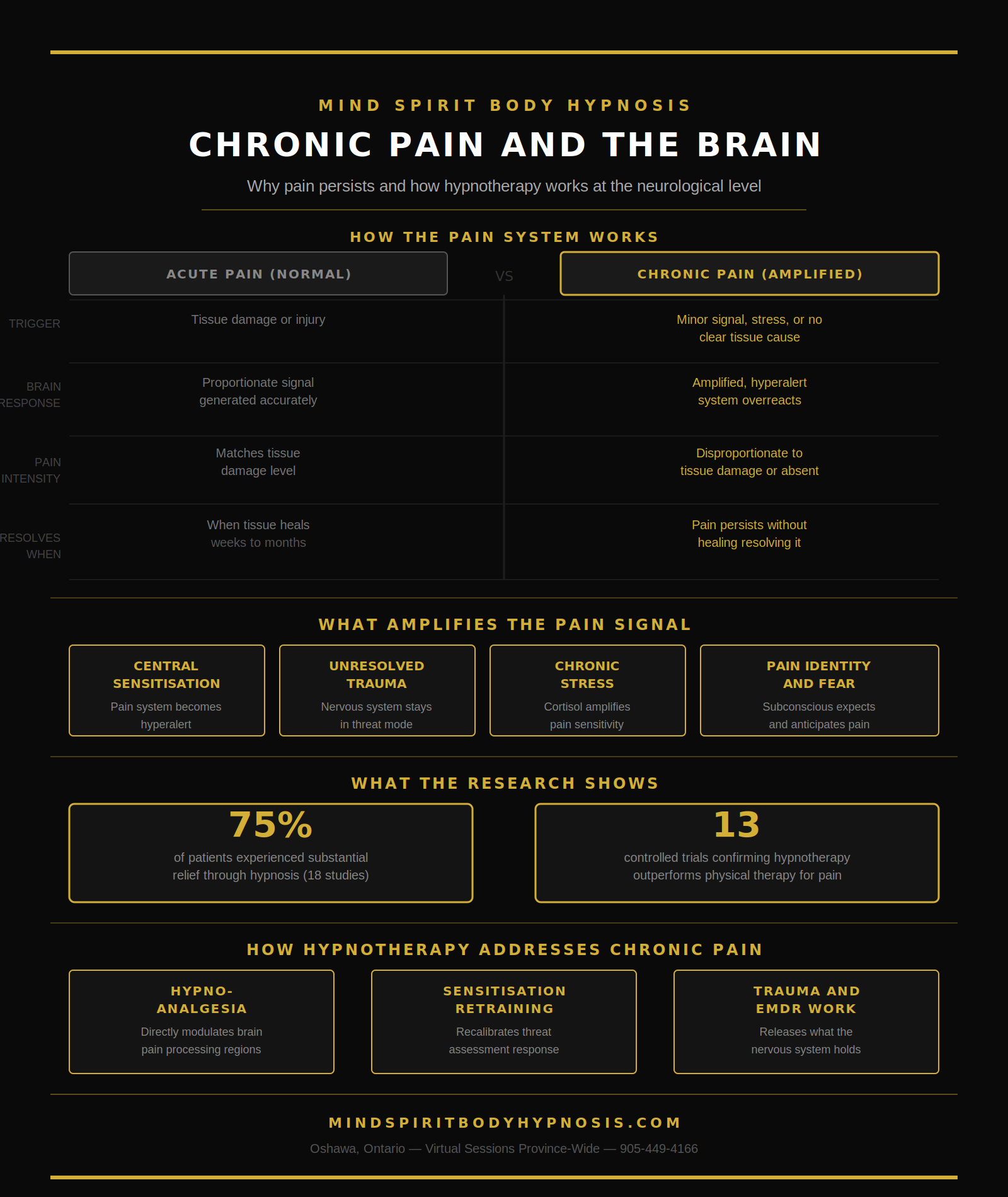
A review of 13 controlled prospective trials published in the International Journal of Clinical and Experimental Hypnosis found that hypnotherapy consistently produced significant reductions in pain across diverse chronic pain conditions, including fibromyalgia, cancer-related pain, back pain, and neuropathic pain, with hypnotherapy generally outperforming physical therapy and education-based control conditions (Elkins, Jensen & Patterson, 2007).
How Does the Brain Create and Amplify Pain?
The neuroscience of chronic pain has been transformed in the past two decades. The old model of pain as a signal travelling from damaged tissue to the brain has been largely replaced by a much more accurate understanding: pain is an output of the brain, not an input from the body.
The brain's pain system involves a network of regions including the anterior cingulate cortex, the insula, the prefrontal cortex, and the thalamus. These regions collectively assess the incoming signals from the body and generate a pain experience proportionate to the perceived level of threat. When the threat assessment system is well-calibrated, acute pain signals danger and resolves when the tissue heals. When it becomes dysregulated due to prolonged injury, chronic stress, trauma, or central sensitization, the system amplifies pain signals beyond their tissue source, generates pain in the absence of ongoing tissue damage, and becomes increasingly responsive to stimuli that would not normally produce pain.
Central sensitization is the name for this dysregulation: a state in which the pain processing system has become hyperalert, responding to minor stimuli as if they were major threats. It is well-established in fibromyalgia, chronic back pain, chronic headache, complex regional pain syndrome, and many other presentations.
The hypnotic trance state has been shown through neuroimaging to directly modulate activity in the anterior cingulate cortex, the region most responsible for the unpleasantness of pain rather than its sensory intensity. This means hypnotherapy does not simply distract from pain. It changes how the brain processes it.
A meta-analysis by Montgomery, DuHamel & Redd found that 75 percent of patients with diverse types of chronic and acute pain experienced substantial relief through hypnosis, with effect sizes significantly exceeding those of other psychological interventions (Montgomery et al., 2000).
For more on how the nervous system processes trauma and stress, and how that connects to physical symptoms, the EMDR trauma therapy page at Mind Spirit Body Hypnosis covers the neurological foundations.
What Is the Connection Between Trauma and Chronic Pain?
One of the most important developments in pain medicine in the past decade is the growing recognition of the relationship between unresolved trauma and chronic pain. This connection is not metaphorical. It is neurological.
Trauma keeps the nervous system in a state of chronic threat-readiness. Cortisol and adrenaline remain elevated. Muscle tension persists. The autonomic nervous system cannot fully enter the parasympathetic recovery state. Over time, this sustained physiological activation produces and amplifies pain signals: headaches, chronic back and neck pain, pelvic pain, digestive pain, jaw pain, and widespread musculoskeletal aching.
Adverse childhood experiences (ACEs) have been associated with significantly higher rates of adult chronic pain across multiple large studies. The more ACEs present, the higher the reported pain severity, the greater the likelihood of multiple pain sites, and the poorer the response to standard pain treatments.
In my practice, clients presenting with chronic pain that has not responded to conventional treatment frequently have significant histories of trauma, emotional suppression, or prolonged stress that have never been directly addressed. The body holds what the mind has not been given the space to process. And it communicates that holding through pain.
For more on how EMDR and hypnotherapy address the trauma that underlies many chronic presentations, the hypnotherapy for anxiety and stress page covers the HPA axis and nervous system mechanisms in detail.
How Hypnotherapy Reduces Chronic Pain
As a certified hypnotherapist trained through the American Board of Hypnotherapy, I approach chronic pain as a multifactorial experience with neurological, subconscious, and, in many cases, trauma-based components. The work is precise, evidence-based, and adapted to the specific pain presentation identified in the initial conversation.
Hypnoanalgesia. Direct pain reduction through hypnotic suggestion is one of the most extensively researched applications of clinical hypnotherapy. In trance, the brain's pain processing system becomes significantly more receptive to suggestion. Direct suggestions for reduced pain sensation, altered pain quality, or sensory transformation produce measurable neurological changes that persist beyond the session itself.
Central sensitization retraining. For clients whose pain has become amplified by central sensitization, trance work addresses the threat-assessment system directly. The subconscious learns to recalibrate its response to body signals, reducing the hyperalert state that amplifies minor signals into major pain experiences.
Trauma processing. Where chronic pain has a trauma root, the emotional material held in the nervous system is addressed using regression work and guided imagery. As the unresolved trauma is processed and the nervous system begins to regulate, many clients notice a corresponding reduction in their pain levels. The body does not need to hold what has been given expression and resolution.
Pain, meaning and identity work. Chronic pain frequently becomes part of a person's identity. The subconscious begins to expect pain, anticipate it, and in some cases generate it as a form of familiar orientation. Subconscious work addresses the role chronic pain has come to play in the person's sense of self, freeing the system to organize around something other than pain.
Self-hypnosis training. Clients are taught a self-hypnosis protocol for independent use between and after sessions. Research consistently shows that regular self-hypnosis practice enhances and extends the benefits of clinical hypnotherapy for chronic pain, giving clients a direct tool for pain management they can use at any time (Dillworth et al., 2012).

The Role of EMDR in Trauma-Rooted Pain
When chronic pain has a clear trauma component, EMDR is often the most effective starting point before deeper hypnotherapy work begins.
EMDR's bilateral stimulation works with the nervous system's natural memory processing mechanism, allowing traumatic memories and the physiological responses attached to them to be reprocessed and filed as past rather than ongoing. For clients whose chronic pain is rooted in accident trauma, medical trauma, childhood trauma, or prolonged emotional suffering, EMDR can reduce the nervous system activation that is directly amplifying the pain signal.
At Mind Spirit Body Hypnosis, EMDR and hypnotherapy are frequently used in combination for chronic pain presentations with a trauma component. EMDR reduces the traumatic charge held in the nervous system. Hypnotherapy then works with the pain processing system, the subconscious beliefs about pain and body, and the identity patterns that have formed around the chronic pain experience.
More about how EMDR and hypnotherapy are combined at Mind Spirit Body Hypnosis is available on the about page.
What to Expect in a Session
The first session is a detailed conversation. Where is the pain? How long has it been present? What does it feel like, and does it change? Is there a clear onset event or did it develop gradually? Has it been investigated medically, and if so, what was found? What has helped, even partially? And what does your relationship with this pain feel like? Is there an emotional dimension to it that has never been addressed?
This mapping shapes the clinical approach. The induction for chronic pain clients is slow and careful, with attention to the body and any areas of heightened sensitivity. The trance work then proceeds according to the presentation: direct hypnoanalgesia for pain reduction, central sensitization work, trauma processing, or a combination.
Most chronic pain programmes at Mind Spirit Body Hypnosis run between five and eight sessions. Many clients notice meaningful pain reduction from the first or second session. All sessions are delivered virtually and are available to clients aged 10 and older across Ontario from the comfort of their own homes. The virtual format is particularly valuable for clients whose pain makes travel difficult.
What My Clients Say
"I began seeing Fanis after a long battle with trauma and grief. I suffered from severe anxiety, panic attacks, insomnia and self harm. After 3 months of weekly hypnotherapy sessions done online, I no longer suffer from panic attacks, insomnia, or self harm and have learned how to better regulate my emotions and find peace. Fanis helped me process many childhood traumas and confront my overwhelming grief. I am eternally grateful to Fanis and his wonderful work."
Sara V. | Trauma and Anxiety | Five Stars
FAQ
Can hypnotherapy really reduce chronic pain? Yes. A review of 13 controlled trials found hypnotherapy consistently produced significant pain reduction across diverse chronic pain conditions, generally outperforming physical therapy and education-based controls. A meta-analysis of 18 studies found that 75 percent of patients experienced substantial pain relief through hypnosis.
How does the brain create and amplify chronic pain? Chronic pain is generated by the brain's pain processing system, which assesses incoming body signals and constructs a pain experience based on perceived threat level. In central sensitization, this system becomes hyperalert and amplifies signals beyond their tissue source. Hypnotherapy modulates the brain's pain-processing regions directly, reducing the amplification.
What is the connection between trauma and chronic pain? Unresolved trauma keeps the nervous system in a state of chronic threat-readiness, with elevated cortisol, persistent muscle tension, and sustained autonomic activation. Over time, this produces and amplifies pain signals. Research links adverse childhood experiences directly to higher rates and severity of adult chronic pain.
How is hypnotherapy different from pain medication? Pain medication reduces pain by acting on neurotransmitter systems or blocking pain signals at the site of injury. Hypnotherapy works with the brain's pain processing system and the subconscious patterns amplifying the pain experience. The two approaches are complementary, and hypnotherapy does not require tapering or produce dependence.
What types of chronic pain can hypnotherapy help with? Research supports hypnotherapy for fibromyalgia, chronic back pain, neuropathic pain, cancer-related pain, headache and migraine, temporomandibular joint pain, pelvic pain, and widespread musculoskeletal pain. At Mind Spirit Body Hypnosis, the approach is adapted to the specific presentation rather than the diagnostic label.
How many sessions will I need? Most chronic pain programmes at Mind Spirit Body Hypnosis run between five and eight sessions. Many clients notice meaningful pain reduction from the first or second session. The timeline depends on the complexity of the presentation and whether there are significant trauma or emotional components.
Is this suitable for younger clients? Yes. Mind Spirit Body Hypnosis works with clients aged 10 and older. Chronic pain in children and adolescents, including tension headaches, abdominal pain, and musculoskeletal presentations, responds well to hypnotherapy and NLP.
Can I do sessions virtually from anywhere in Ontario? Yes. All sessions are delivered virtually, province-wide, with no referral required. The virtual format is particularly valuable for clients whose pain makes travel difficult or exhausting.
What if my pain has a clear physical cause? Hypnotherapy is a complementary approach that works alongside medical treatment, not instead of it. Clients are encouraged to continue working with their healthcare team. Many find that hypnotherapy produces pain reduction that complements and enhances their medical management.
How do I get started? Book a free 30-minute virtual strategy session at calendly.com/mindspiritbodyhypnosis. No referral needed.
Ready to Take the Next Step?
If chronic pain has been limiting your life and every conventional approach has provided only partial or temporary relief, the brain's pain processing system and its subconscious patterns may be part of what has not yet been addressed.
I offer a free 30-minute virtual strategy session for new clients across Ontario. There is no pressure, just a conversation about what you are experiencing and how hypnotherapy, EMDR, or NLP may support meaningful pain reduction.
Book your free session: calendly.com/mindspiritbodyhypnosis
Call or text: 905-449-4166
Email: mindspiritbodyhypnosis@gmail.com
Visit: mindspiritbodyhypnosis.com
Serving clients virtually across Ontario, including Durham Region, Toronto, Ottawa, and beyond.
Disclaimer: This article is for informational purposes only and does not constitute medical or psychological advice. Hypnotherapy, NLP, and EMDR are complementary approaches and are not a substitute for medical diagnosis or treatment. If you experience chronic pain, please consult a qualified healthcare provider before pursuing complementary treatment. Results vary by individual.
Written by Fanis Makrigiannis | Certified Hypnotherapist & NLP Master Practitioner | Mind Spirit Body Hypnosis.