Can hypnotherapy help with workplace anxiety?
Can Hypnotherapy Help With Workplace Anxiety?
TL;DR: Workplace anxiety is not a sign that you are in the wrong career. It is a subconscious threat response that has taken hold in your professional environment, and it is costing you performance, sleep, and quality of life. At Mind Spirit Body Hypnosis in Oshawa, Ontario, Fanis Makrigiannis uses hypnotherapy and NLP to work directly with the subconscious patterns driving workplace anxiety, helping clients of all ages across the province perform with clarity and confidence rather than dread.
Quick Answer
Hypnotherapy for workplace anxiety is a subconscious-focused approach that addresses the specific triggers, threat responses, and limiting beliefs that generate anxiety in professional environments by retraining the nervous system and updating the subconscious associations that make work feel unsafe. Research published in Global Advances in Integrative Medicine and Health in 2026 found that guided imagery hypnotherapy produced a significant, progressive decline in emotional exhaustion and an increase in self-compassion across sessions. Fanis Makrigiannis, a Certified Hypnotherapist and NLP Master Practitioner at Mind Spirit Body Hypnosis in Oshawa, Ontario, offers virtual sessions across the province for clients of all ages ready to stop letting anxiety run their professional lives.
Questions This Article Answers
Can hypnotherapy help with workplace anxiety?
What causes anxiety at work?
Why does work anxiety follow you home?
How is workplace anxiety different from general anxiety?
What is the best treatment for work-related anxiety?
In This Article:
You check your email before you get out of bed. The Sunday evenings are the worst, the dread that arrives around 4 pm and does not leave until you are asleep. You replay the meeting in your head on the drive home. You rehearse conversations that have not happened yet. You perform well by every external measure, and yet the internal experience of work is one of constant low-grade threat.
This is workplace anxiety. And it is significantly more common than most people realize, partly because the people who experience it most intensely are often the ones working hardest not to show it.
In my practice, clients with workplace anxiety frequently arrive having already tried the obvious interventions: better time management, meditation apps, talking to their manager about workload. Some have seen therapists. Most have achieved genuine external success despite the anxiety, which paradoxically makes it harder to take seriously. The subconscious, however, does not care about external evidence of competence.
What Is Workplace Anxiety and Why Is It So Common?
Workplace anxiety is a persistent pattern of anxiety that is specifically triggered by or significantly amplified within the professional context. It may present as generalized dread about going to work, acute anxiety in specific situations such as presentations or performance reviews, or a chronic underlying tension that makes the professional environment feel permanently threatening.
According to the Mental Health Commission of Canada, workplace mental health conditions, including anxiety, cost the Canadian economy an estimated $50 billion annually, with anxiety and depression the leading contributors to lost productivity, presenteeism, and absenteeism. In Ontario, where competitive professional environments, long commutes, and the lingering effects of pandemic-driven remote work disruption have all amplified baseline stress levels, workplace anxiety is one of the most commonly reported concerns among working-age adults.
The condition is common for several reasons. Modern workplaces often combine the specific ingredients most likely to activate a threat response in the nervous system: performance evaluation, social comparison, hierarchical power dynamics, public visibility, and the constant availability created by digital communication. For a nervous system predisposed to anxiety, this environment is a near-perfect collection of triggers.
⭐ Pro Tip: If your workplace anxiety is strongest on Sunday evenings, the issue is not Monday itself. It is the anticipatory dread your subconscious is generating in response to the upcoming shift in environment. This specific pattern, sometimes called the Sunday Scaries, responds particularly well to hypnotherapy because it is a conditioned anticipatory response rather than a situational one, meaning it can be deconditioned just as it was conditioned.
What Causes Anxiety at Work?
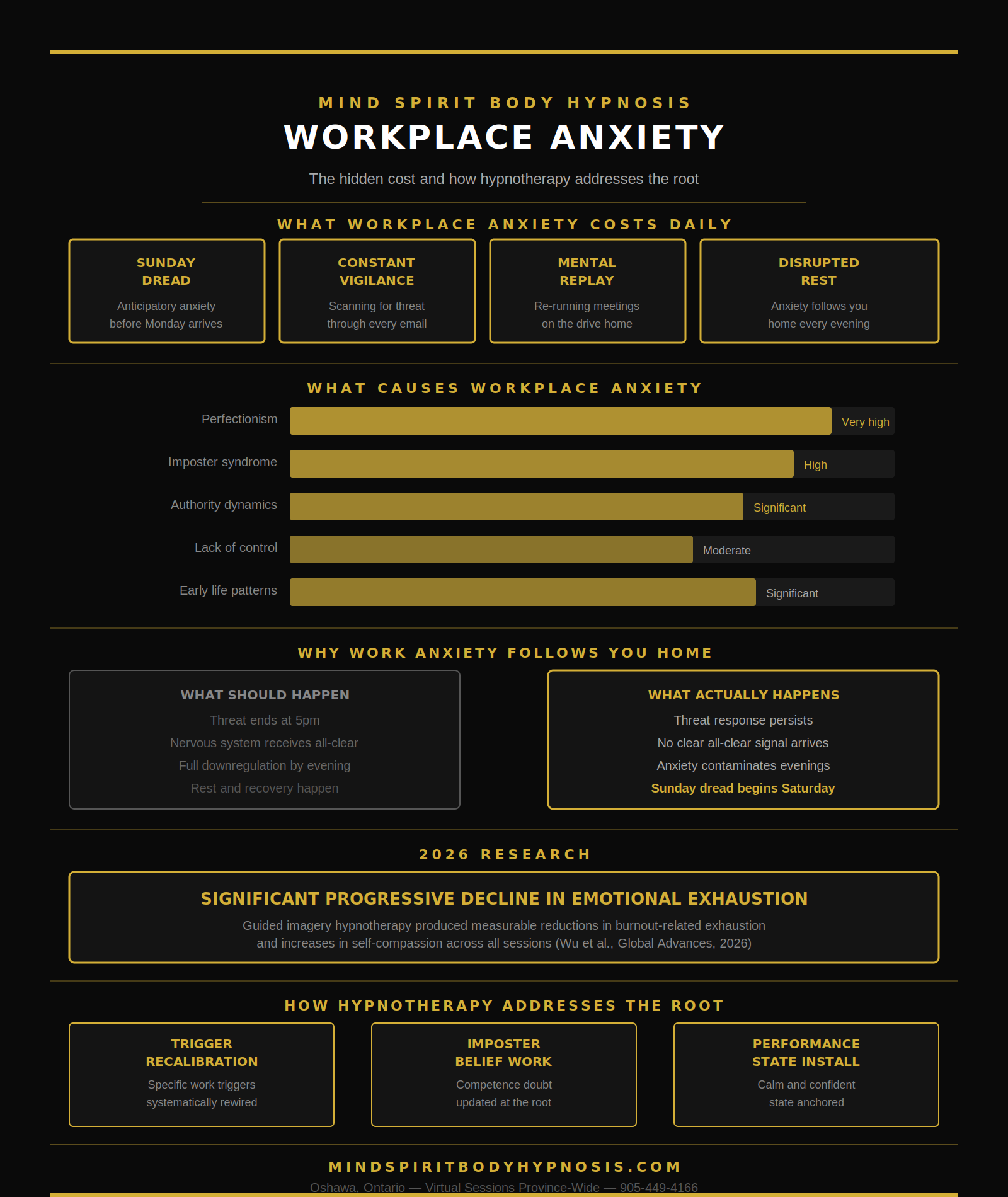
Workplace anxiety rarely has a single cause. In my experience working with clients across Ontario, it almost always involves a combination of the following:
Performance pressure and perfectionism. When the subconscious has concluded that mistakes are dangerous, the professional environment, which by definition involves evaluation, visibility, and the real possibility of error, becomes a constant source of low-grade threat. The perfectionist subconscious is not simply striving for excellence. It is managing fear.
Imposter syndrome and competence doubt. The persistent belief that success is undeserved, that discovery of inadequacy is imminent, and that genuine capability is less than what others perceive. Imposter syndrome is a subconscious identity pattern, not an accurate assessment of competence, and it tends to intensify precisely as external achievement increases.
Difficult relationships and power dynamics. A critical manager, a competitive colleague, an environment of chronic micromanagement, or a history of workplace conflict can condition the nervous system to treat the entire professional environment as unsafe. The source of the threat may no longer be present, but the nervous system continues to operate as if it is.
Lack of control and unpredictability. The nervous system tolerates stress best when it has some degree of agency. Environments characterized by constant change, unclear expectations, or arbitrary decision-making are particularly activating for anxiety-prone nervous systems.
History of trauma or difficult early experiences. Authority figures, evaluation, criticism, and the possibility of failure in professional settings can activate subconscious material rooted in early life experiences that predate the workplace entirely. For clients whose anxiety intensifies dramatically in the presence of authority, the root is often not professional at all.
Research published in the Journal of Occupational Health Psychology found that workplace anxiety is significantly predicted by anxiety sensitivity, intolerance of uncertainty, and maladaptive perfectionism, with all three operating primarily at the subconscious level and showing limited response to conscious coping strategies alone (Frone, 2000).
For more on how generalized anxiety and its subconscious roots are addressed at Mind Spirit Body Hypnosis, the hypnotherapy for anxiety and stress pillar page covers the foundational nervous system mechanisms in detail.
Why Work Anxiety Follows You Home
One of the most exhausting features of workplace anxiety is that it does not stay at work. The commute becomes a decompression exercise that does not fully work. The evenings carry the residue of the day. Weekends are contaminated by the anticipation of Monday. And the quality of life outside of work is gradually eroded by an anxiety that was supposed to belong to the professional context alone.
The reason is neurological. The nervous system does not file anxiety by context. When the threat response is activated, it persists until the nervous system receives a clear all-clear signal. In a chronically anxious professional, that signal rarely arrives clearly enough to fully downregulate the system before the next working day begins.
The result is a nervous system that is never fully off. Sleep is lighter than it should be. Relaxation is partial. And over time, the sustained sympathetic activation that workplace anxiety produces contributes to the physical and emotional exhaustion that, if left unaddressed, leads to full burnout.
A 2026 study published in Global Advances in Integrative Medicine and Health examined the impact of guided imagery hypnotherapy on occupational emotional exhaustion. Participants showed a significant progressive decline in burnout-related emotional exhaustion across sessions, alongside a progressive increase in self-compassion, with EEG data confirming a shift toward approach-related self-regulation (Wu et al., 2026). The authors noted that the nervous system changes observed during hypnotherapy sessions suggested a fundamental retraining of the autonomic response to occupational stress, not merely temporary symptom relief.
⭐ Pro Tip: The transition between work and home is one of the highest-leverage moments for managing workplace anxiety. Creating a deliberate, consistent end-of-work ritual, even something as simple as a five-minute walk, a change of clothing, or a specific piece of music, gives the nervous system a contextual signal that the work state is ending. This is a simple form of anchoring that complements the deeper subconscious work done in hypnotherapy sessions.
How Hypnotherapy Addresses Workplace Anxiety at the Root
As a certified hypnotherapist trained through the American Board of Hypnotherapy, I approach workplace anxiety as a subconscious pattern with identifiable origins and specific trigger structures. The work is targeted, practical, and builds tools that the client can use independently in professional situations.
Trigger mapping and nervous system recalibration. Sessions begin by mapping the specific professional situations that most reliably activate the anxiety response: presentations, performance reviews, interactions with particular people, email notifications, open-plan office environments, or the transition into the working week. Once mapped, the automatic threat response attached to each trigger is systematically addressed in trance. The trigger fires. The anxiety does not follow.
Imposter and competence beliefs work. For clients whose workplace anxiety is rooted in imposter syndrome or chronic competence doubt, trance work accesses the subconscious beliefs generating those patterns. The belief that genuine capability is less than what others perceive is identified, examined in the context of actual evidence, and replaced with a more accurate and functional self-assessment at the subconscious level.
Authority and relationship pattern work. Where workplace anxiety is intensified by specific relationships or authority dynamics, the subconscious patterns from earlier experiences that are being activated in the current context are identified and addressed. The current manager or colleague stops carrying the emotional weight of historical material they had no part in creating.
Performance state installation. Using guided imagery and direct suggestion in trance, the client is walked through their most challenging professional scenarios, delivering presentations, receiving feedback, and navigating conflict, in a state of genuine calm, clarity, and confidence. These scenes are filed as expected memory, making the actual situations feel more familiar and manageable.
NLP Techniques That Calm the Work Anxiety Response
NLP offers precise, portable tools for managing workplace anxiety in real time. Clients I work with across Ontario find these particularly useful between sessions.
The circle of excellence. A resource state of calm, competent, grounded professionalism is built during trance and anchored to a physical cue. The client steps into this state before high-pressure professional situations, replacing the automatic anxiety response with a practised alternative. Many clients describe this as feeling like accessing a different, more capable version of themselves on demand.
Submodality works on the anxious internal state. The internal experience of workplace anxiety has a specific structure. It sits somewhere in the body; it has a texture, a colour, a sound. Changing those qualities directly reduces the intensity of the experience. Clients learn to do this independently in under two minutes, producing a measurable shift in anxiety level before a difficult meeting or interaction.
Belief reframing for perfectionism. The perfectionist belief that any error is catastrophically dangerous is examined through logical levels of work. New, more functional beliefs are installed: that competence includes the ability to recover from mistakes, that errors are data rather than evidence of inadequacy, and that good enough is genuinely good enough in the vast majority of professional situations.
Future pacing high-pressure situations. The client mentally rehearses upcoming challenging professional events in trance, experiencing them with calm and confidence. The subconscious files this as a familiar experience rather than an unknown threat, which measurably reduces the anticipatory anxiety associated with the actual event.
For more on how NLP and hypnotherapy are combined in practice at Mind Spirit Body Hypnosis, the hypnotherapy for self-sabotage page covers the overlapping confidence and performance patterns in detail.

What to Expect in a Session
The first session is a conversation. Which professional situations activate the anxiety most? Is there a specific relationship or context that makes it worse? How long has it been present? Is there a time in your professional life when it was noticeably less severe, and if so, what was different?
This mapping shapes the subconscious work. The induction is gentle, and most clients reach a deeply relaxed trance state within minutes. The core work then targets the specific triggers, belief patterns, and relationship dynamics identified in the conversation.
Most workplace anxiety programmes at Mind Spirit Body Hypnosis run between three and five sessions. Many clients notice a meaningful shift in their professional experience after the first two sessions: a reduction in the Sunday dread, a calmer response to email, a greater sense of groundedness in high-pressure interactions. Later sessions deepen the identity-level work and install the independent tools.
All sessions are delivered virtually and are available to clients aged 10 and older across Ontario from the comfort of their own homes. The virtual format is particularly well-suited to workplace anxiety clients because it removes any anxiety associated with being seen seeking help.
More about how Fanis approaches confidence and performance at Mind Spirit Body Hypnosis is available on the about page.
What My Clients Say
"Working with Fanis has changed my life. After years of therapy for anxiety and confidence issues, I wanted to try something different. This experience has transformed me from the inside out and continues to have an effect even after our sessions. I am now able to be myself, face my fears, surround myself with those who care about me and live a fulfilling and happy life. So grateful."
Kristen W. | Anxiety and Confidence | Five Stars
FAq
Can hypnotherapy help with workplace anxiety? Yes. Hypnotherapy works directly with the subconscious trigger patterns, limiting beliefs, and nervous system dysregulation that generate workplace anxiety. Research supports hypnotherapy for occupational emotional exhaustion, with a 2026 study confirming significant progressive reductions in burnout-related exhaustion across hypnotherapy sessions.
What causes anxiety at work? Workplace anxiety is most commonly driven by performance pressure and perfectionism, imposter syndrome, difficult authority relationships, lack of control or predictability, and in many cases, subconscious material from early life that becomes activated by the professional environment. It rarely has a single cause.
Why does work anxiety follow you home? The nervous system does not file anxiety by context. When the threat response is activated and does not receive a clear all-clear signal, it persists into evenings, weekends, and sleep. A chronically anxious professional is running on a nervous system that never fully downregulates, which over time contributes to burnout.
How is workplace anxiety different from general anxiety? Workplace anxiety is specifically triggered or significantly amplified by the professional context. While it shares the same neurological mechanisms as generalized anxiety, its triggers are specific to the work environment: evaluation, authority, performance visibility, and professional relationships. The treatment approach is tailored to address those specific structures.
What is the best treatment for work-related anxiety? Approaches that address both the subconscious trigger patterns and the nervous system dysregulation maintaining the anxiety produce the most lasting results. Hypnotherapy and NLP work at both levels simultaneously, providing bigger and more durable change than stress management techniques that target only the conscious experience.
How many sessions will I need? Most clients at Mind Spirit Body Hypnosis working on workplace anxiety complete three to five sessions. Many notice a meaningful shift after the first two. The timeline depends on the depth of the pattern and whether there are compounding factors such as imposter syndrome, difficult relationships, or longer-standing anxiety.
Is this suitable for younger clients? Yes. Mind Spirit Body Hypnosis works with clients aged 10 and older. Workplace and academic performance anxiety in younger clients, including students and young professionals, responds well to hypnotherapy and NLP.
Can I do sessions virtually from anywhere in Ontario? Yes. All sessions are delivered virtually, province-wide, with no referral required.
What if I have always been anxious at work? Long-standing workplace anxiety can absolutely shift. The subconscious patterns maintaining it can be updated regardless of how long they have been in place. Many clients who have been anxious at work for their entire career find that addressing the root cause produces changes that years of coping strategies could not.
How do I get started? Book a free 30-minute virtual strategy session at calendly.com/mindspiritbodyhypnosis. No referral needed.
Ready to Take the Next Step?
If work has started to feel like a constant performance of calm you do not actually feel, and the anxiety follows you home most days, that is not simply the nature of your job. It is a subconscious pattern. And it can change.
I offer a free 30-minute virtual strategy session for new clients across Ontario. There is no pressure, just a conversation about what is happening and how hypnotherapy or NLP may help you work with confidence rather than dread.
Book your free session:calendly.com/mindspiritbodyhypnosis
Call or text:905-449-4166
Email:mindspiritbodyhypnosis@gmail.com
Visit:mindspiritbodyhypnosis.com
Serving clients virtually across Ontario, including Durham Region, Toronto, Ottawa, and beyond.
Disclaimer: This article is for informational purposes only and does not constitute medical or psychological advice. Hypnotherapy and NLP are complementary approaches and are not a substitute for diagnosis or treatment by a qualified healthcare provider. Please consult a licensed professional if you have concerns about your mental health. Results vary by individual.
Written by Fanis Makrigiannis | Certified Hypnotherapist & NLP Master Practitioner | Mind Spirit Body Hypnosis.