Hypnosis for Weight loss
Hypnosis for Weight Loss in Ontario: Why Willpower Fails Against Cravings and What Actually Works
TL;DR: Food cravings are not a moral failing, and they are not evidence of weak character. They are neurological events driven by the brain's reward and habit circuitry, operating at a level where willpower has very little purchase. Hypnosis for weight loss in Ontario addresses cravings directly at the subconscious level where they are generated, not at the conscious level where most people have already been trying to resist them. A meta-analysis in the Journal of Consulting and Clinical Psychology found that combining hypnotherapy with behavioural weight loss programmes produced significantly greater weight loss than programmes without it.
Quick Answer
Hypnosis for weight loss in Ontario is a subconscious-focused approach that targets the neurological craving and reward patterns driving habitual overeating, not simply the conscious desire to eat less. A controlled clinical trial published in the International Journal of Obesity found that participants receiving hypnosis focused on stress reduction maintained significantly greater weight loss after 18 months than those receiving dietary advice alone. Fanis Makrigiannis, a Certified Hypnotherapist (ABH) and NLP Master Practitioner (ABNLP) at Mind Spirit Body Hypnosis in Oshawa, Ontario, offers virtual sessions for clients aged 10 and older across Ontario who are ready to address the subconscious layer of their relationship with food. No referral is required.
Questions This Article Answers
Why do food cravings override willpower even in motivated people?
What is actually happening in the brain during a craving?
Why do some foods produce cravings and others do not?
What does hypnotherapy specifically do to change the craving response?
How many sessions does it take to see a meaningful shift?
In this article:
There is a particular kind of frustration that comes with food cravings in the context of a genuine weight loss effort. It is not that the person does not know what they want to do. They know exactly. They want to eat well, lose weight, and feel better in their body. They are committed. They have planned. And then three o'clock arrives, or the evening comes, or a particular feeling arises, and the craving appears, and the plan collapses.
The failure is attributed to willpower. The solution proposed is more willpower. And the cycle repeats.
In my practice in Oshawa, what I see consistently is that the people who struggle most with food cravings are not the least motivated people in the room. They are among the most. They have tried harder than most. The problem is not the trying. The problem is the level at which the trying is aimed.
Why Willpower Is the Wrong Tool for Food Cravings
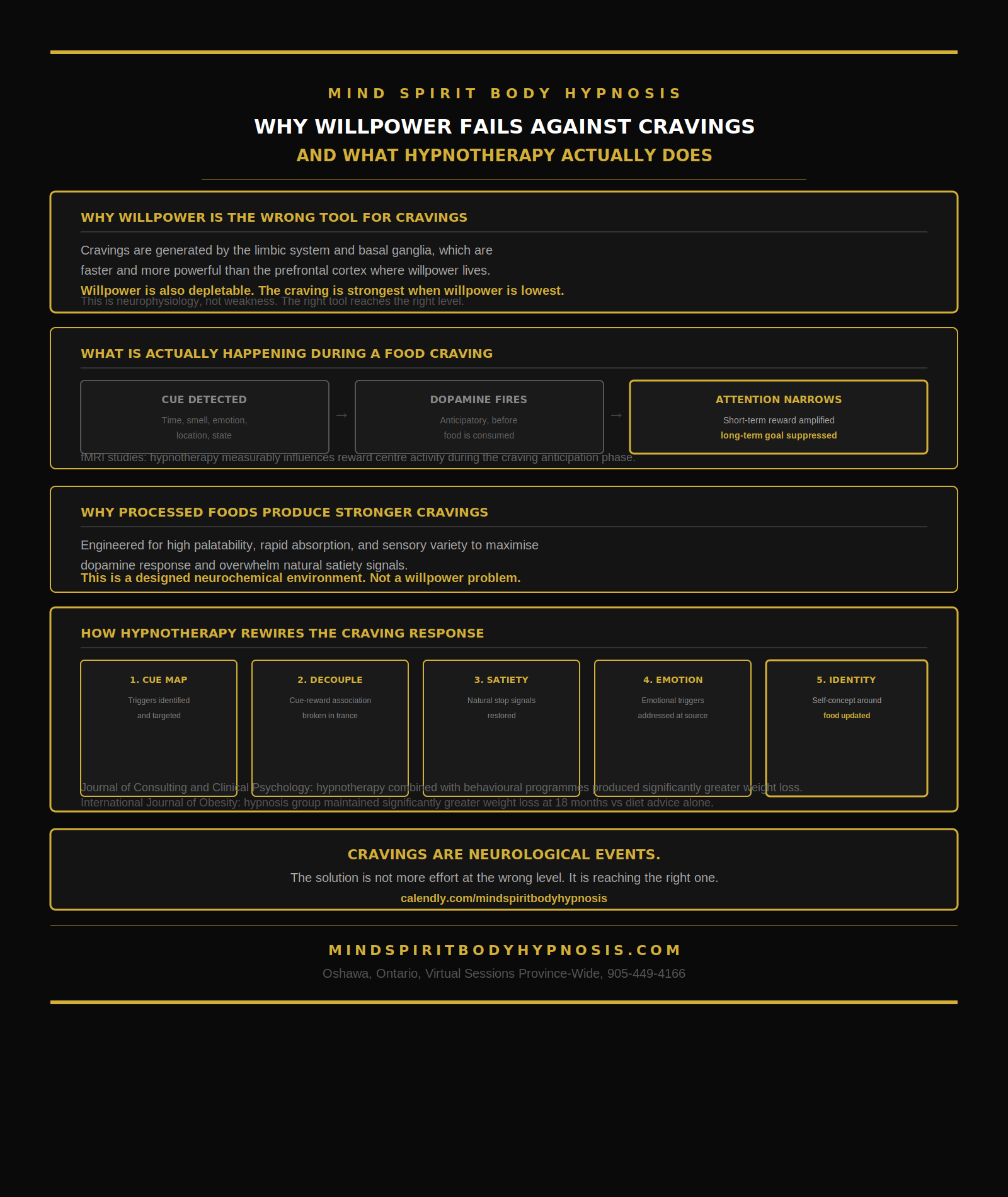
Willpower is a function of the prefrontal cortex: the part of the brain responsible for planning, decision-making, and conscious self-regulation. It is genuinely useful for managing behaviour in the short term. It is poorly suited to sustained resistance to impulses originating in older, faster, and more powerful brain systems.
Food cravings are generated primarily in the limbic system and the basal ganglia: the brain's reward and habit circuitry. These systems operate automatically, below the threshold of conscious deliberation, and they are significantly more powerful than the prefrontal cortex in competition for behavioural output. When the craving system fires, it does not present itself as a single option for the prefrontal cortex to evaluate. It produces a state of urgency that narrows attention, suppresses competing motivations, and makes the food feel genuinely necessary rather than merely wanted.
Resisting this with willpower is possible, temporarily, under the right conditions. But willpower is a depletable resource. It degrades with fatigue, stress, emotional depletion, and cognitive load. The person who has held it together all day through a demanding schedule is precisely the person who has the least willpower available when the evening craving arrives. This is not weakness. It is neurophysiology.
The solution to a problem generated in the subconscious reward system is not more conscious effort directed at the same system. It is direct work at the subconscious level where the craving is generated. This is what makes hypnotherapy the appropriate tool for this kind of change, and why hypnosis for weight loss in Ontario has been gaining consistent attention from people who have tried the conscious-effort approach and found its limits.
For more on how the anxiety and stress patterns that compound craving intensity in the evening are addressed, the hypnotherapy for anxiety and stress page covers these mechanisms in full.
What Is Actually Happening in the Brain During a Craving?
A craving is a neurological event with a specific sequence.
A cue is detected: a time of day, a smell, a visual trigger, an emotional state, a location. This cue has been repeatedly paired with the consumption of a specific food through prior experience. The basal ganglia, which stores habitual associations, fires the expectation of reward. Dopamine is released in anticipation of the food, not just in response to it. This dopamine release is what creates the urgency and the narrowing of attention that characterizes the craving experience.
The prefrontal cortex receives this signal and attempts to evaluate it against longer-term goals. But the dopamine release has already altered the weighting of options. The short-term reward is neurochemically amplified. The longer-term goal of weight management is neurochemically suppressed. The competition is not equal, and willpower is not a neurochemical. It cannot match the dopamine signal on its own terms.
fMRI studies have shown that hypnotherapy measurably influences activity in the brain's reward and habit centres during this anticipatory phase, making it one of the few interventions that can directly affect the neurological substrate of the craving rather than simply asking the prefrontal cortex to override it more forcefully.
This is the structural case for why hypnotherapy is well-positioned for craving work: it reaches the system where the craving is generated, rather than strengthening resistance at a system that was never designed to win this competition through effort alone.
Why Do Certain Foods Produce Cravings and Others Do Not?
Three properties produce disproportionate craving responses, and processed foods are specifically engineered to maximize all three.
High palatability. Foods engineered to be maximally pleasurable trigger larger dopamine responses than naturally occurring foods. The larger the dopamine response, the stronger the craving association formed for future exposure to the same cue.
Rapid absorption. Ultra-processed foods are typically designed for rapid absorption, producing a fast spike in blood glucose and a correspondingly fast reward signal. This speed strengthens the association between the cue and the reward, making the habit more automatic with each repetition.
Sensory variety. The specific combination of salt, sugar, and fat found in most processed comfort foods exploits multiple reward pathways simultaneously. Natural foods tend to produce satiety signals that reduce consumption. Engineered foods are calibrated to delay or suppress these signals, keeping the reward pathway active longer.
This is not about discipline. The person who finds it hard to stop at one portion of an ultra-processed food is responding to an engineered neurochemical environment, not demonstrating weak character. The craving is rational given the neurological input. The solution requires changing the neurological input, not simply demanding that the prefrontal cortex work harder against it.
Understanding this reframes the entire weight loss conversation. The question is not how do I resist this craving. It is how do I update the subconscious association that produces it.
What Does Hypnotherapy Specifically Do to Rewire the Craving Response?
As a Certified Hypnotherapist with ABH and NGH certifications working with clients across Durham Region and Ontario, I address food cravings through a structured protocol that targets the specific mechanisms generating them. Here is the sequence I use:
1. Cue identification and mapping. In the first session, a detailed map is built of the specific cues that most reliably precede cravings for this person. Time of day, emotional state, social context, physical location, and preceding activity are all identified. This map determines the targets for the trance work that follows.
2. Dopamine expectation decoupling. In trance, the association between the identified cues and the anticipated reward is directly addressed. The subconscious is walked through the cue without the dopamine release that currently accompanies it. New, more neutral associations are installed. This is the subconscious equivalent of updating the habit loop at its source.
3. Satiety signal strengthening. Many people with habitual overeating have a weakened or delayed relationship with natural satiety signals: the body's genuine indication that enough has been consumed. In trance, the awareness of and responsiveness to these signals is directly strengthened. The natural stopping point, which has been overridden by the engineered palatability of processed foods, is reinstalled as a functional automatic response.
4. Emotional trigger processing. For many people, food cravings are as much emotional as they are neurochemical: the reaching for food is a reaching for relief from a specific uncomfortable state. The emotional states most reliably preceding cravings are identified and addressed directly in trance, with more functional routes to the same relief installed as competing automatic responses.
5. Identity update. Long-term craving patterns shape how people see themselves in relation to food. The person who has struggled with cravings for years often carries an identity of someone who cannot control their eating. In trance, this identity is directly updated to one of someone whose relationship with food is governed by genuine satisfaction rather than habitual urgency.
A meta-analysis in the Journal of Consulting and Clinical Psychology found that participants combining hypnotherapy with behavioural programmes lost significantly more weight than those using programmes alone. The finding reflects exactly this: hypnotherapy addresses the layer that behavioural programmes alone cannot reach.
What Do Sessions Look Like at Mind Spirit Body Hypnosis?
A typical programme for hypnosis for weight loss in Ontario at Mind Spirit Body Hypnosis, focused specifically on craving rewiring:
Session 1: Intake and craving map. A thorough conversation about the specific pattern of cravings for this person: what triggers them, when they are strongest, what emotions precede them, what foods are most involved, and what the person wants their relationship with food to feel like. No judgment and no diet advice. The focus is the subconscious pattern.
Sessions 2 and 3: Cue decoupling and satiety restoration. Trance work targeting the specific cue-reward associations most active in this person's pattern. Satiety signal awareness reinstalled. Emotional trigger states addressed.
Sessions 4 and 5: Identity update and future pacing. The self-concept around food and eating updated. The person is walked through future situations (the evening, the three o'clock moment, the social food context) from the updated subconscious baseline, filing the new response as expected.
In my practice, craving-focused weight loss work typically runs between three and five sessions. All sessions are virtual, available across Ontario, and open to clients aged 10 and older. No referral is required. Full credentials and background are available on the about page.
For a full overview of how the weight loss work at Mind Spirit Body Hypnosis addresses the broader range of weight-related patterns, the weight loss and emotional eating pillar page covers the complete approach.

WHAT MY CLIENTS SAY
“I had a great experience with Fanis at Mind Spirit Body Hypnosis. He is very understanding, patient, and genuinely takes the time to provide personal attention to your individual needs. The sessions have helped me work through anxiety and build more confidence. I also really appreciate the convenience of the virtual sessions, which make it easy to attend from home. I highly recommend Fanis to anyone looking for a caring and understanding hypnotherapist.” — Otibo E.
Frequently Asked Questions
Why does willpower fail against food cravings even when I am genuinely motivated? Because food cravings are generated by the brain's reward and habit circuitry, which operates faster and more powerfully than the prefrontal cortex where willpower lives. Willpower is also a depletable resource that degrades with fatigue and stress. The more demanding the day, the less willpower is available precisely when the craving is strongest.
What is actually happening in the brain during a craving? A cue triggers the basal ganglia to fire the expectation of reward. Dopamine is released in anticipation of the food, narrowing attention and amplifying the short-term reward relative to longer-term goals. The prefrontal cortex attempts to override this but is working against a neurochemical signal it cannot match through effort alone.
Why are some foods so much harder to stop eating than others? Because ultra-processed foods are specifically engineered to maximize palatability, rapid absorption, and sensory variety in combinations that overwhelm natural satiety signals and produce stronger, faster craving associations than naturally occurring foods. This is a designed neurochemical environment, not evidence of personal weakness.
Does hypnotherapy actually work for food cravings and weight loss? Yes. A meta-analysis in the Journal of Consulting and Clinical Psychology found that adding hypnotherapy to behavioural weight loss programmes produced significantly greater weight loss than programmes alone. A controlled clinical trial in the International Journal of Obesity found that hypnosis focused on stress reduction produced significantly greater weight loss maintained at 18 months. fMRI studies have shown hypnotherapy measurably influences activity in the brain's reward centres during the craving anticipation phase.
Is this approach a replacement for healthy eating and exercise? No. Hypnotherapy addresses the subconscious psychological layer that makes healthy eating and exercise difficult to sustain consistently. It works best as part of a comprehensive approach that includes sensible nutrition and movement. What it does is remove the subconscious resistance that has been undermining the conscious effort.
Will I have to give up specific foods permanently? The goal is not rigid restriction. It is a genuine shift in the relationship with food: from urgency and compulsion to genuine choice and satisfaction. Some clients find that certain foods naturally become less appealing after the craving association is updated. This is not deprivation. It is the craving losing its charge.
How many sessions will I need? Craving-focused weight loss work typically runs three to five sessions in my practice. An honest, specific estimate for your situation is always given in the free 30-minute strategy session, with no commitment required.
Can younger people be helped with food cravings and weight concerns? Yes. I work with clients aged 10 and older. Craving patterns often establish early, and addressing them before they become deeply entrenched tends to produce faster and more durable results.
Can I access sessions from anywhere in Ontario? Yes. All sessions are delivered virtually across Ontario, including Durham Region, Toronto, Ottawa, and beyond. No referral is required.
Ready to Take the Next Step?
If food cravings have been overriding your best intentions for long enough, the problem is not the intentions. It is the level at which the solution has been applied.
I offer a free 30-minute virtual strategy session for new clients across Ontario. No pressure. Just an honest conversation about what the craving pattern has been like and whether this approach is the right fit.
Book your free session:calendly.com/mindspiritbodyhypnosis
Call or text:905-449-4166
Email:mindspiritbodyhypnosis@gmail.com
Visit: mindspiritbodyhypnosis.com
Serving clients virtually across Ontario, including Durham Region, Toronto, Canada, and beyond.
Disclaimer: This article is for informational purposes only and does not constitute medical or psychological advice. Hypnotherapy, NLP, and EMDR are complementary approaches and are not a substitute for diagnosis or treatment by a qualified healthcare provider. Please consult your doctor before beginning any weight management programme. Results vary by individual.
Written by Fanis Makrigiannis | Certified Hypnotherapist (ABH, NGH) and NLP Master Practitioner (ABNLP) | Mind Spirit Body Hypnosis, Oshawa, Ontario.