Does Hypnosis Really work for Panic attacks?
Hypnotherapy for Panic Attacks in Ontario: What It Is, What It Does, and What the Research Shows
TL;DR: Panic attacks are one of the most distressing anxiety experiences a person can have, and one of the most misunderstood. They are not a sign of weakness or serious mental illness. They are a misfiring of the body's threat response in the absence of a genuine threat. Hypnotherapy addresses panic attacks at the subconscious level where the trigger threshold is calibrated, and a 2025 meta-analysis of 20 randomized controlled trials found that hypnosis significantly reduced anxiety symptoms. Fanis Makrigiannis at Mind Spirit Body Hypnosis in Oshawa, Ontario, offers virtual sessions across Ontario for clients whose panic is ready to change.
Quick Answer
Hypnotherapy for panic attacks Ontario is a subconscious-focused approach that addresses the sensitized threat response driving panic, the feared body sensations that trigger the panic cycle, and the anticipatory anxiety that keeps the nervous system primed between episodes. A 2025 systematic review published in the Journal of Psychosomatic Research found that hypnosis significantly reduced anxiety across 20 RCTs involving 1,250 patients. Fanis Makrigiannis, a Certified Hypnotherapist (ABH) and NLP Master Practitioner (ABNLP) at Mind Spirit Body Hypnosis in Oshawa, Ontario, offers virtual sessions for clients aged 10 and older across the province, with no referral required.
Questions This Article Answers
What is actually happening in the body and brain during a panic attack?
Why do panic attacks seem to come out of nowhere?
Why does the fear of having another panic attack become its own problem?
What does hypnotherapy specifically do for panic attacks?
How many sessions does it take to notice a difference?
In this article:
The word panic is one of the most overused words in everyday language, which is part of why the clinical experience of a panic attack is so often underestimated by people who have not had one. A panic attack is not feeling anxious or stressed. It is a sudden, overwhelming physiological experience in which the body activates its full emergency response in the complete absence of a genuine emergency.
The heart pounds. The chest tightens. Breathing becomes rapid and shallow. The hands tingle. A wave of dread arrives that is unlike ordinary worry: certain, total, and physical. Many people who have their first panic attack believe they are dying.
In my practice, the people who arrive for panic attack work have usually already been told what a panic attack is. They have googled it. They know the physiology. And knowing has not stopped the next one from arriving.
This is the gap that hypnotherapy is designed to bridge.
What Is Actually Happening During a Panic Attack?
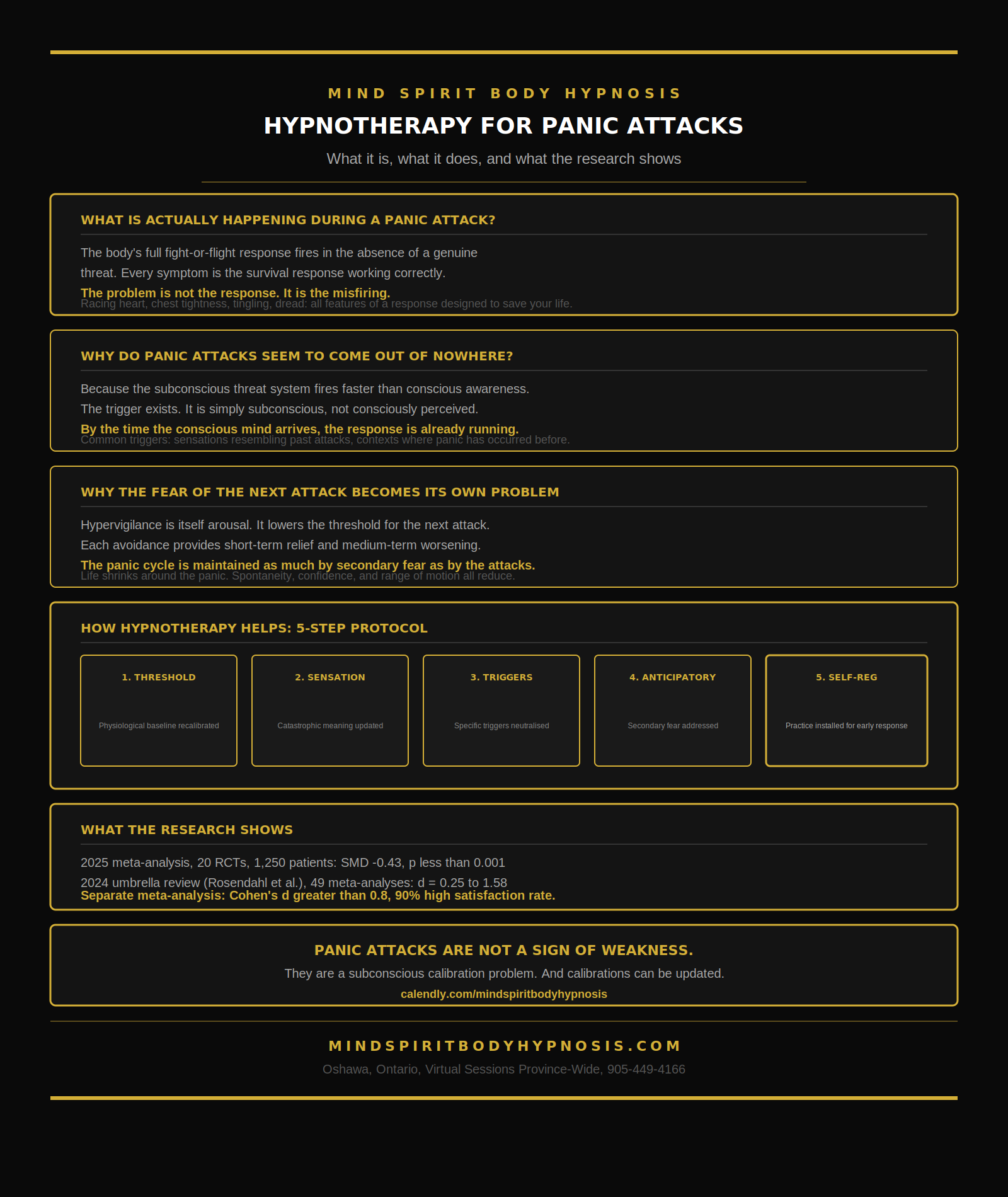
A panic attack is the body's emergency stress response activating in the absence of a genuine threat. To understand why this happens, it helps to understand what the response is designed to do.
The fight-or-flight response is one of the most fundamental survival mechanisms in the human nervous system. When the brain's threat-detection system perceives genuine danger, it triggers an immediate cascade of physiological changes: adrenaline is released, heart rate increases rapidly, blood flow is redirected to the large muscle groups, breathing becomes faster to increase oxygen availability, and non-essential processes like digestion temporarily shut down.
Every single symptom of a panic attack is a feature of this response functioning exactly as it was designed to function. The racing heart is delivering oxygen to the muscles. The chest tightness reflects the engagement of the respiratory muscles. The tingling in the extremities reflects blood flow redistribution. The overwhelming dread is the conscious experience of the body's certainty that something life-threatening is occurring.
The problem in panic is not that the response is malfunctioning. It is that the response is misfiring: activating at full intensity in response to a perceived threat that is not actually life-threatening. The body is doing its job. The threat-detection system is operating on incorrect information.
This distinction matters enormously for how hypnotherapy approaches the problem. The goal is not to suppress the body's protective response. It is to update the threat-detection system's calibration so that everyday sensations, situations, and experiences stop registering as emergencies.
For more on how the anxiety and nervous system mechanisms that underlie panic are addressed at Mind Spirit Body Hypnosis, the hypnotherapy for anxiety and stress in Ontario page covers the full nervous system picture.
Why Do Panic Attacks Seem to Come Out of Nowhere?
They rarely do. The "out of nowhere" quality is one of the most distressing features of panic disorder, and it is almost always the result of subconscious triggering rather than truly random activation.
The subconscious threat-detection system (primarily the amygdala) operates faster than conscious awareness. When it identifies a match with a stored threat pattern, it fires the emergency response before the prefrontal cortex has had time to evaluate whether the current situation is actually dangerous. By the time conscious awareness registers what is happening, the physiological response is already at full intensity. From the conscious mind's perspective, the panic arrived without warning. From the subconscious's perspective, it was responding to something specific.
Common subconscious triggers for panic attacks that feel spontaneous include:
A heart rate that increased slightly during exertion, which the sensitized nervous system misread as the beginning of a cardiac event
A mild sensation of light-headedness from standing up quickly, which triggered associations with previous panic episodes
A confined space, a crowd, a temperature, or a particular quality of light that matched the sensory context of a previous attack
Internal sensations of anxiety from an unrelated concern that the body interpreted as the beginning of a panic attack
Once the body has experienced panic attacks in a particular context, the nervous system begins to scan that context automatically for early warning signals. This scanning is itself a form of low-grade arousal that lowers the threshold for further activation. The subconscious becomes increasingly vigilant, increasingly sensitive, and increasingly likely to fire the response at inputs that did not previously trigger it.
A 2024 umbrella review by Rosendahl and colleagues, analyzing 49 meta-analyses spanning two decades and 261 primary studies, found medium to large effect sizes for hypnotherapy on anxiety-related outcomes (Cohen's d ranging from 0.25 to 1.58), noting that the approach is particularly well-suited to conditions where the threat response has become sensitized and dysregulated.
Why the Fear of Having Another Panic Attack Becomes Its Own Problem
This is the dimension of panic disorder that makes it so significantly limiting: the primary fear of the panic attack is often surpassed by the secondary fear of having another one.
After experiencing panic attacks, most people develop a heightened monitoring of their own physical state. Any sensation that could be the beginning of a panic attack becomes a source of alarm. The heart rate that increases slightly during exercise. The brief shortness of breath from walking up stairs. The light-headedness from hunger. All of these normal physiological experiences become potential triggers because the subconscious has learned to treat them as early warning signals.
This vigilance, which feels protective, is actually one of the primary mechanisms that maintains and intensifies the panic cycle. The hypervigilance produces a baseline of physiological arousal (because monitoring is itself a form of activation) that sits dangerously close to the threshold at which the panic response fires. This means that any additional physiological input pushes the system over the edge more easily, producing more frequent attacks, which produces more hypervigilance, which produces a lower threshold, and so on.
People with significant panic disorder often begin to restrict their lives to avoid situations in which panic might occur. Driving on the motorway. Shopping in large stores. Attending events in enclosed spaces. Taking public transport. Each avoidance that prevents a panic attack provides short-term relief and medium-term worsening: the nervous system learns that avoidance is the appropriate response to these situations, and the situations themselves become increasingly threatening.
Hypnotherapy for panic attacks in Ontario is particularly well-suited to this secondary fear layer, because it addresses both the physiological sensitization and the subconscious avoidance patterns that maintain the cycle, not just the acute attack response.
What Does Hypnotherapy Specifically Do for Panic Attacks?
As a Certified Hypnotherapist with ABH and NGH certifications working with clients across Durham Region and Ontario, I address panic attacks through a structured approach that targets the specific mechanisms maintaining them. This is the approach I use, session by session.
1. Physiological recalibration. The trance state produces genuine parasympathetic activation: the physiological opposite of the sympathetic emergency response that drives panic. In trance, the nervous system experiences genuine calm at a depth that ordinary relaxation often does not reach. Repeated across sessions, this recalibrates the subconscious baseline, raising the threshold at which the emergency response fires.
2. Sensation reframing. A significant component of panic disorder is the catastrophic interpretation of normal bodily sensations. In trance, I work directly with the subconscious meaning assigned to these sensations. An increased heart rate is updated from "something is very wrong" to "my body is responding normally to this situation." This is not a conscious reframe that the subconscious evaluates and rejects. It is a direct subconscious update in the receptive trance state.
3. Trigger identification and neutralization. Using the intake map from the first session, the specific subconscious triggers most associated with panic onset are identified and worked with directly in trance. The stored threat associations are updated: the confined space, the previous panic context, the early physical sensations that now trigger the cascade are all addressed.
4. Anticipatory anxiety reduction. The fear of the next attack is addressed directly. In trance, the experience of encountering a previously triggering situation and remaining regulated is installed as an expected experience. This directly counters the anticipatory dread that has been maintaining the hypervigilance.
5. Self-regulation skill installation. I teach a brief self-hypnosis and regulation practice for use in the early stages of a developing panic response, before the full cascade activates. Clients who use this practice consistently find that it gives them a genuine sense of agency in a situation that has previously felt completely beyond control.
The research supports this approach strongly. A meta-analysis cited by ResearchGate found Cohen's d values above 0.8 (indicating large effect sizes) for hypnotherapy on anxiety outcomes, with 90% of participants reporting high satisfaction with treatment.
What Do Sessions Look Like at Mind Spirit Body Hypnosis?
A typical programme for hypnotherapy for panic attacks in Ontario at Mind Spirit Body Hypnosis:
Session 1: Intake and trigger mapping. A detailed conversation about the history and pattern of the panic: when attacks first started, what situations or sensations most reliably precede them, what the anticipatory anxiety looks like, and what the person wants to be different. No pressure to describe attacks in detail if that itself is activating.
Sessions 2 and 3: Physiological recalibration and sensation reframing. Deep trance work targeting the baseline activation level and the catastrophic interpretation of bodily sensations. Self-regulation practice installed.
Sessions 4 and 5: Trigger neutralization and anticipatory anxiety. Direct subconscious work with the specific triggers and contexts most associated with panic onset. The secondary fear layer addressed. Future situations visited from a regulated baseline.
In my practice, panic attack work typically runs between three and five sessions for most people, with meaningful reduction in attack frequency and intensity often noticeable within the first two. All sessions are virtual, available across Ontario, and open to clients aged 10 and older. No referral is required. Full credentials and background are available on the about page.
The confidence and identity effects of long-term panic disorder (the shrinking of life around the attacks, the loss of spontaneity) are addressed through the confidence and self-sabotage work that I often incorporate into later sessions once the acute panic pattern has reduced.
WHAT MY CLIENTS SAY
“Thank you so much Fanis for your enduring commitment to my health and well being. You are truly dedicated to your craft and to your clients. You stuck with me well beyond the initial timeline set for my progress and worked with me during travel cancellations, time changes and even a hurricane! Your belief in me, in yourself and in the process established a steady and stable foundation for my continued growth and recovery. And if I ever need a little support or boost, I trust you will be there if I come knocking. Mahalo nui loa! In gratitude.” — Jill R.
Frequently Asked Questions
What is actually happening in the body during a panic attack? The body's full fight-or-flight emergency response is activating in the absence of a genuine threat. Every symptom (racing heart, chest tightness, tingling, shortness of breath, dread) is a feature of the survival response functioning correctly. The problem is not the response itself but the threat-detection system misfiring in response to non-threatening input.
Why do panic attacks seem to happen out of nowhere? The subconscious threat system fires faster than conscious awareness. By the time the conscious mind registers what is happening, the physiological response is already running. The trigger exists; it is simply subconscious rather than consciously perceived. Common triggers include bodily sensations that resemble panic, sensory contexts that match previous attacks, and low-grade anxiety from unrelated concerns.
Why does the fear of having another panic attack become a bigger problem than the attacks themselves? Because the secondary hypervigilance lowers the physiological threshold for the next attack. Monitoring for early warning signs is itself a form of arousal that keeps the nervous system close to the threshold. Each avoided situation provides short-term relief and medium-term worsening. The panic cycle is maintained by the fear response as much as by the attacks themselves.
Does hypnotherapy actually work for panic attacks? The research is strong. A 2025 meta-analysis of 20 RCTs involving 1,250 patients found significant anxiety reduction from hypnotherapy (SMD = -0.43, p < 0.001). A 2024 umbrella review of 49 meta-analyses found medium to large effect sizes (d = 0.25 to 1.58) across anxiety outcomes. A separate meta-analysis found effect sizes above 0.8 (large) with 90% participant satisfaction. The evidence base is one of the strongest in the complementary mental health field.
How is hypnotherapy different from CBT for panic attacks? CBT works primarily through conscious identification and challenging of thoughts and behaviours. This is effective but requires sustained conscious effort and does not always reach the subconscious level where the sensitized threat response is calibrated. Hypnotherapy works directly at the subconscious level, updating the physiological threshold, the sensation interpretations, and the anticipatory anxiety patterns without requiring the person to consciously override the response each time it fires. The approaches are complementary.
Will I have to recreate or re-experience panic during sessions? No. Sessions are always conducted at a pace that feels safe and manageable. The work does not involve inducing panic or deliberately activating distressing sensations. Where historical experiences are relevant, they are approached indirectly and gently.
How many sessions will I need? In my practice, panic attack work typically runs three to five sessions, with noticeable reduction in frequency and intensity often within the first two. An honest, specific estimate is always given in the free 30-minute strategy session.
Can I access sessions from anywhere in Ontario? Yes. All sessions are delivered virtually across Ontario, including Durham Region, Toronto, Canada, and beyond. No referral is required, and no in-person visit is needed.
Can teenagers experience panic attacks and be helped? Yes. Panic attacks are common in adolescents, often triggered by academic pressure, social anxiety, or physical changes during puberty. I work with clients aged 10 and older, and the approach is adapted appropriately for younger clients.
Ready to Take the Next Step?
Panic attacks are one of the most physically overwhelming experiences anxiety produces. They are also one of the presentations that respond well to hypnotherapy, because the mechanism driving them is subconscious, and that is exactly the level hypnotherapy reaches.
I offer a free 30-minute virtual strategy session for new clients across Ontario. No pressure and no trance work in the strategy session. Just an honest conversation about what the panic has been like and whether this is the right approach.
Book your free session: calendly.com/mindspiritbodyhypnosis
Call or text: 905-449-4166
Email: mindspiritbodyhypnosis@gmail.com
Visit: mindspiritbodyhypnosis.com
Serving clients virtually across Ontario, including Durham Region, Toronto, Canada, and beyond.
Disclaimer: This article is for informational purposes only and does not constitute medical or psychological advice. Hypnotherapy, NLP, and EMDR are complementary approaches and are not a substitute for diagnosis or treatment by a qualified healthcare provider. If you are experiencing frequent panic attacks, please also consult your doctor to rule out any underlying medical conditions. Results vary by individual.
Written by Fanis Makrigiannis | Certified Hypnotherapist (ABH, NGH) and NLP Master Practitioner (ABNLP) | Mind Spirit Body Hypnosis, Oshawa, Ontario.