Can Hypnotherapy Stop racing thoughts at night?
Can Hypnotherapy Stop Racing Thoughts at Night?
TL;DR: Racing thoughts at night are not a thinking problem. They are a nervous system problem, and the subconscious is running a programme of hyperarousal that keeps the analytical mind switched on long after the body wants to rest. Fanis Makrigiannis, Certified Hypnotherapist and NLP Master Practitioner at Mind Spirit Body Hypnosis in Oshawa, Ontario, uses hypnotherapy and NLP to quiet the bedtime mind at the level where the pattern actually lives. Virtual sessions are available across Ontario for clients aged 10 and older.
Quick Answer
Hypnotherapy for racing thoughts at night is a subconscious-focused approach that calms the hyperarousal driving bedtime overthinking by retraining the nervous system's transition from alert to rest. Research suggests it may significantly reduce pre-sleep cognitive arousal and improve sleep onset in adults and adolescents. Fanis Makrigiannis, a Certified Hypnotherapist and NLP Master Practitioner at Mind Spirit Body Hypnosis in Oshawa, Ontario, offers virtual sessions across the province for clients of all ages struggling to quieten the mind at bedtime.
Questions This Article Answers
Why do my thoughts race when I try to sleep?
Can hypnotherapy stop racing thoughts at night?
What is the best treatment for overthinking at bedtime?
Why does my brain won't turn off at night?
How does hypnotherapy calm an overactive mind?
In This Article:
You get into bed. The room is dark and quiet. Every condition for sleep is in place. And then the mind switches on.
Tonight's agenda. The conversation from Tuesday that you should have handled differently. The thing you forgot to do. The thing you did do and wish you had not. A vague, source-less worry that grows heavier in the silence.
If this happens most nights, you are not alone. And it is not because you have too much to think about, though you may. It is because your nervous system has not yet learned how to make the transition from day-mind to sleep-mind. That transition is a skill. And like all skills, it can be learned.
Why Does the Mind Race at Night?
In my practice, clients with racing thoughts at night often arrive believing the problem is the content of their thoughts. If they could just solve the work situation, resolve the relationship tension, or stop worrying about their health, the thoughts would stop. But in most cases, the content is not the issue. The arousal state is.
Racing thoughts at night are almost always a symptom of a nervous system that has not successfully downregulated from the demands of the day. The transition from alert wakefulness to restful sleep requires a measurable drop in cortisol, a shift from beta brainwave activity (fast, analytical, problem-solving) to alpha and then theta (relaxed, drowsy, receptive). When the nervous system is chronically stressed, that transition fails to happen naturally. The brain stays in beta, and because there are no external demands to focus on, it turns inward and processes whatever material is available.
Research published in Cognitive Therapy and Research found that pre-sleep cognitive arousal, the technical term for racing thoughts at bedtime, is one of the strongest predictors of sleep onset difficulty and is significantly more prevalent in individuals with high daytime stress, anxiety, and perfectionist thinking styles (Harvey, 2002).
The subconscious plays a central role. Once the pattern of bedtime overthinking is established, the subconscious begins to associate the bedroom, darkness, and the act of lying down with the activation of the analytical mind. The environment itself becomes a trigger. This is why clients often find they can fall asleep on the sofa without difficulty but become wide awake the moment they get into bed.
What Is Actually Happening in the Brain at Bedtime?
Understanding the neuroscience makes the hypnotherapy approach much clearer.
The brain's default mode network (DMN) is a set of interconnected regions that activate during inward-focused thought, particularly self-referential processing, mental time travel (reviewing the past, anticipating the future), and social cognition. The DMN is supposed to quieten during sleep onset as the thalamus begins gating sensory input and the prefrontal cortex reduces its activity.
In people with chronic racing thoughts, this gating process is disrupted. The DMN remains highly active. The prefrontal cortex, rather than stepping back, continues to generate and evaluate thoughts. The result is the familiar paradox: the more tired the person is, the more the mind seems to speed up.
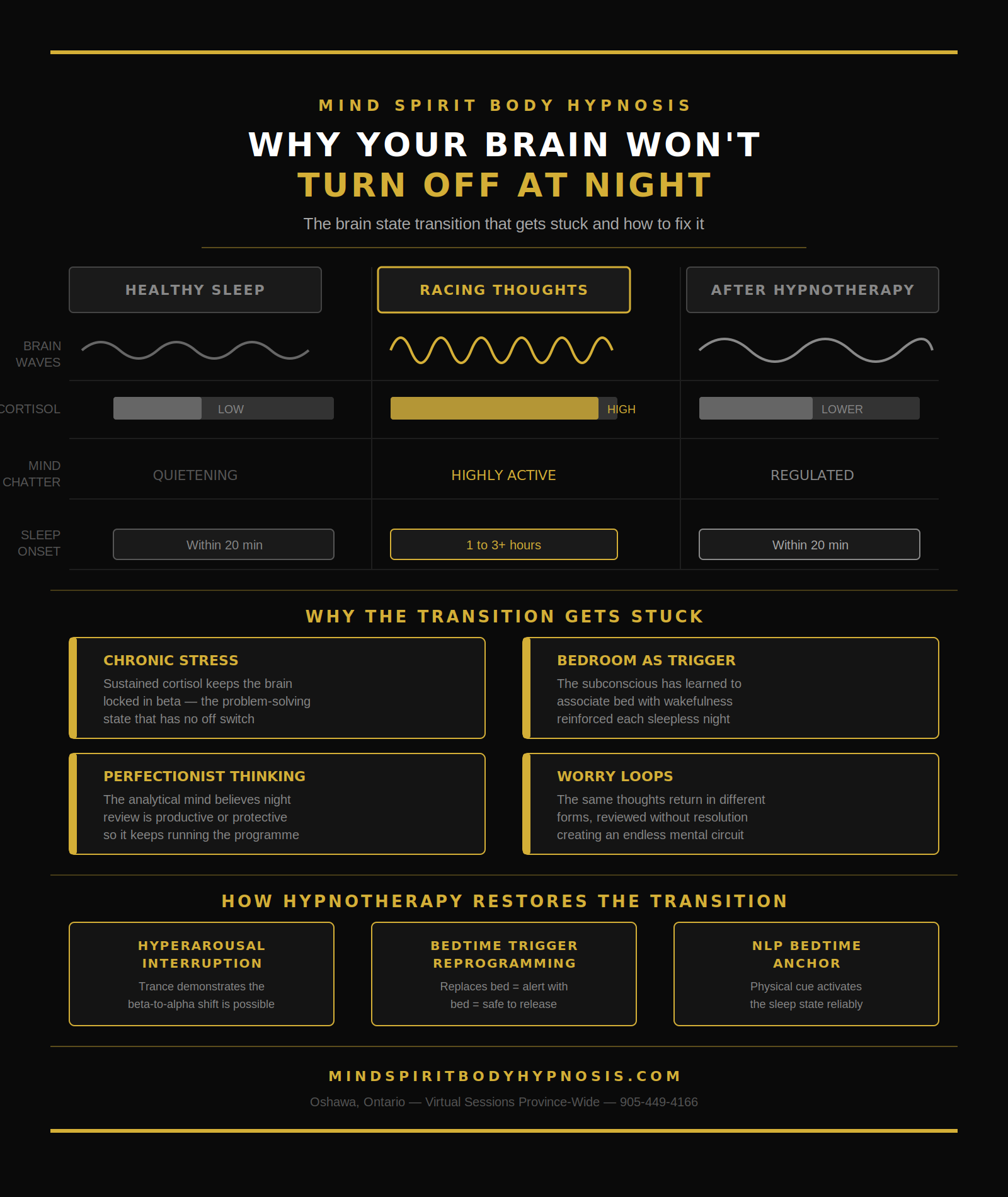
Here is how the three states compare:
Healthy sleep onset: Brainwaves shift from beta to alpha to theta. Cortisol declines naturally. The default mode network quietens. Result: natural sleep onset within 20 minutes.
Racing thoughts pattern: Brainwaves remain in sustained beta. Cortisol stays elevated. The default mode network remains highly active. Result: prolonged wakefulness, frustration, and mounting anxiety about sleep.
After hypnotherapy: Alpha brainwaves become dominant at bedtime. Cortisol baseline is lower. The default mode network is regulated. Result: faster, more reliable sleep onset without effort or medication.
Hypnotherapy works directly with the subconscious to facilitate the regulated state. It does not force sleep. It removes the obstacles the subconscious has built against it.

How Hypnotherapy Quiets the Racing Mind
As a certified hypnotherapist trained through the American Board of Hypnotherapy, I work with the specific subconscious patterns that maintain bedtime hyperarousal. This is not generic relaxation therapy. It is targeted subconscious intervention.
Hyperarousal pattern interruption. The hypnotic trance state is itself a demonstration to the subconscious that the shift from beta to alpha is possible. In trance, the analytical mind relaxes, and the subconscious becomes receptive. Many clients describe their first trance experience as the first time their mind has been genuinely quiet in months. This experience becomes a reference point the subconscious can return to at bedtime.
The bedtime trigger reprogramming. In trance, the subconscious association between bed and mental activation is identified and directly replaced. New associations are installed: darkness signals safety, lying down signals permission to let go, the bedroom environment becomes a cue for the mind to soften rather than sharpen.
Worry loop interruption. The most persistent feature of racing thoughts is the circular quality. The same thoughts return in slightly different forms, reviewed, rehearsed, and re-examined without resolution. Using guided suggestion and NLP, the subconscious learns to recognize the loop and step out of it rather than continue the circuit.
Cortisol baseline reduction. Research published in the American Journal of Clinical Hypnosis demonstrated that hypnotic induction produces measurable reductions in salivary cortisol, with effects that extend beyond the session itself when practised regularly (Horton-Hausknecht et al., 2001). Clients who complete a course of hypnotherapy for racing thoughts typically report a calmer overall stress response, not just improved sleep.
For more on how sleep disruption and nervous system dysregulation intersect, the hypnotherapy for sleep and insomnia page at Mind Spirit Body Hypnosis covers the foundational mechanisms.
NLP Techniques That Create the Mental Off Switch
NLP offers precise, practical tools for the specific thought patterns that drive bedtime hyperarousal. Clients I work with in Ontario find these particularly useful because they can be applied independently between sessions.
The Cognitive Shuffle. A technique with growing research support, cognitive shuffling involves deliberately generating a sequence of unrelated, random mental images at bedtime. This mimics the natural pre-sleep imagery pattern of healthy sleepers and disrupts the analytical DMN activity that sustains racing thoughts. Research by Beaudoin et al. published in Behaviour Research and Therapy found cognitive shuffling significantly reduced pre-sleep cognitive arousal in people with insomnia (Beaudoin et al., 2014). In sessions, I teach a structured version of this technique anchored to a specific physical cue so it becomes automatic.
Submodality work on the worry voice. The internal voice or image driving racing thoughts has a specific structure: a location in the mind's space, a volume, a tempo, a quality. NLP submodality work changes those qualities directly. Moving the voice further away, slowing its tempo, and reducing its volume produces an immediate reduction in the urgency of the thoughts without requiring their content to be resolved.
The bedtime anchor. A deeply relaxed, drowsy state experienced during trance is anchored to a simple physical cue, such as a specific breath pattern or hand position. At bedtime, activating the anchor shifts the nervous system reliably toward the sleep state. Clients often report this as the single most practically useful tool from the programme.
Parts integration. Many racing-thought clients have an internal conflict between the part that wants to sleep and the part that believes reviewing problems at night is productive or protective. NLP parts integration resolves this conflict, allowing the mind to genuinely release planning and problem-solving at bedtime rather than sustaining a low-grade argument with itself all night.
For more on how NLP and hypnotherapy are combined in my practice, the about page outlines the full clinical approach and qualifications.
What to Expect in a Session
The first session begins with a conversation. How long have the racing thoughts been present? What topics dominate? Is there a specific time the mind activates most reliably? Has the bedroom itself started to feel like a place of dread rather than rest?
This mapping shapes the subconscious work. The induction is gentle and most clients reach a deeply relaxed state within the first few minutes. For many, particularly those who have not experienced true mental quiet in a long time, the trance state itself is striking. The work then targets the specific patterns identified.
Most racing-thought programmes at Mind Spirit Body Hypnosis run between three and five sessions. The first two focus on nervous system regulation, bedtime trigger reprogramming, and installing the NLP tools the client will use independently. Later sessions deepen the work and address any underlying anxiety or stress patterns maintaining the hyperarousal.
All sessions are delivered virtually, available to clients aged 10 and older across Ontario. The virtual format is particularly well suited to sleep-related work as clients can move directly to bed after the session if they choose. Full details on the virtual session process are on the virtual hypnotherapy Ontario page.
What My Clients Say
"Fanis is a good man who cares deeply for people. He is compassionate and was always there for me with encouraging words. I had been suffering from insomnia and anxiety. I went months without sleeping more than 2 hours a night. Over the course of our sessions I slowly got better, and overtime I got back to a point where I sleep 8 hours a night again — without the use of any pills of any kind. We did our sessions virtually which was very convenient."
Dan B. | Sleep and Anxiety | Five Stars
FAQ
Why do my thoughts race when I try to sleep? Racing thoughts at night are caused by a nervous system that has not successfully transitioned from daytime alertness to pre-sleep calm. The subconscious has often built an association between the bedroom environment and mental activation, which is reinforced each night the pattern repeats. Hypnotherapy addresses the subconscious pattern directly rather than trying to resolve the content of the thoughts.
Can hypnotherapy really stop racing thoughts at bedtime? Yes. Hypnotherapy works directly with the subconscious hyperarousal pattern driving bedtime overthinking, retraining the nervous system's transition from alert to rest. Research supports hypnotic intervention for pre-sleep cognitive arousal, with clients reporting significant reductions in both thought frequency and sleep onset time.
What is the best treatment for overthinking at bedtime? Approaches that work at the subconscious and nervous system level produce the most lasting results for bedtime overthinking. Hypnotherapy and NLP address the root hyperarousal pattern rather than managing the content of the thoughts, making them more effective for chronic racing-thought presentations than sleep hygiene advice or medication alone.
Why won't my brain turn off at night? The brain's failure to quieten at bedtime is almost always a nervous system regulation issue. Chronic stress, anxiety, or perfectionist thinking styles keep the analytical brain in a sustained beta state that does not downregulate naturally at bedtime. The bedroom environment can itself become a trigger for mental activation through learned association.
How does hypnotherapy calm an overactive mind? Hypnotherapy guides the nervous system into a deep alpha state during trance, demonstrating to the subconscious that the transition to mental quiet is possible. It then reprograms the bedtime associations driving the racing pattern and installs NLP tools the client can use independently to make the transition reliably every night.
How many sessions will I need? Most clients at Mind Spirit Body Hypnosis working on racing thoughts complete three to five sessions. Many notice a significant improvement after the first two. The timeline depends on the duration of the pattern and whether there are underlying anxiety or stress patterns contributing.
Is this suitable for younger clients? Yes. Mind Spirit Body Hypnosis works with clients aged 10 and older. Racing thoughts at bedtime are common in adolescents, particularly during academic pressure periods, and respond well to hypnotherapy and NLP.
Can I do sessions virtually from anywhere in Ontario? Yes. All sessions are delivered virtually, province-wide, with no referral required. Clients can go straight to bed after the session if they choose, which many find helpful.
What if I have tried meditation and it did not work? Meditation and hypnotherapy are different processes. Meditation asks the conscious mind to observe thoughts without engaging. Hypnotherapy works below the conscious mind, directly reprogramming the subconscious associations and nervous system patterns that generate the racing thoughts in the first place.
How do I get started? Book a free 30-minute virtual strategy session at calendly.com/mindspiritbodyhypnosis. No referral needed.
Ready to Take the Next Step?
If racing thoughts have been stealing your sleep night after night, that is not simply your personality or your lot in life. It is a subconscious pattern. And it can change.
I offer a free 30-minute virtual strategy session for new clients across Ontario, Canada and the US. There is no pressure, just a conversation about what is happening at bedtime and how hypnotherapy or NLP may help.
Book your free session: calendly.com/mindspiritbodyhypnosis
Call or text: 905-449-4166
Email: mindspiritbodyhypnosis@gmail.com
Visit: mindspiritbodyhypnosis.com
Serving clients virtually across Ontario, including Durham Region, Toronto, Canada, and beyond.
Disclaimer: This article is for informational purposes only and does not constitute medical or psychological advice. Hypnotherapy, NLP, and EMDR are complementary approaches and are not a substitute for diagnosis or treatment by a qualified healthcare provider. Please consult a licensed professional if you have concerns about your mental or physical health.
Written by Fanis Makrigiannis | Certified Hypnotherapist & NLP Master Practitioner | Mind Spirit Body Hypnosis.