Hypnotherapy for stress eating in Ontario: break the cycle for good
Why do I eat when stressed? Breaking the cycle for good!
TL;DR: Stress eating is not a discipline problem. It is a subconscious coping pattern reinforced by cortisol, and it runs automatically before the conscious mind has a chance to intervene. Hypnotherapy and NLP at Mind Spirit Body Hypnosis in Oshawa may help clients of all ages across Ontario rewire that pattern at the root.
Quick Answer
Stress eating is the automatic use of food to manage emotional overload, particularly stress, anxiety, or exhaustion, driven by cortisol and subconscious associations between food and relief. Hypnotherapy in Ontario addresses stress eating by rewiring those associations, releasing the emotional triggers behind them, and installing healthier automatic responses to stress that do not involve food. At Mind Spirit Body Hypnosis in Durham Region, virtual sessions are available province-wide for clients aged 10 and older.
In This Article:
It is 9 pm. The deadline was brutal. The kids were relentless. The inbox never emptied. And now you are standing in front of the open fridge, not because you are hungry, but because something in you needs to feel better right now.
That is stress eating. And it is one of the most common, least addressed eating patterns in Canada.
What Is Stress Eating and Why Does It Happen?
Stress eating is the automatic use of food as a coping mechanism for emotional overload. It is not triggered by genuine physical hunger. It is triggered by an internal state: stress, pressure, exhaustion, or frustration. The food provides temporary relief not because it solves anything, but because eating activates the brain's reward system and briefly reduces the cortisol spike driving the discomfort.
A survey by the Canadian Mental Health Association found that food was one of the top three coping mechanisms used by Canadians during periods of high stress, alongside alcohol and reduced physical activity (CMHA, 2021). Research published in Appetite found that chronic stress significantly increases preference for high-fat, high-sugar foods, with the effect most pronounced in individuals with elevated cortisol reactivity (Tryon et al., 2013).
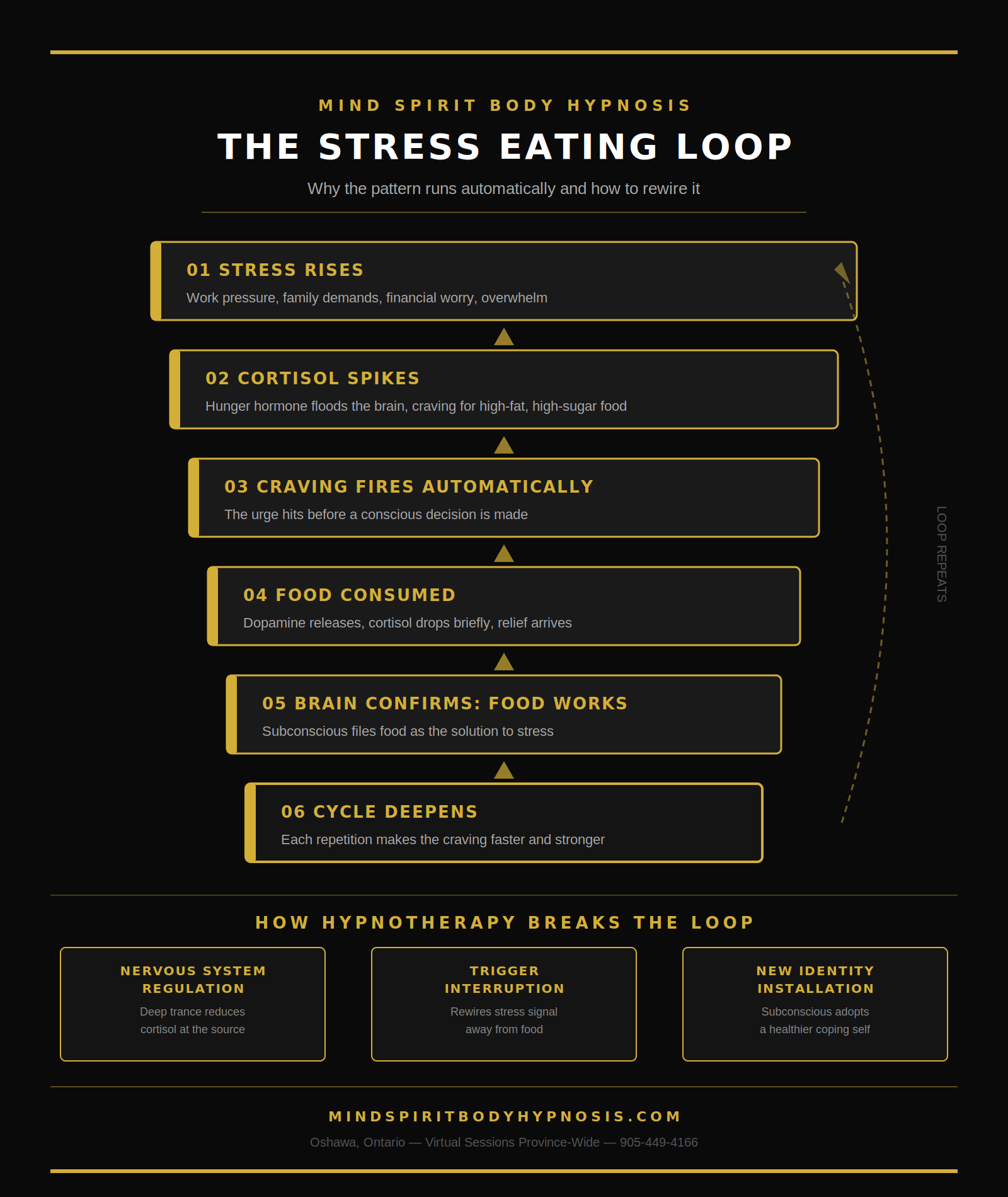
The challenge is that stress eating works, briefly. The relief is real. And because it is real, the subconscious files it as a successful strategy and reaches for it again the next time the stress rises. Over time, the pattern becomes deeply automatic, firing before the conscious mind has had a chance to make a different choice.
Stress Eating vs. Emotional Eating
These two patterns are closely related but meaningfully different.
Emotional eating uses food to manage or suppress any emotion: sadness, loneliness, boredom, celebration, or anxiety. The common thread is using food as an emotional regulation tool rather than as sustenance.
Stress eating is a specific subset driven by the physiological stress response. Cortisol directly increases appetite and makes calorie-dense food more rewarding, making stress eating uniquely self-reinforcing. The stress creates the craving, the craving is satisfied, the cortisol briefly drops, and the brain registers food as the solution to stress.
Both patterns are subconscious. Both respond well to hypnotherapy and NLP. For more on how emotional eating develops and how it is addressed at Mind Spirit Body Hypnosis, the hypnotherapy for weight loss and emotional eating page covers the broader picture.
How Cortisol Drives Food Cravings
When the brain perceives stress, it triggers a release of cortisol from the adrenal glands. Cortisol is a survival hormone designed to prepare the body for threat. Among its effects, it increases appetite and activates reward centres in the brain to make calorie-dense food feel more appealing.
In a genuine survival scenario, this makes sense. You need fuel to respond to physical danger. The problem is that modern stress, the kind produced by deadlines, financial pressure, and chronic overcommitment, activates the same cortisol response as physical danger, but there is no physical threat to escape from. The body is primed for action that never comes. And the craving for high-fat, high-sugar food persists, driven by neurochemistry rather than genuine hunger.
Chronic stress means chronically elevated cortisol, which means persistent cravings and a cycle that becomes progressively harder to interrupt with willpower alone.
How Hypnotherapy Rewires Stress Eating at the Root
At Mind Spirit Body Hypnosis, stress eating sessions address both the subconscious habit patterns and the underlying nervous system dysregulation that drives the cortisol-craving cycle.
Nervous system regulation. The hypnotic trance state is itself a cortisol intervention. Deep trance activates the parasympathetic nervous system, reduces cortisol and adrenaline, and resets the baseline arousal level that makes stress eating more likely. Clients who complete a course of hypnotherapy often report that their overall stress response is calmer, not just their eating.
Trigger interruption. Sessions identify the specific stressors, times of day, and emotional states that most reliably trigger the urge to eat. Once mapped, the automatic connection between those triggers and the reach-for-food response is interrupted in trance. New responses are installed so the stress signal no longer automatically means eat.
Root cause regression. Many stress eating patterns trace to a specific period in which food became the primary coping tool: a high-pressure childhood household, a demanding job with no other outlet, a period of grief or loss. Regression work identifies that origin, releases the emotional charge, and updates the subconscious record so it is no longer running a solution designed for a situation that no longer exists.
New identity installation. Many stress eaters carry a subconscious identity of being someone who cannot handle stress without food. Shifting that identity at the subconscious level produces more lasting results than behaviour-based strategies alone.
A study published in the International Journal of Eating Disorders found that hypnotherapeutic interventions significantly reduced stress-related eating behaviour and improved emotional regulation, with effects maintained at six-month follow-up (Barabasz, 2007).

NLP Techniques That Break the Stress-Food Loop
NLP offers practical, precise tools for dismantling the subconscious architecture of stress eating. At Mind Spirit Body Hypnosis, these are integrated into every session alongside hypnotherapy.
Anchoring a calm stress response. A deeply calm, regulated state experienced during trance is anchored to a physical cue. When stress rises in daily life and the urge to eat fires, activating the anchor shifts the nervous system toward calm, giving the subconscious a different solution to reach for.
The Swish Pattern. A rapid NLP technique that interrupts the automatic stress-to-food sequence and replaces it with a chosen alternative. Particularly effective for habitual patterns like eating while working or the evening wind-down eating pattern.
Parts integration. Most stress eaters have an internal conflict between the part that wants to eat to feel better and the part that desperately wants to stop. NLP parts integration aligns these, so the person is no longer fighting themselves every time the stress peaks.
For more on how NLP is applied at Mind Spirit Body Hypnosis, the about page covers the full clinical approach and qualifications.
What to Expect in a Session
The first session begins with a conversation. When does the stress eating typically happen? What are the most reliable triggers? How long has the pattern been present, and what has already been tried?
This mapping shapes the subconscious work that follows. The induction is gentle, and most clients reach a deeply relaxed state within minutes. The core work then targets the specific triggers, cortisol-craving patterns, and identity structures identified in the conversation.
Most stress eating programs at Mind Spirit Body Hypnosis run between three and six sessions. Clients with a clear, identifiable trigger pattern often notice significant changes after the first two sessions. All sessions are delivered virtually, available to clients aged 10 and older across Ontario from the comfort of their own home. For everything you need to know about the virtual process, visit the virtual hypnotherapy Ontario page.
What My Clients Say
"Fanis has literally changed my life! I came in for weight loss and stress eating and have lost 20 pounds in 3 months. I no longer reach for food when I am stressed and I finally feel in control around food for the first time in years. I cannot recommend him enough!"
Sandra M. | Weight Loss and Stress Eating | Five Stars
FAQ
Why do I eat when I am stressed? Stress triggers a cortisol release that increases appetite and cravings for high-fat, high-sugar foods. At the same time, the subconscious has learned that eating provides temporary relief from stress. Both the neurochemical and subconscious components drive the pattern automatically before the conscious mind can intervene.
What is the difference between stress eating and emotional eating? Emotional eating uses food to manage any emotion. Stress eating is a specific subset driven by the cortisol stress response, which directly increases appetite and makes calorie-dense food more rewarding. Stress eating has both a psychological and physiological component that makes it particularly self-reinforcing.
Can hypnotherapy help with stress eating? Yes. Hypnotherapy addresses both the subconscious habit patterns and the nervous system dysregulation driving the cortisol-craving cycle. Research supports hypnotherapeutic intervention for stress-related eating behaviour, with effects maintained at long-term follow-up.
What is the best way to stop stress eating? Approaches that address the subconscious and physiological drivers simultaneously produce the most lasting results. Hypnotherapy and NLP work at both levels, rewiring the stress-to-food association and reducing the baseline cortisol reactivity that fuels the cravings.
How does cortisol cause food cravings? Cortisol is a stress hormone that increases appetite and activates the brain's reward centres to make high-energy food more appealing. In chronic stress, elevated cortisol means persistent cravings for high-fat, high-sugar foods that have nothing to do with genuine hunger.
Does NLP help with stress eating? Yes. NLP techniques, including anchoring a calm stress response, the Swish Pattern, and parts integration, are particularly effective for breaking the automatic stress-to-food sequence at the subconscious level.
How many sessions will I need? Most clients at Mind Spirit Body Hypnosis working on stress eating complete three to six sessions. Simpler presentations with clear trigger patterns often resolve faster. Those with chronic anxiety or long-standing emotional eating may benefit from a longer program.
Is this suitable for younger clients? Yes. Mind Spirit Body Hypnosis works with clients aged 10 and older. Stress-related snacking and eating patterns in younger clients respond well to hypnotherapy and NLP, which are gentle and medication-free.
Can I do sessions virtually from anywhere in Ontario? Yes. All sessions are delivered virtually, province-wide, with no referral required.
How do I get started? Book a free 30-minute virtual strategy session at calendly.com/mindspiritbodyhypnosis. No referral needed. The first conversation is simply a chance to discuss what is happening and whether hypnotherapy is the right fit.
Ready to Take the Next Step?
If stress has been driving your eating for months or years, and every attempt to stop it falls apart the moment the pressure rises, that is not a willpower problem. It is a subconscious programme. And it can change.
I offer a free 30-minute virtual strategy session for new clients across Ontario. There is no pressure, just a conversation about what you are going through and how hypnotherapy, NLP, or EMDR may support you.
Book your free session:calendly.com/mindspiritbodyhypnosis
Call or text:905-449-4166
Email:mindspiritbodyhypnosis@gmail.com
Visit:mindspiritbodyhypnosis.com
Serving clients virtually across Ontario, including Durham Region, Toronto, Ottawa, and beyond.
Disclaimer: This article is for informational purposes only and does not constitute medical or psychological advice. Hypnotherapy, NLP, and EMDR are complementary approaches and are not a substitute for diagnosis or treatment by a qualified healthcare provider. Please consult a licensed professional if you have concerns about your mental or physical health.
Written by Fanis Makrigiannis | Certified Hypnotherapist & NLP Master Practitioner | Mind Spirit Body Hypnosis.